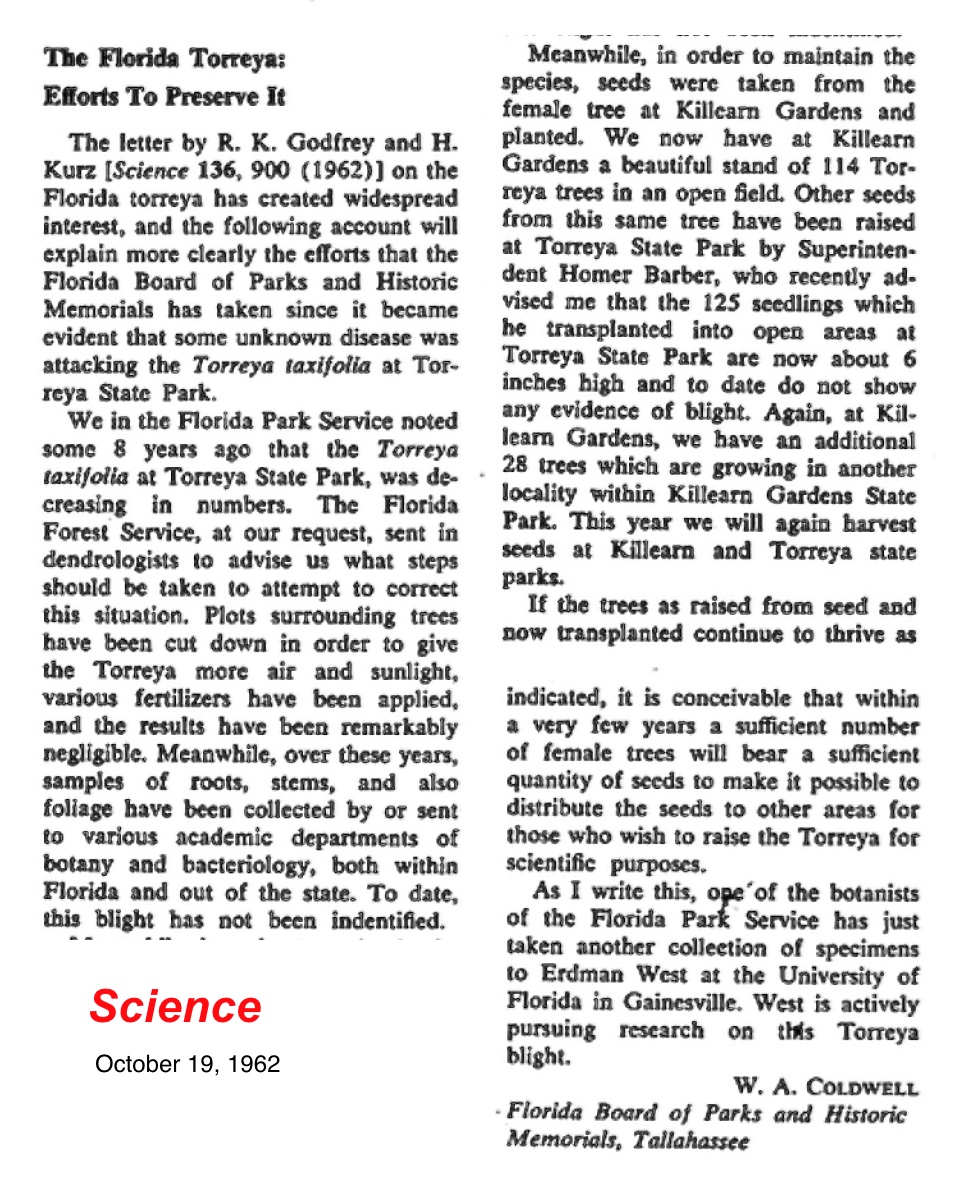
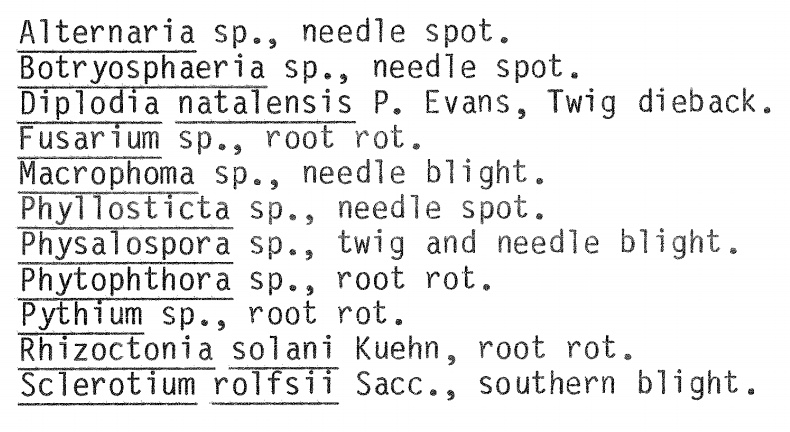
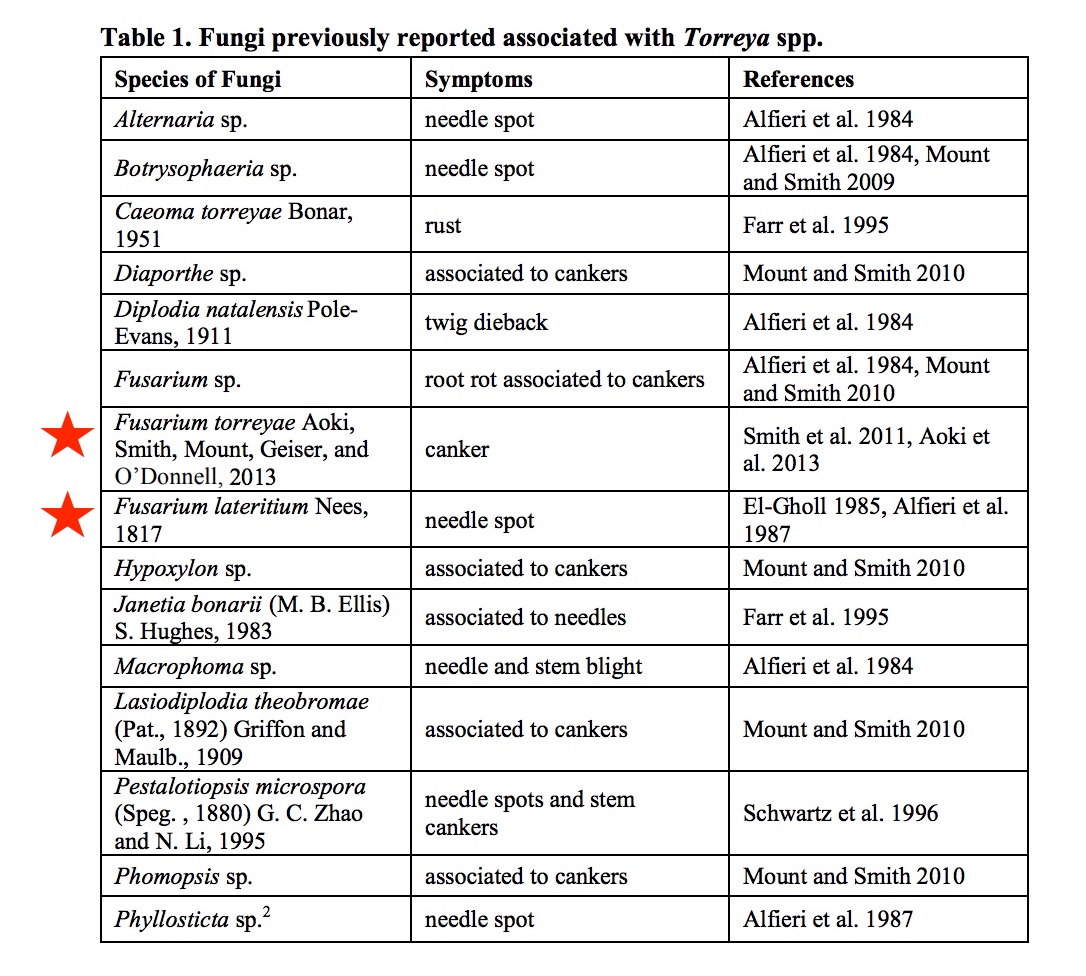
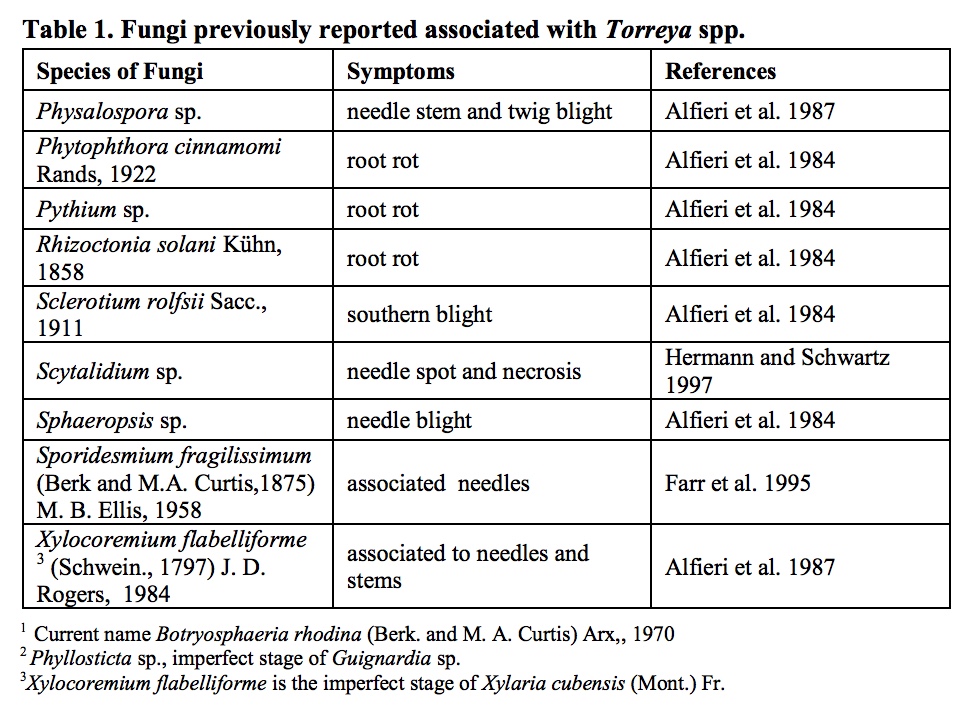
3C. EARLY ADVOCACY OF ASSISTED MIGRATION
1990 POPULAR ESSAY IN NATURAL HISTORY MAGAZINE:
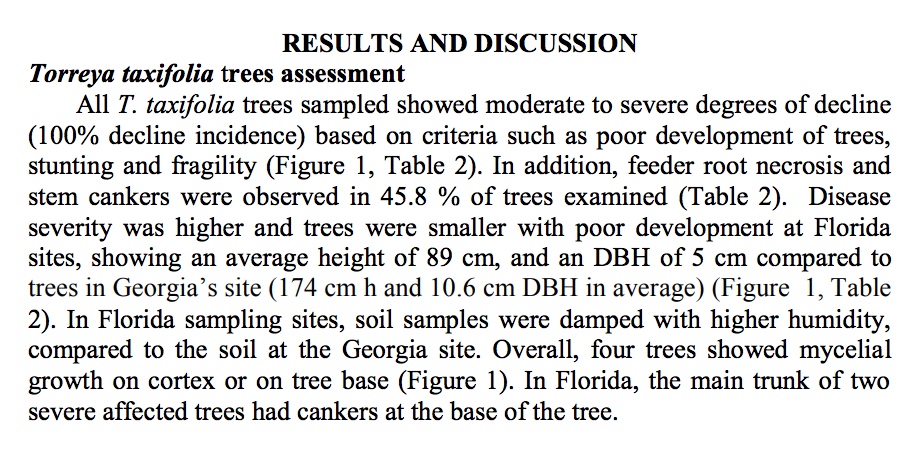
• Chasing Ghosts: The steep ravines along Florida's Apalachicola River hide the last survivors of a dying species, Torreya taxifolia, by Rob Nicholson, 1990, Natural History Magazine
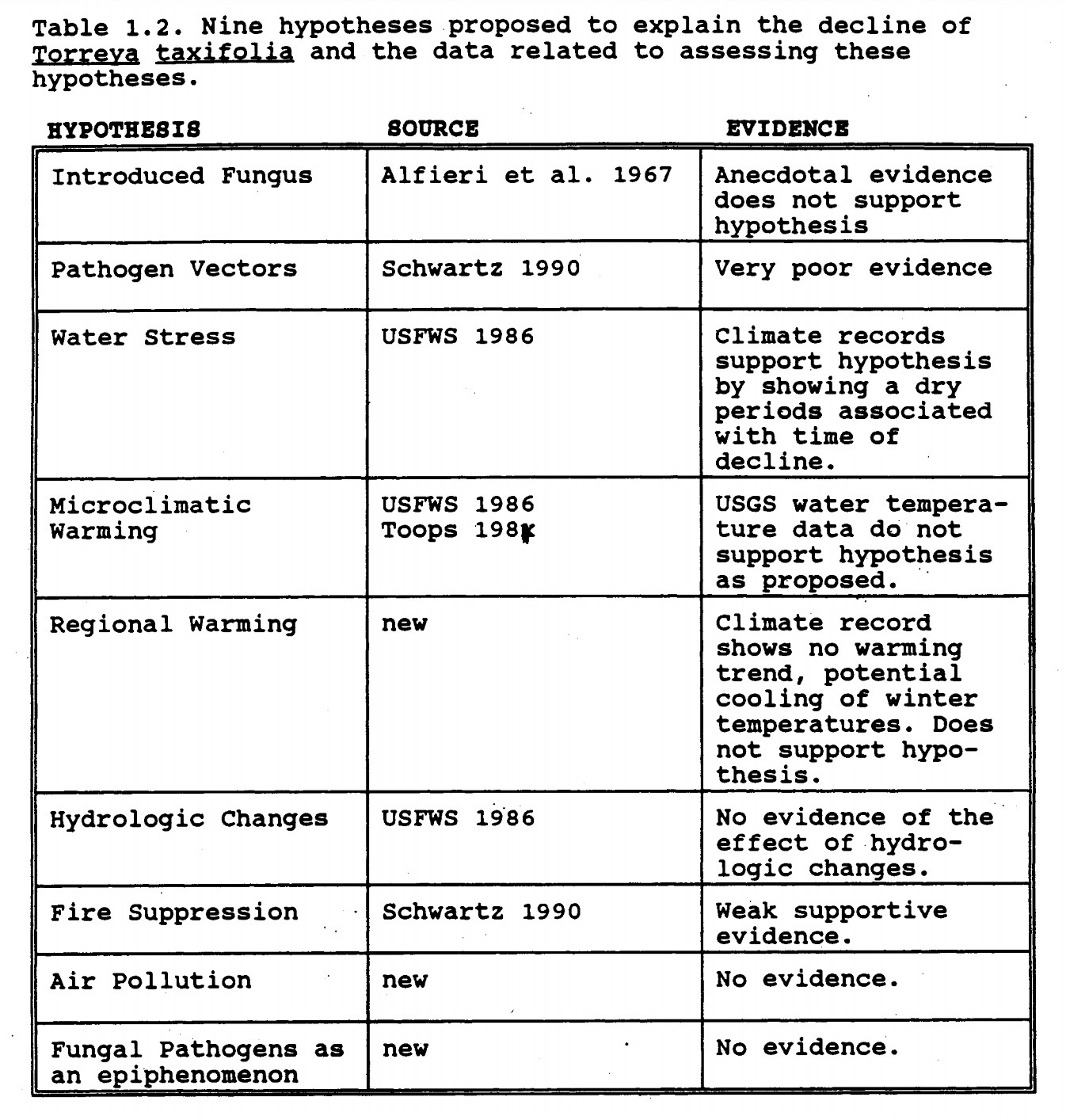
EXCERPTS: ... All the unknowns confound any recovery plan. Is Torreya an early victim of global warming and a precursor of a new wave of inexplicable extinctions? Has local land use destroyed this Torreya habitat? Is there any point in trying to fortify existing populations by replanting if a virulent pathogen lurks unchecked? Will propagations of cuttings from existing wild trees carry a new pathogen wherever the new trees are distributed? Or, frozen by doubt, will plant scientists do nothing while the unique species slips away, tree by tree?
... The Apalachicola Bluffs and the ravines that dissect them are at the cusp of the deciduous woodlands and the lush subtropical jungle. It is an undecided forest, its luxuriant ecotone having been shaped by the forces of glaciation during the Pleistocene era. As a New Englander used to deciduous woods, I was unsettled by seeing beech, maple, and hickory mixed with bold fan-leafed palmettos, spiky yuccas, and huge evergreen magnolias.
... In June 1989 I joined Mark Schwartz and we surveyed as many ravine systems as possible, carefully mapping and labeling the plants growing there.... When we returned in the fall, we collected small cuttings, tissue samples, and soil samples for genetic, propagation, and pathological studies. Alarmingly, in just a few months, a number of our mapped trees had been lost — to deer rubbing, disease, and even falling limbs from the upper canopy. The species was going extinct before our eyes and will probably not last another generation.
... To travel the bluff tops down the steep slopes to the creek beds, 100 to 200 feet below, is to read a primer in zonal plant ecology. Species are stratified by drought tolerance and light demands. Those on the tops of the bluffs are adapted to full sun and dray conditions. Endangered gopher tortoiss burrow amid opuntia cactus, longleaf pine, yuccas, and bushes of sparkleberry. At the base of the ravines can be found the rare Florida azalea, native bamboo, and Sabal palmetto amid a thick tangle of Florida star anise that rivals the tangled rhododendron 'hells' of Virginia and Tennessee.
The steep pitch between these two zones includes a number of endemic plants: croomia, Ashe's magnolia, florida yew, pyramid magnolia, and Torreya, as well as species known throughout the eastern seaboard, such as American holly, American beech, tulip tree, and leatherleaf. The southern magnolia, known to me as an ornamental tree of glossy green, rubbertree-like leaves, festooned with outlandishly large white flowers, here grew as 100-foot forest giants, with a a first branch higher than a man could throw a rope and with crowns so dense they blotted out the sun.
The Florida yew, like the Torreya, belongs to the Taxaceae family. It is also a rare endemic, whose range is actually smaller than, and within, that of Torreya. Although occupying much the same habitat, the yew has not been affected by whatever is affecting its larger relative. The ravines are not identical, however. Variations in grade, soils, aspect, and moisture create subtly different habitats, some of which Torreya can tolerate. It dominates nowhere, and past references indicate it never did. It is an occasional midcanopy, midslope tree found on sandy limestone sols. In general Torreya prefers good drainage to flat, constantly wet soil; and while it is almost always found in filtered, dense shade, I have seen cultvated Torreya grow perfectly well in full sun. In its native environment, the stinking cedar may be better able to compete on the shaded slopes than in sunnier areas.
... More than 2,500 cuttings were collected from 166 trees and were treated with a variety of hormones to promote rooting. These were brought to Harvard's Arnold Arboretum, where 2,100 were successfully rooted and potted. The accession number of the sampled trees follows each of these clones (and any subsequent propagations) with the particulars as to the plant's original location in the wild. Therefore, in the distant future, ravines might be replanted with the same genetic material that once grew there. Cuttings taken from the wild five years ago are growing well and so far show no signs of disease.
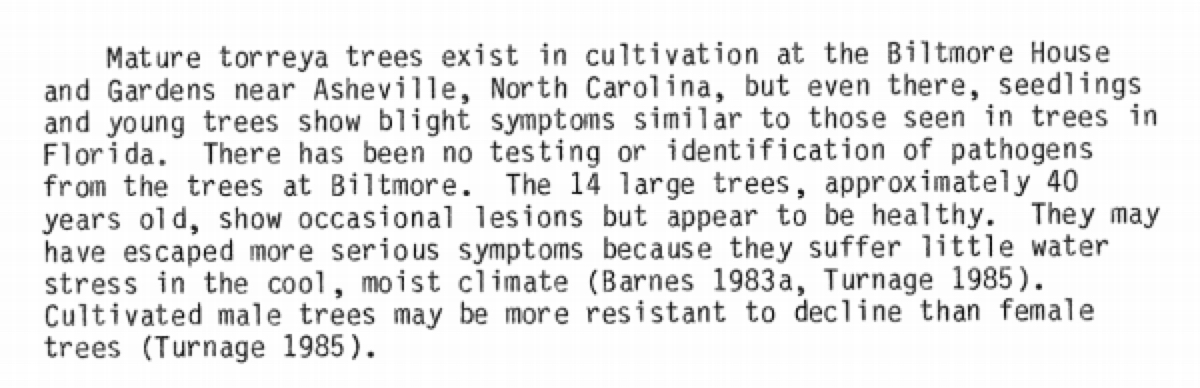
... While the few remaining saplings may outlast the blight, not many people who have seen the trees would wager their homes on it. More likely, clusters of trees, propagated from specific ravines, will be grown in botanical gardens, universities, preserves, and state parks. This Florida native, as evidenced by the few healthy trees in cultivation, seems to thrive on the southern slopes of the Appalachian Mountains and is more cold tolerant than its present range would suggest. Possibly an Apalchicola refugium can be re-created, an artificial Torreya forest where pollen can float, genes mingle, and the evolution of the past hundred million years can continue, even if it is in a pitifully discounted format.
CONNIE BARLOW WRITES: I am founder of Torreya Guardians, and I am documented as having advocated for assisting Florida Torreya to migrate northward, beginning in 2001:
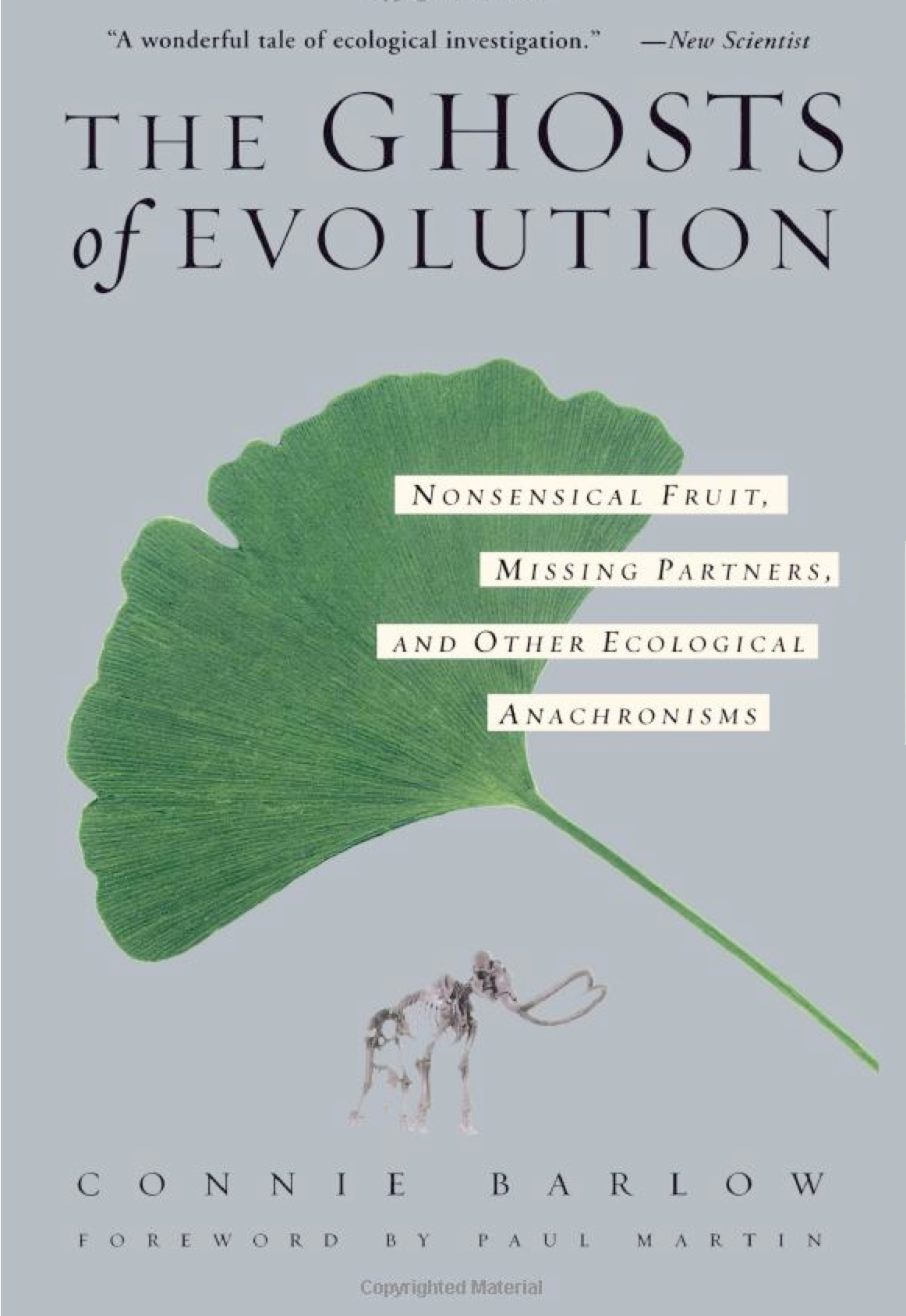
• The Ghosts of Evolution: Nonsensical Fruit, Missing Partners, and Other Ecological Anachronisms, by Connie Barlow, 2001 (Basic Books)
 |
|
EXCERPT: ... In a study of endangered species published in 2000, Rob Channell and Mark Lomolino concluded that "most species examined persist in the periphery of their historical geographic ranges." The implication is that the last place a troubled species is found may not, in fact, be the best place to assist its recovery. Transplantation is an uncommon and controversial technique for biodiversity conservation today. But after the greenhouse effect has ratcheted up temperatures and rerouted rainfall, it surely will become the norm. If gardening a few local patches of endangered plants is tough today, it's going to get a lot tougher when, like it or not, we become gardeners of the planet. Helping plants track climate change from one patch of forest to another will be a routine tactic for conserving biodiversity decades hence. Is it too early to begin now with Florida torreya?
Note: My 1999 visit to Torreya State Park and subsequent ruminations appear on pages 229-231.
|
Later, I learned there had been an advocate for northward movement of Torreya before me. In late February 2004 I visited the Biltmore Estate and Garden near Asheville NC for the first time. There I met with Bill Alexander in his office before he showed me the otherwise unmarked site where Florida Torreya had been growing — and naturalizing. Bill told me that he had advocated (alas, to no avail) at a conference in the 1990s for assisting the recovery of Torreya taxifolia by planting more specimens in northward locales. I documented that conversation in a chapter I contributed to a 2009 book, published by MIT Press.
• Chapter 10, "Deep Time Lags: Lessons from Pleistocene Ecology", by Connie Barlow:
 |
|
... One section of [my 2001 Ghosts of Evolution] book used the deep-time perspective to re-examine
the circumstances of perhaps the world's most endangered species of
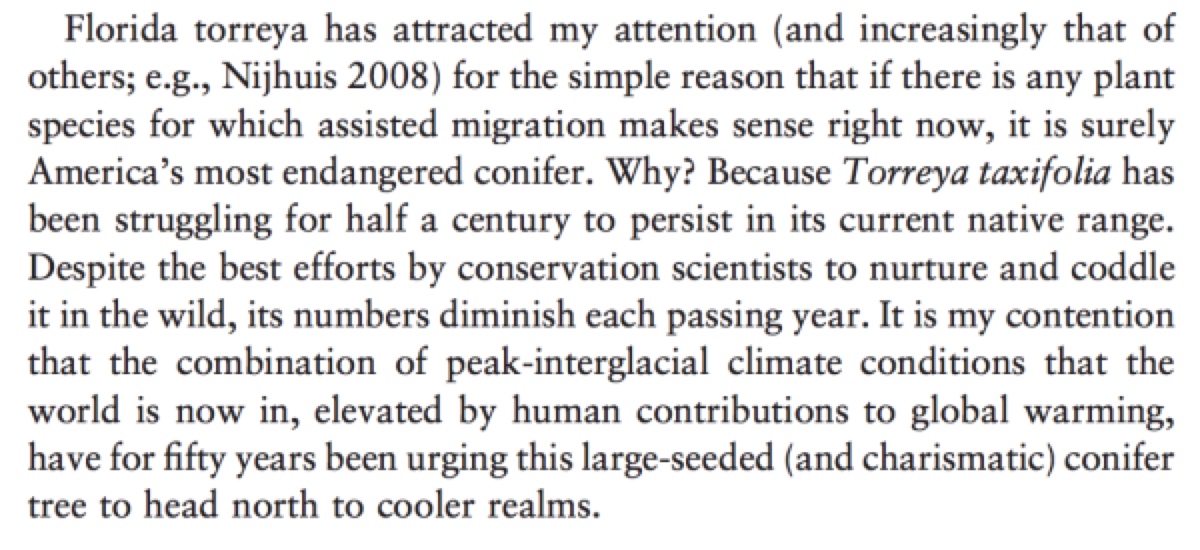
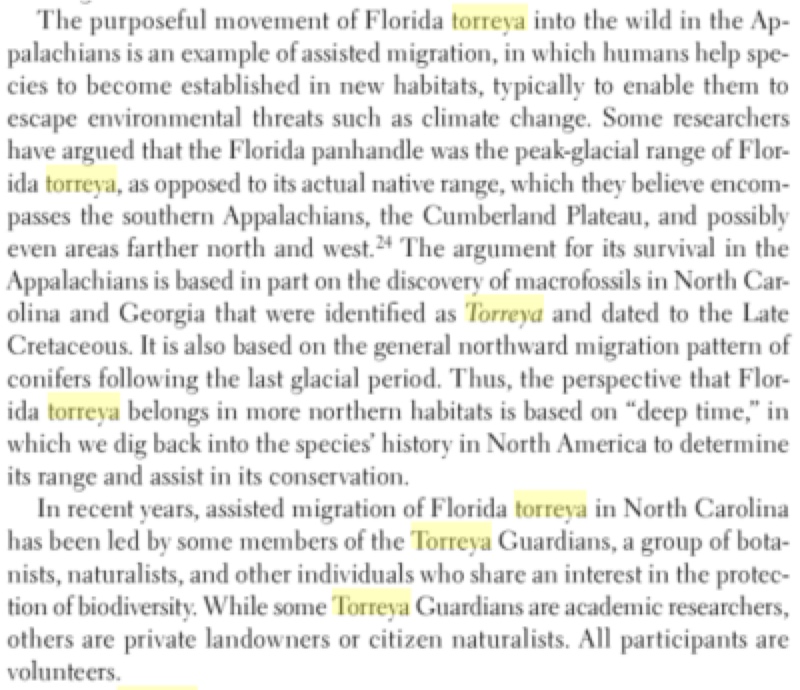
conifer tree: the Florida torreya (Torreya taxifolia). It occurred to me that torreya's desperate plight owed to its failure to migrate north (perhaps for want of a seed disperser) from its Ice Age refuge in the Florida panhandle to habitat better suited to the tree's needs in peak interglacial times. That better habitat would likely have been the core of torreya's range during previous interglacials: the southern and central Appalachian Mountains.
As it turns out, I was not the first to make this suggestion. Bill Alexander, forest historian at the Biltmore Gardens of Asheville, North Carolina (in the central Appalachian Mountains), observed his garden's own grove of Florida torreya, and concluded that North Carolina seemed more conducive to the wellbeing of this conifer than was northern Florida (personal communication)...
|
EXCERPT CONTINUES: In a 1990 article, botanist Rob Nicholson speculated, "Is Torreya an early victim of global warming and a precursor of a new wave of inexplicable extinctions?" How prescient he was! Thanks to a host of recent scientific papers (e.g., Barlow and Martin 2005; McLachlan et al. 2007; Hoegh-Guldberg 2008) and popular articles (e.g., Fox 2007; Nijhuis 2008; Marris 2008), Florida torreya has become a "poster plant" for alerting the public and scientists alike to the lurking dangers of global warming and to the consequent need for what has come to be known as assisted migration. Assisted migration must not, of course, be promoted as an alternative to reducing greenhouse gas emissions. But it is decidedly unrealistic to assume that climatic change and its challenges to biotic diversity will vanish in the next decade or two. Again, time lags (melting polar and glacial ice) will take a long time to equilibrate even if the concentration of atmospheric CO2 could politically and economically be stabilized at today's levels....
• Next, in 2004 CONNIE BARLOW and Pleistocene ecologist PAUL S. MARTIN co-authored an advocacy essay:
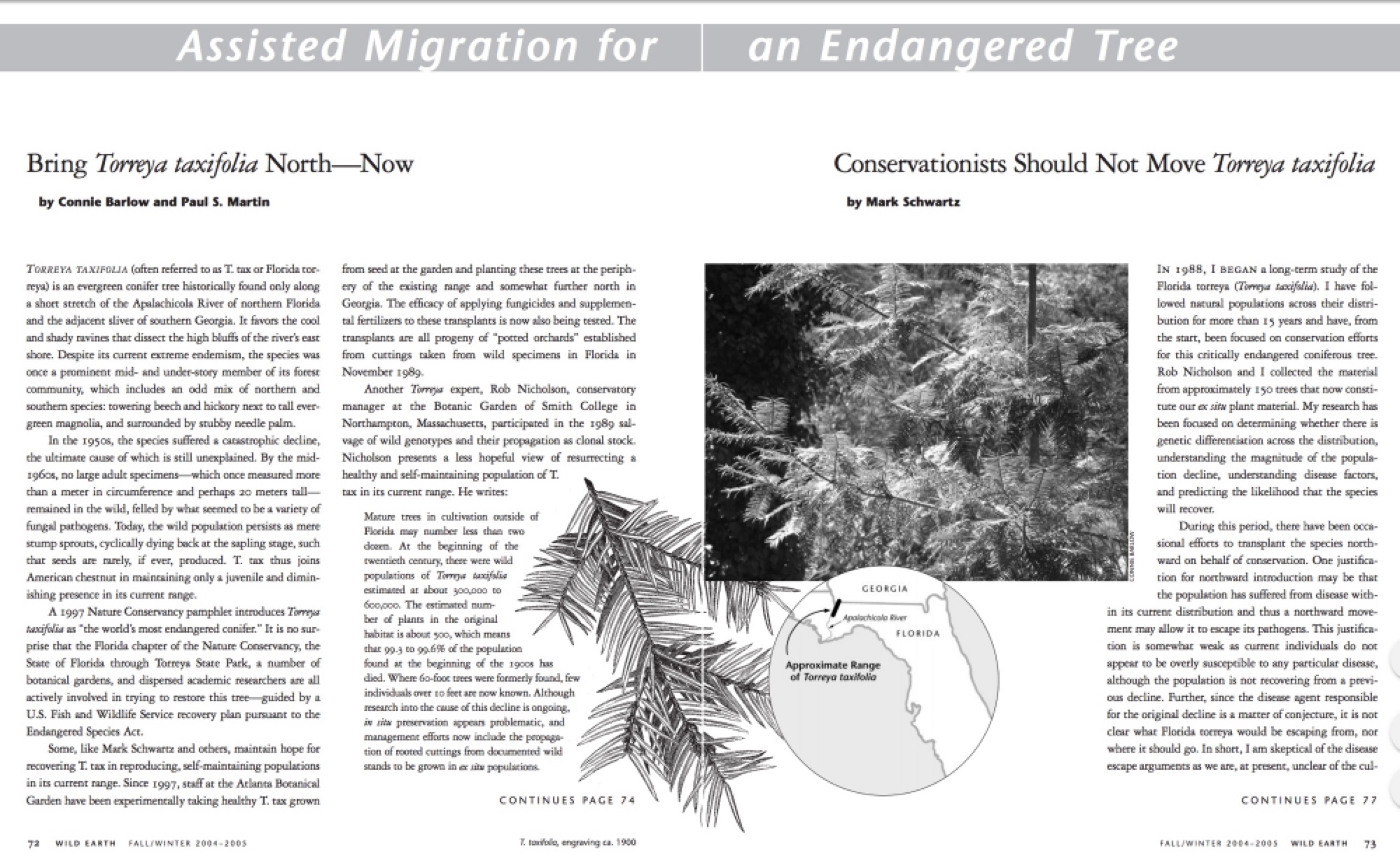
ABOVE: Wild Earth journal published a "Forum" pair of essays in its Winter 2004/2005 issue. Access in pdf the PRO Assisted Migration article by Connie Barlow and Paul S. Martin. Also, the ANTI Assisted Migration article by Mark Schwartz.
BACKGROUND ON THE ABOVE "FORUM" ARTICLES. Barlow initiated extensive communications with professional botanists and others in 2003-2004, hoping to work through issues and find common ground for joint publication of a journal article in favor of assisted migration for Florida Torreya. Discussions were helpful but ultimately failed to reach any consensus. Barlow and Paul S. Martin held the most radical position, so they stepped ahead with writing an article, and then recommended that Mark Schwartz would be the professional most suited for (and interested in) contributing an oppositional piece. More detail, along with links to archival documentation of communications can be accessed at Archived Documents of Early Roots of Torreya Guardians. An excerpt is below:
March 24, 2004 - title: Torreya: 10 questions for discussion
Hello Torreya Group: This is Connie Barlow. I am dedicating today to Torreya taxifolia, as I need to catch up with you all with thoughts and conversations that have come my way over the past few weeks, and which only now I am having a chance to assimilate and pass on. Bascially, since I last wrote to you in depth, I have visited the T. taxifolia propagation effort at Atlanta Botanical Garden (Ron Determann and Carol Denhoff), the thriving grove of T. taxifolia at the Biltmore Gardens in Asheville (Bill Alexander), the office of Hazel and Paul Delcourt at University of Tennessee Knoxville (from which I walked off with a lot of useful papers to read and a lot of sobering thoughts), and a potential private preserve for rewilding T. tax along the east side of the Cumberland Plateau.
....[final para] This realm of thought is very depressing for me, because I am a wildlands advocate and would vastly prefer us to simply make
preserves big enough and corridors connected enough for nature
to do what it needs to do without our meddling. The Fall issue of Wild Earth is on the theme of corridors, so what sorts of
contributions might be generated from this group, from our
discussion of T. taxifolia and all the ancillary thoughts that
go along with that?
• CONNIE BARLOW has a peer-reviewed chapter in a 2009 book that advocates in behalf of Florida Torreya. (This book was already referenced above as documenting Bill Alexander's advocacy. Here it appears in chronological sequence to affirm Barlow's published advocacy.)
EXCERPTS CONTINUE (that focus on "assisted migration" as a new tool in conservation biology): ... Assisted migration as a conservation tool is both fascinating and frightening for anyone focused on plants. It is fascinating because endangered plants can be planted by whomever so chooses, with no governmental oversight or prohibitions—provided that private seed stock is available and that one or more private landowners volunteer suitable acreage toward this end. This cheap-and-easy route for helping imperiled plants is in stark contrast to the high-profile, high-cost, and governmentally complicated range recovery programs for mobile animals, like gray wolf, lynx, and California condor.
&nbps;
Assisted migration frightens for precisely the same reasons it fascinates: anybody can do it, for good or ill, and with care or abandon. Its promotion could undermine decades of public education about the dangers of nonnative plants, as well as more recent efforts to promote the concept of wildlands corridors and connectivity. Still, in an age of deforestation, severe habitat fragmentation, and rapid global warming, assisted migration as a plant conservation tool should not be ignored. According to Peter Wharton, curator of the Asian Garden of the University of British Columbia Botanical Garden writes, "... the Torreya question is a door to immense issues relating to how we facilitate global 'floraforming' of vegetational zones in a warming world. It represents another layer of
responsibility for those of us who have a passion for forests and wish to
promote the ecologically sensitive reforestation of so many degraded
forest ecosystems worldwide" (P. Wharton, personal communication).
The test case for assisted migration occurred in July 2008 when the
citizen group I helped found (Torreya Guardians) undertook assisted
migration for 31 seedlings of Torreya taxifolia purchased from a nursery in South Carolina. A handful of volunteers (and reporters documenting the action) gathered in the mountains near Waynesville, North Carolina, to spend a day planting the seedlings into wild forested settings on two parcels of private land. The Torreya Guardians' website documents that action....
• BACK TO MAIN TABLE OF CONTENTS
Part 4
Torreya taxifolia is a Case Study in Conservation Biology
ENDANGERED SPECIES PROTECTION OF PLANTS V. ANIMALS: A 1988 paper published in Pace Environmental Law Review offers an excellent history of the long-held distinction in U.S. governmental regulation of plants v. animals ("wildlife") and how that distinction was forged into a compromise that entailed less rigid regulation (and to some extent, entire "exceptions") for how plants would be handled under the 1973 Endangered Species Act. See in pdf the 1988 article by Faith Campbell, "Legal Protection of Plants in the United States", which is also a reference for the PLANTS paragraph in the ESA 1973 wikipedia entry.
A visit to the Annotated Scholarly Links webpage on this website reveals that the controversy over assisted migration of Florida Torreya, (and the fact that citizens have stepped out ahead of official managers of this listed endangered species) has garnered a lot of attention within both the conservation biology and forestry professions.
The MEDIA have also given this controversy a great deal of attention. On the History of Torreya Guardians webpage one can learn about these citizen actions and also access a linked and excerpted list of Torreya Guardians in the Media.
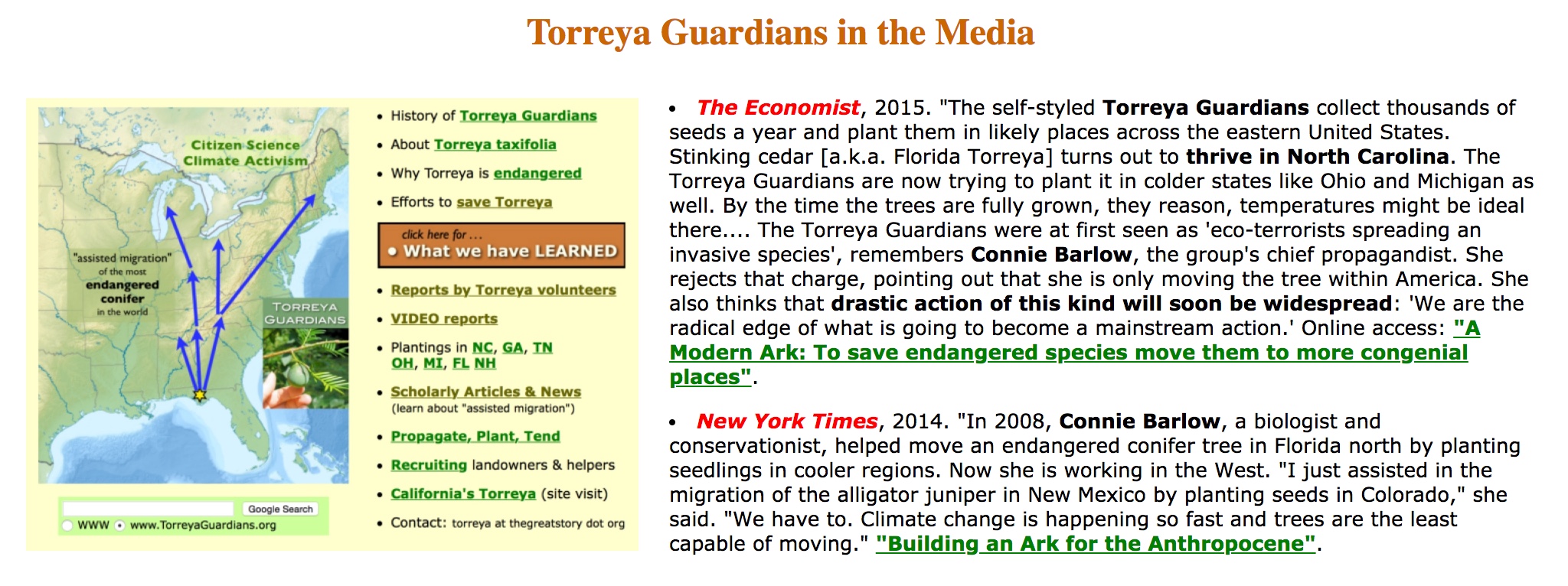
Overall, TORREYA GUARDIANS IN THE MEDIA includes news reports in these science journals: Nature, Nature Climate Change, Science, Forestry Chronicle, Environmental Science and Policy. Non-academic news outlets and magazines have also reported on Torreya Guardians: New York Times, Los Angeles Times, Scientific American, Audubon, Orion, Sierra Magazine, Earth Island Journal.
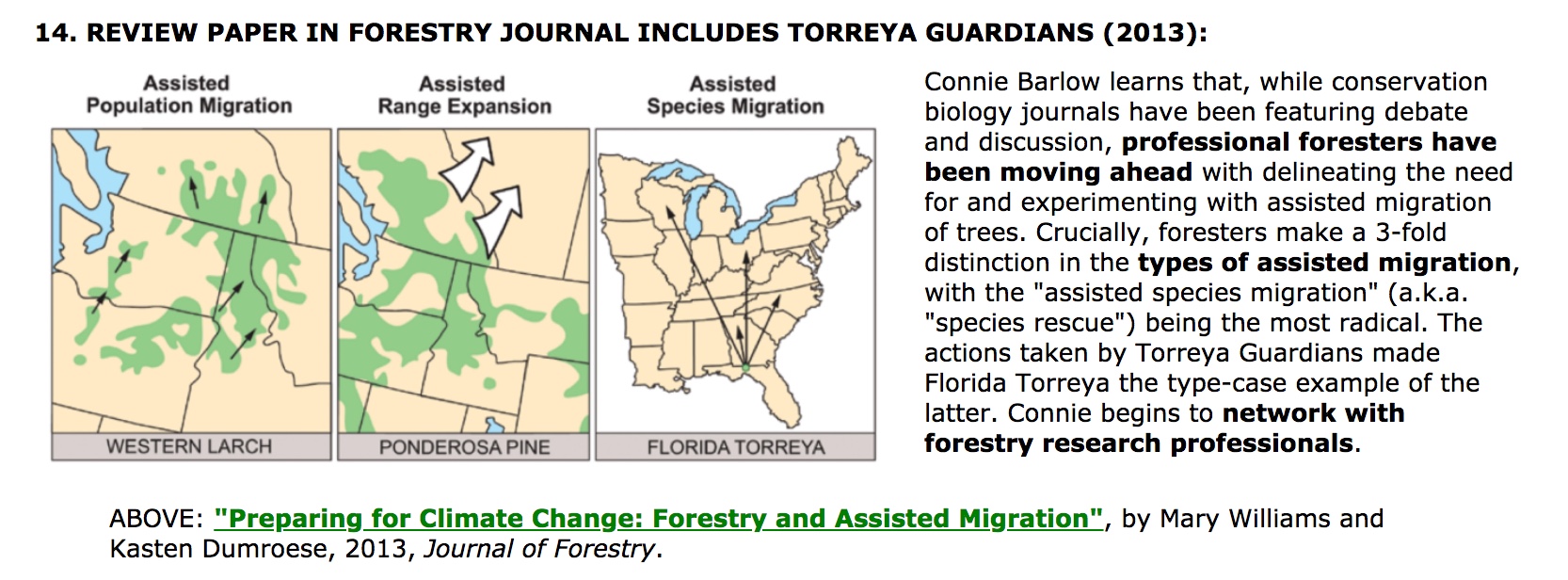
Research papers published in FORESTRY JOURNALS have also paid a good bit of attention to the actions of Torreya Guardians. Foresters have a more use-oriented and practical relationship with tree species than do conservation biologists. Owing to ongoing and expected climate change (and the impacts of warmth and drought already evident even among common native trees), an urgency manifests among foresters to move past the assisted migration controversy. Hence, Torreya Guardians is helpful in that we serve as the radical edge of a continuum of possible climate adaptations actions, as pictured in the image below.
Nevertheless, because it is professionals in CONSERVATION BIOLOGY rather than FORESTRY who decide the actions authorized for Florida Torreya climate adaptation under the Endangered Species Act, several of the key multi-author or review papers published in conservation biology or botany journals will be focal points below. These demonstrate the high visibility that Florida Torreya receives.
4A. ACCESS PAPERS ON ASSISTED MIGRATION CONTROVERSY
Conservationist scientists, activists, managers, journalists, and others who need to become familiar with the 21st century controversy over assisted migration (a.k.a. managed relocation, assisted colonization) as a new tool for climate adaptation — not only of endangered species but of other plants and animals unlikely to track the rapid movement of climate zones on their own — may access the SCHOLARLY LINKS webpage on this website, as below.
Although the modern debate about assisted migration began around 2007, prominent conservation biologists recognized decades earlier that, should global warming continue, humans would indeed need to play a role in assisting species to migrate to cooler realms.
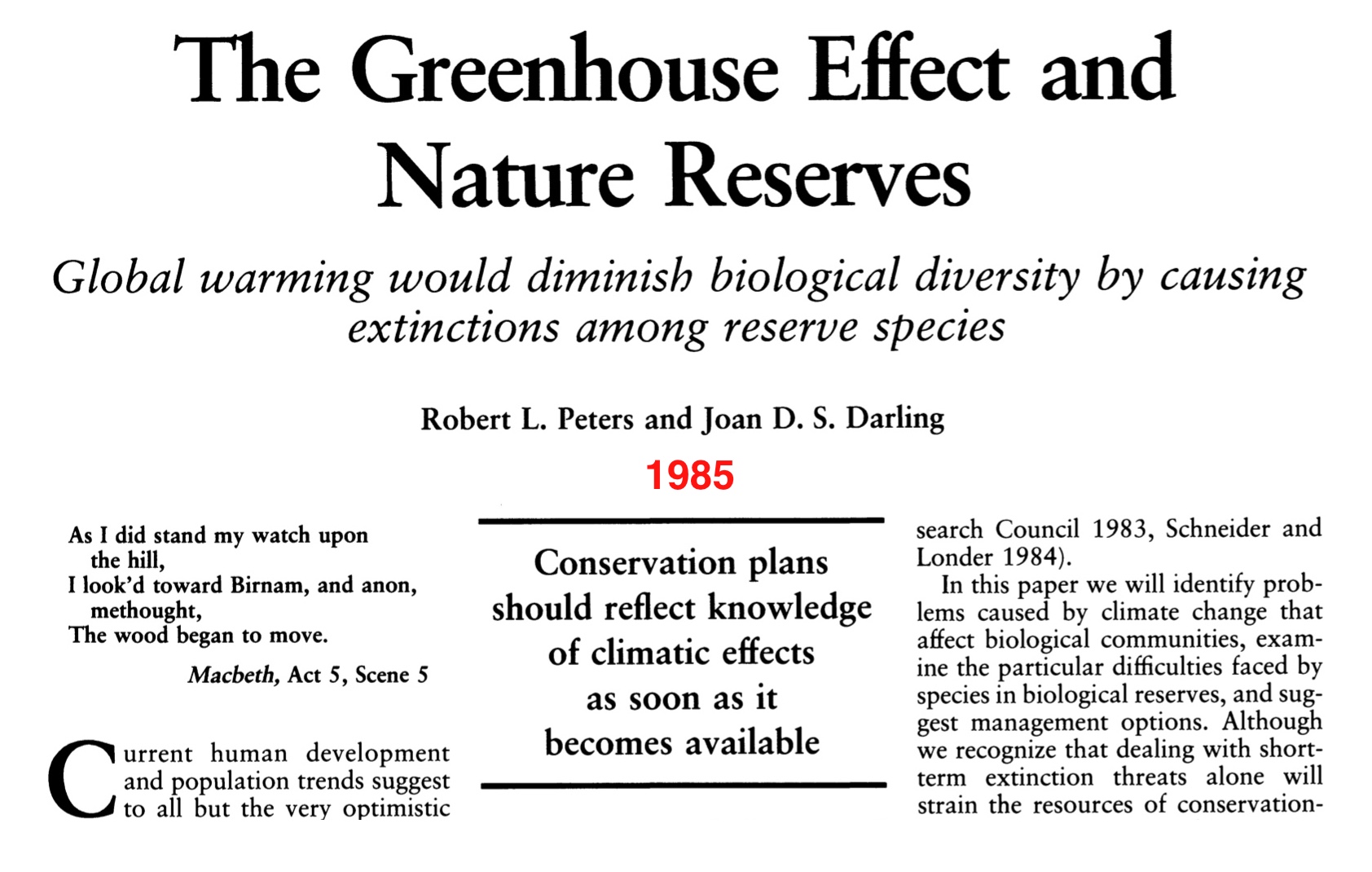
Below is the first widely-cited CONSERVATION BIOLOGY paper, 1985, to recognize that GLOBAL WARMING would make HUMAN ASSISTANCE IN MIGRATION necessary. Published in the journal Bioscience, this paper by Robert L. Peters and Joan D.S. Darling is also highly recommended for its thorough and well-written overview of the basic concepts in conservation biology. EXCERPTS: "... If estimates of a several-hundred-kilometer poleward shift in temperate biotic belts during the next [21st] century are correct, then a localized population now living where temperatures are near its maximum thermal tolerance would have to shift northward at a rate of several kilometers per year to avoid being left behind in areas too warm for survival...."
 |
|
"... Although some species, such as plants propagated by spores or dust seeds, may be able to match these rates, many species could not disperse fast enough to compensate for the expected climatic change without human assistance." (p. 711)
"... If such measures are unsuccessful, and old reserves do not retain necessary thermal or moisture characteristics, individuals of disappearing species may have to be transferred to new reserves.... "It makes sense to locate reserves as near the northern limit of a species' range as possible, rather than farther south, where conditions are likely to become unsuitable." (p. 715)
• "The Greenhouse Effect and Nature Reserves", by Robert L. Peters and Joan D.S. Darling, 1985, Bioscience
|
Note: A 2016 Research Summary (Technical Report) of U.S. Forest Service
(289 pages in pdf), references the above 1985 paper, as excerpted below: Effects of Drought on Forests and Rangelands in the United States: A Comprehensive Science Synthesis, James Vose et al., editors (collaborative effort of 77 scientists).
Assisted migration, a management strategy where organisms are translocated from sites with suboptimal environmental conditions to sites with more optimal conditions, may become integral to conservation strategies as the rate of climate change increases (Peters and Darling 1985). Assisted migration can encompass a broad range of goals, from minimizing loss of biodiversity to preventing extinction, and operate at a range of spatial scales, from local to continental (Williams and Dumroese 2013). Seed transfer guidelines, because they determine transfer distances that avoid maladaptation (Johnson and others 2004) and can be re-projected using models of expected future environmental conditions (Thomson and others 2010), will play an integral role in the planning of assisted migration efforts under global change. (page 182)
4B. FLORIDA TORREYA IS A FOCAL SPECIES IN ASSISTED MIGRATION CONTROVERSY
CONNIE BARLOW WRITES: I initiated the above Annotated Scholarly Links webpage in 2007, when journalist Douglas Fox published in Conservation Magazine a cover story: "When Worlds Collide". Our citizen-led assisted migration actions of Torreya Guardians was the introductory example in that article, but our effort was presented as just the preview of what would follow as climate change pressed on. Nearly simultaneously, the New York Times posted a story by science writer Carl Zimmer: "A Radical Step to Preserve Species: Assisted Migration". Through 2014, I could barely keep up on all the papers and news reports dealing with this utterly new and (to many) disturbing conservation strategy. Using "Google Alerts" to ongoingly learn of new publications has been a great help in recent years for keeping this page current, while preserving its complex history.
As of July 2016 the debate and the publications arising from it have tapered off enormously. "Assisted migration" (by whatever term used) is now a standard entry in revisions to management plans for continuing to conserve lands, waters, and biodiversity in this century of rapid climate change. Assisting native species in moving upslope, poleward, and toward climate refugia is now just one more acceptable tool for moving ahead with "climate adaptation." By far, public and private forestry professionals have moved the fastest and farthest in forecasting when and where native tree species should be given a boost, and implementation is well underway in the forests of Alaska and western Canada (hardest hit by climate change in North America.)
Florida Torreya as focal species: As of March 2019, if you do an internal "Find" for "Torreya" within this Annotated Scholarly Links webpage you will discover that this word appears 171 times — at least 80 percent of which occur within the excerpts of papers, articles and news reports on assisted migration that are listed, linked, and annotated.
4C. FLORIDA TORREYA IS THE LONGEST-STANDING CASE STUDY ON ASSISTED MIGRATION IN CONSERVATION BIOLOGY
In 2008, at the annual meeting of the Ecological Society of America, a Managed Relocation Working Group
was formed to explore and aim for a coauthored statement on whether and how to professionally move forward on this new tool in conservation biology for assisting species and ecological communities in moving in sync with the expected shifts in climate zones. Two multi-author papers resulted from that initiative: David M. Richardson and 22 coauthors in 2009; then Mark W. Schwartz and 30 coauthors in 2012. The citizen actions of Torreya Guardians were mentioned in both papers, as below.
• 2009 - "Multidimensional Evaluation of Managed Relocation", by David M. Richardson, Jessica J. Hellmann, Jason S. McLachlan, Dov F. Sax, Mark W. Schwartz, Patrick Gonzalez, E. Jean Brennan, Alejandro Camacho, Terry L. Root, Osvaldo E. Sala, Stephen H. Schneider, Daniel M. Ashe, Jamie Rappaport Clark, Regan Early, Julie R. Etterson, E. Dwight Fielder, Jacquelyn L. Gill, Ben A. Minteer, Stephen Polasky, Hugh D. Safford, Andrew R. Thompson, and Mark Vellend, edited by Paul R. Ehrlich, 2009, Proceedings of the National Academy of Sciences.
ABSTRACT: Managed relocation (MR) has rapidly emerged as a potential intervention strategy in the toolbox of biodiversity management under climate change. Previous authors have suggested that MR (also referred to as assisted colonization, assisted migration, or assisted translocation) could be a last-alternative option after interrogating a linear decision tree. We argue that numerous interacting and value-laden considerations demand a more inclusive strategy for evaluating MR. The pace of modern climate change demands decision making with imperfect information, and tools that elucidate this uncertainty and integrate scientific information and social values are urgently needed. We present a heuristic tool that incorporates both ecological and social criteria in a multidimensional decision-making framework. For visualization purposes, we collapse these criteria into 4 classes that can be depicted in graphical 2-D space. This framework offers a pragmatic approach for summarizing key dimensions of MR: capturing uncertainty in the evaluation criteria, creating transparency in the evaluation process, and recognizing the inherent tradeoffs that different stakeholders bring to evaluation of MR and its alternatives.
This 2009 multi-author paper includes a "Supplementary information" pdf summarizing the application of their methods to 3 CASE STUDIES, of which Torreya taxifolia was case study #2. "Case 2: Translocating Torreya taxifolia to the Southern Appalachians"
EXCERPT: ... More recently, 2 efforts have begun for the conservation of this species. Torreya taxifolia has been planted in North Carolina in an attempt to establish populations in that region (http://www.torreyaguardians.org/). This effort was done as an indirect
response to climate change. The species is in declining in its
native range with no sign of recovery. Proponents felt that this
species 'belongs' in the region where they relocated it. They also
feel that this intervention is the best chance for the species to
survive, given its condition in its native range.
Evaluation of Case 2 by Stakeholder A, "Advocate for a Broad Distribution of Torreya taxifolia." Feasibility score is 4 (±1): Seeds are moderately easy to germinate; plant material in the form of cuttings are legally available through several botanical gardens in possession
of numerous genotypes of known origin. Cuttings, however, take many years to reestablish apical dominance, so the process is slow. With a small number of mature female trees at Biltmore Gardens (Asheville, NC), the most available seed represents a very narrow subset of the genetic variability of the species. Although this is a federally listed species, it is possible to plant legally obtained plant material on private lands without seeking state or federal approval or permits. Acceptability score is 4.5(�±0.5): The species is generally sparse and does not tend to form
monospecific stands. The likelihood of this species becoming
weedy is low. Focal Impact score is 4.5 (��±0.5): There is no
supportive evidence that we can conserve the species in its recent
historical range. Torreya taxifolia represents 1 of 2 North American species in the genus and 1 of 5 North American Representatives in its family; 1 of 7 species in its genus and 16 species in
its family worldwide (17). Loss of this species significantly erodes
biodiversity. Collateral impact score is 4.5 (��±0.5): This species is slow growing, produces few seed and is of relatively small stature
as a mature tree. Being dioecious and producing relatively few
seeds, this species would be relatively easy to control. Related
taxa tend to be found either in localized patches or as subdominants in mixed forests. It appears unlikely to dominate and displace other Appalachian forest species — [none of the 10 species in the family are known to be invasive when planted outside their
range (18).
Continue reading the online pdf for the anti-assisted-migration perspective on Florida Torreya: Evaluation of Case 2 by Stakeholder B, "Advocate for Local Conservation
of Torreya taxifolia." Feasibility score is 2 (�±1)
Note: Case #1 in the above paper was on the Bay Checkerspot Butterfly. However, that case dropped out of continuing discussion when in April 2014, this mobile creature did something unexpected: "Endangered butterfly defies climate change with new diet and habitat". Case #3 centered on actions by commercial foresters. That leaves Florida Torreya as the focal species for discussion of assisted migration among conservation biologists.
• 2012 - "Managed Relocation: Integrating the Scientific, Regulatory, and Ethical Challenges" by Mark W. Schwartz and 30 coauthors, BioScience August 2012 (12 pp in pdf)
List of all authors: Mark W. Schwartz, Jessica J. Hellmann, Jason M. McLachlan, Dov F. Sax, Justin O. Borevitz,
Jean Brennan, Alejandro E. Camacho, Gerardo Ceballos, Jamie R. Clark, Holly Doremus,
Regan Early, Julie R. Etterson, Dwight Fielder, Jacquelyn L. Gill, Patrick Gonzalez, Nancy Green,
Lee Hannah, Dale W. Jamieson, Debra Javeline, Ben A. Minteer, Jay Odenbaugh, Stephen Polasky,
David M. Richardson, Terry L. Root, Hugh D. Safford, Osvaldo Sala, Stephen H. Schneider,
Andrew R. Thompson, John W. Williams, Mark Vellend, Pati Vitt, and Sandra Zellmer
ABSTRACT: Managed relocation is defined as the movement of species, populations, or genotypes to places outside the areas of their historical distributions to maintain biological diversity or ecosystem functioning with changing climate. It has been claimed that a major extinction event is under way and that climate change is increasing its severity. Projections indicating that climate change may drive substantial losses of biodiversity have compelled some scientists to suggest that traditional management strategies are insufficient. The managed relocation of species is a controversial management response to climate change. The published literature has emphasized biological concerns over difficult ethical, legal, and policy issues. Furthermore, ongoing managed relocation actions lack scientific and societal engagement. Our interdisciplinary team considered ethics, law, policy, ecology, and natural resources management in order to identify the key issues of managed relocation relevant for developing sound policies that support decisions for resource management. We recommend that government agencies develop and adopt best practices for managed relocation.
Note: The word "Torreya" appears 11 times in this paper. Key excerpts below.
EXCERPTS: ... Managed relocation is already being applied. Climate motivated translocations have been implemented with an endangered tree, Torreya taxifolia, in the southeastern United States (Barlow 2011; www.torreyaguardians.org) and with two butterfly species in the United Kingdom (Willis et al. 2009). Additional undocumented cases may be more frequent than is realized. For example, giant sequoia
(Sequoiadendron giganteum) has been widely planted outside its historical range, although the motivation for such plantings remains unclear. Pressure to undertake managed relocation is likely to increase as the consequences of climate change become more apparent.
"...Therefore, it may be as important to discourage ad hoc managed relocation by enthusiastic individuals or groups
as it is to provide guidelines for well-planned actions. So far, there has been little discussion of how best to limit unsanctioned private actions. This is a curious gap, given that one of the most visible cases of managed relocation is being conducted by a citizen action group (www.torreya
guardians.org) that has moved a federally listed endangered plant species across state lines and 600 kilometers north of the historical distribution of the species, without any regulatory oversight (figure 1). This is not to imply a governance failure. Plants are afforded limited protection under the ESA, no oversight was required by the agencies, and this private group sought no public consultation. Although legislating
or regulating restraint sounds simple, it is difficult to do so effectively. Private translocation, as the Lake Davis example mentioned above demonstrates, can be extremely difficult to detect and prevent. However, individuals and groups like the Torreya Guardians, who are motivated by conservation goals, may be dissuadable by education efforts. An ideal policy framework for managed relocation would not rely on
a simple prohibition of private actions but, instead, would include outreach efforts designed to inform well-meaning conservation advocates of the harm that inappropriate translocation can cause.
Comments on Schwartz et al. 2012 by Connie Barlow were posted on this website, December 2012.
EXCERPTS: ... A second reason why the 2012 paper's definition of "assisted migration" does not accurately depict the intentions of what we at Torreya Guardians are doing is that, with respect to our particular species, the core group of activists and private landowners believe that our actions are simply assisting this species in mirroring the natural northward migrations it is reasonably assumed to have undertaken in sync with the onset and intensification of previous interglacial episodes of climate warming during the Pleistocene. T. taxifolia's "historic native range" is, after all, also known to be a well-established "pocket glacial refugium," and thus it served as a vitally important refuge for eastern deciduous forest species at the peak of each glacial episode. That is why the late Paul S. Martin (Pleistocene ecologist) depicted Torreya taxifolia as having been "left behind in near time." See our 2004 paper on this topic, "Bring Torreya Taxifolia North — Now".
What the word "migration" thus means in this context is not the annual migration of seasonally resident animal species but the epochal movements of the species at the timescale of Milankovitch cycles. By using the term "migration" to depict what we are are assisting Torreya in doing, rather than "colonization" or "relocation," we hope that regional residents near our project sites will be able to grasp that we are simply assisting this endangered species in doing what it naturally has done in previous warming periods. The term "assisted migration" thus has a far less interventionist aura to it than does the hegemonic feel of "colonization" or "relocation."
...In my view, until conservation biologists and managers and the public at large are given an opportunity to reflect on how long-lived species and genera of plants (such as Torreya) have indeed had to migrate long distances in the past, this issue of "managed relocation" will continue to foment more discord than necessary. We must cast what we are doing (or thinking about doing) not in the light of purely artificial intrusions in natural ecological dynamics but rather as necessary assistance in helping plants do what they have naturally done over the course of millennia and millions of years.
Indeed, I would not have initiated the Torreya Guardians movement simply on the basis of experiencing the species as doomed and feeling sorry for it; a deep-time paleoecological perspective (which I gained largely thanks to Paul S. Martin and Hazel Delcourt) was the crucial impetus moving me into action. My sense was that the managers and ecologists in charge of the Endangered Species Act (ESA) management of Torreya taxifolia lacked this perspective, and thus would continue to constrict their management focus exclusively to the ever-degrading "historic range" in Florida. Sadly, this proved to be true: In June 2010 Torreya Guardians were the only participants to vote "Yes," when the USF&WS staffer in charge of the ESA management plan update for T. taxifolia asked the gathered advisors whether a "pilot project" to test planting Torreya taxifolia to the north of its historic range should be added to the management plan. (You can access ours and other comments via: http://www.torreyaguardians.org/esa-recovery-plan.html.)
Frustrated by the lack of a deep-time perspective by the ESA advisory group for Torreya, I wrote and posted online the essay that I am grateful the 2012 Bioscience paper chose to include in its references cited: "Paleoecology and the assisted migration debate: Why a deep-time perspective is vital". This 12-point summary aggregates the data and develops strong scientific reasoning in favor of assisted migration for Torreya taxifolia. The essay also advocates a shift in the foundational paradigm from assuming 1491 is the proper time-standard for assessing native range to a "deep-time" perspective grounded in a paleoecological understanding that native ranges for all plants in temperate latitudes of the Northern Hemisphere have undergone substantial altitudinal and/or latitudinal migrations that have tracked changes in climate during the past several million years of Pleistocene glacial and interglacial cycles.

Note 1: Barlow's above comments were written in 2012. In 2015 (following a site visit to a 19th-century horticultural planting of Florida Torreya along the Chattahoochee River by Columbus GA), she revised her "glacial relict hypothesis" to offer the possibility that at whichever glacial episode during the Pleistocene Florida Torreya extended its range into Florida while losing its populations northward, it may never have been able to return northward again. That is, Torreya may have had to survive previous interglacial warm times in its current Holocene range. It is only the anthropogenic warming within the last hundred years that pushed this species over a physiological threshold of tolerance. Access the full explanation of this, and the Chattahoochee Torreya Tree VIDEO at this section on the Learnings webpage.
Note 2: The lead author of the above paper, Mark Schwartz, was the lead scientist exploring Florida torreya's decline in field studies in the early 90s; he is also the author of the anti-assisted-migration Torreya paper that was paired with the Barlow and Martin pro-assisted-migration Torreya paper in the Forum section of the Winter 2005/5 issue of Wild Earth.
• 2017 - REVIEW: "Climate Change, Managed Relocation, and the Risk of Intra-Continental Plant Invasions: A Theoretical and Empirical Exploration Relative to the Flora of New England", by Jesse Bellemare, Bryan Connolly, and Dov F. Sax, June 2017, Featured Review, Rhodora.
EXCERPT RE TORREYA: In the well-documented case of T. taxifolia, a private group called the Torreya Guardians has already launched unofficial managed relocation efforts aiming to naturalize the species at sites in the southern Appalachians, where the tree apparently grows more successfully than within its small native range on the coastal plain (Barlow and Martin 2004; but see Schwartz 2004).
• 2017 - INVASIVE SPECIES ADVISORY COMMITTEE: "Managed Relocation: Reducing the Risk of Biological Invasion" - U.S. Department of the Interior, December 2017 (3 pages plus citations). ISAC Members: Edward E. Clark, Jr. (Wildlife Center of Virginia), Dan Simberloff (University of Tennessee), Mark Schwartz (University of California - Davis), Brent Stewart (Hubbs-SeaWorld
Research Institute), and John Peter Thompson (Maryland Nursery
and Landscape Association).
EXCERPTS: ... In order to further Action 4.1.3, a Managed Relocation Task Team was established under the auspices of ISAC. This paper reflects the work of that task team, including internal group discussions, expert consultations, and literature review. The Task Team considered two parallel bodies of science to inform the analysis: a) the species translocation literature (Schwartz and Martin 2013; Seddon 2010), particularly as it relates to changing climates and b) a parallel, more empirically rich and much larger literature on the harmful consequences of invasive species on ecosystems (Mack et al. 2000) and on prediction and management of the risks of invasion (Hulme 2009; Kolar and Lodge 2002; Simberloff 2009; Thuiller et al. 2005). See Annex 1 for examples of managed relocation scenarios, Annex 2 for a list of referenced literature, and additional as citations for further reading.
The task team offers the following key finding and recommendation to strengthen federal capacities to reduce the risk of biological invasion being facilitated through managed relocation practices....
At a minimum, the national policy and any supporting policies should:
A. Limit the use of managed relocation to extraordinary circumstances;
B. Delineate conditions that constitute legitimate exceptions to E.O. 13571 (e.g., imminent extinction of a keystone species), recognizing that the national need that may supersede the caution imposed by the executive order;...
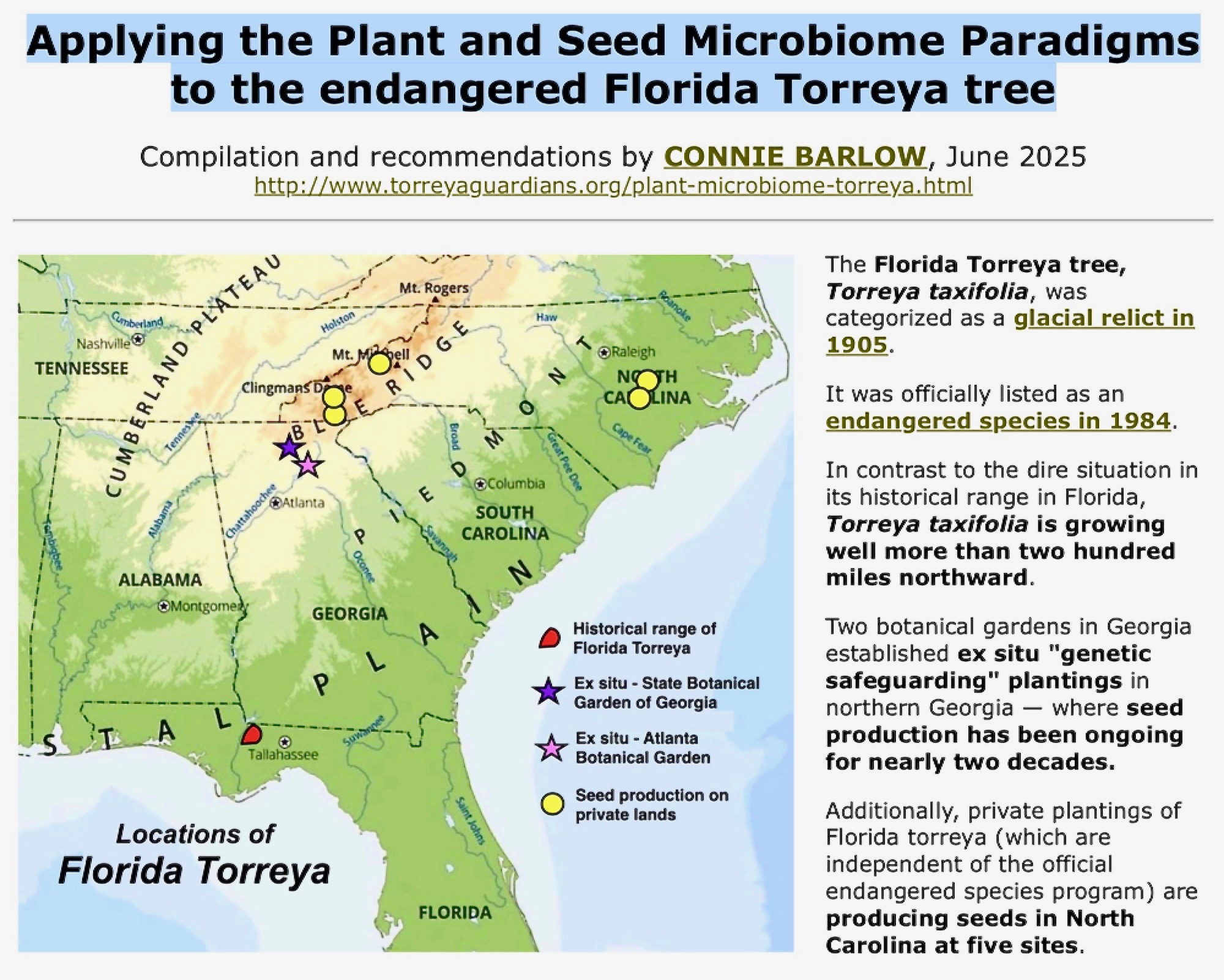
EXCERPT from Annex 1: Private Landowner Effects on Public Lands - Private land managers have the capacity to a affect public lands by introducing non-native species to their property with little or no ecological justification. These species may spread onto federal lands creating a potential need for land managers to either declare the species an invasive species or of conservation value. The Torreya Guardians began a program to actively spread Torreya taxifolia more than a decade ago (http://www. torreyaguardians.org). The group began with an effort to expand this species' range from northern Florida and southern Georgia over 600 km northward to North Carolina. The group has continued the spread of T. taxifolia as far north as Michigan and New Hampshire and west to Oregon with apparently no effort for ecological justification. In all cases the group has endorsed private plantings of this federally listed endangered tree species on private lands in a manner that is ecologically unjustified and risky, though they have not violated any rules or guidelines adopted by any governing body...
Factual correction by Connie Barlow: Torreya Guardians did not move the species into Oregon; that was done by a private landowner in Oregon several decades before the group was established; the group did accept 3,900 seeds offered by the Oregon grower in 2016, for experimental plantings east of the Mississippi.
Alert by Connie Barlow: Two of the authors of this 2017 DOI policy statement have been among the strongest critics of assisted migration (managed relocation) of Florida Torreya since the onset of this controversy:
• Daniel Simberloff, well known for his long leadership in invasive species policy, is coauthor of "Assisted colonization is not a viable conservation strategy", 2008, Trends in Ecology and Evolution, which is the most-cited anti-assisted-migration paper in the academic literature. It includes this direct mention of the torreya controversy:
"... A recent position paper by
the Ecological Society of Australia supports assisted colonization as a management response to climate change (http://www.ecolsoc.org.au/Position_papers/ClimateChange.htm). Other organizations could follow, driven by desperation in the face of anticipated species loss. Indeed,
some scientists have claimed that rejecting assisted colonization will 'greatly increase the threat of climate-driven extinction' [4]. At least one private group has already taken matters into its own hands: the 'Torreya Guardians' (http://
www.torreyaguardians.org) are planting seeds and seedlings across the eastern USA to expand the range of an endangered conifer, Torreya taxifolia, whose modern distribution is confined to the Florida panhandle. These events signal the emergence among some conservationists of a new philosophy regarding species introductions that is at odds with the traditional objective of
preservation...."
• Mark Schwartz did a great deal of field research on Torreya taxfiolia (with many publications) in the 1990s. (An internal find for "Schwartz" within this webpage turns up 28 instances.) The issue of assisted migration (managed relocation) as a potential conservation action to assist this endangered species first appeared in the Winter 2004/5 Forum of Wild Earth in which Schwartz wrote the anti-assisted-migration opinion piece in contrast to the pro-assisted-migration piece by Connie Barlow and Paul S. Martin. His leadership on this issue continued, culminating in first authorship of the 30-coauthor paper linked and annotated above.
• BACK TO MAIN TABLE OF CONTENTS
Part 5
U.S. Forest Service Leads the Way in Assisted Migration Policy
5A. U.S. FOREST SERVICE LEADS THE WAY IN U.S. GOVERNMENT FOR ASSISTED MIGRATION POLICY.
• REPORT: "Assisted Migration"
, 2018, prepared for USDA Forest Service Climate Change Resource Center
EXCERPTS: Evidence suggests that species have responded individually during historic periods of dramatic climate change through geographic migrations to and from unique glacial refugia. Recent research has demonstrated that many tree species are already undergoing distribution shifts in response to climate change, with different studies highlighting species that are moving poleward and higher in elevation, or moving east-west to track changes in moisture availability. Despite the complexities of forecasting species range shifts into the future, the underlying challenge still remains that many species will face extinction or local extirpation if they do not acclimate, adapt via natural selection, or migrate to new suitable habitats as conditions change.
 |
|
EXCERPTS cont: Given the observed and projected rates of change, there is a substantial risk that some species will be unable to migrate quickly enough to track change. Natural migration over long distances requires several generations, and this process is slow because trees require several years to get to
reproduction age, and regeneration opportunities may be limited for a variety of reasons. Recent estimates indicate that post-glacial migration rates for many tree species were 100 to 500 meters per year. Recent rates of change for particular locations in the US have been even more dramatic, with rates of change from 1,000 to 10,000 meters per year for large areas of the Midwest, Great Plains, and Southeast, as well as isolated locations in the western US. These distances are a function of climate change rates ("climate velocity") and spatial climatic variation due to topography.
|
For species with very specific habitat needs or ranges limited by physical barriers, such as fragmentation or geographic features, this may mean that the entire species could be at risk of extinction or extirpation due to climate change.
... Studies involving reciprocal transplants of different species along large gradients have demonstrated the potential for assisted migration to benefit tree species and local populations. For example transplant studies of white spruce in Quebec showed that physiological traits such as
photosynthetic rate and stomatal conductance were relatively plastic between populations and suggested that southern seed sources might be used in northern locations to increase growth and productivity without sacrificing seedling survival. Promising results have been demonstrated for species with more restricted ranges as well. Trials with whitebark pine demonstrated that seeds can be successfully germinated and grown large distances (800 km, 500 miles) to the north of the current species range boundary — seed sources from Oregon and Washington performed well in
locations in northwestern British Columbia . These studies, and others, have demonstrated that assisted migration is a reasonable option to help populations and species occupy areas of projected suitable habitat under climate change. Furthermore, assisted migration doesn't necessarily need to be implemented as a widespread action to be successful. Even if small founder populations of individuals can survive beyond existing ranges, they may contribute genetic diversity associated with warmer climates to native
populations such that the native populations might have a better chance to adapt through natural selection....
Within the USDA Forest Service, Regional Geneticists have recommended a "no regrets" approach to considering assisted migration and seed transfer as a climate adaptation strategy in the 2012 report "Genetic Resource Management and Climate Change: Genetic Options for Adapting National Forests to Climate Change."...
This USDA report links to: "Adaptive Silviculture for Climate Change.
• BACK TO MAIN TABLE OF CONTENTS
Part 6
CONCLUSION: Assisted Migration Now
6A. OVERVIEW & ADVOCACY BY CONNIE BARLOW, 2019
Any decision to implement genetic engineering on Florida Torreya and/or decide yet again to refrain from initiating "assisted migration" pilot projects as part of the recovery plan update process in 2019 will need to set that decision within the context of the actual scholarship and debate on this breakthrough issue in conservation science. Florida Torreya decision-making as part of the official species recovery plan will necessarily play on the world stage.
That the Department of Interior's "Invasive Species Advisory Committee" came out with such a strong statement against "managed relocation" in December 2017 (excerpt is immediately above), and that Torreya Guardians was singled out as a negative example, is important to consider from an agency perspective (Fish & Wildlife Service being part of DOI). That is why, in her comments re the 2019 recovery plan update (directly below), Barlow called attention to the new-in-2018 Historic Groves webpage. There, documentation achieved over the years during site visits by Torreya Guardians to northward plantings of now-mature specimens provide solid evidence that Florida Torreya (which has long been suspected of poor dispersal capabilities) has proved non-invasive in the mountains of North Carolina.
Currently, it appears that the individuals and institutions officially involved or expressing research interest in recovery of Torreya taxifolia have turned concern away from the long-standing questions of invasiveness and ability-to-thrive in northward locations (especially given the decade+ experience of healthy and seed-productive ex-situ groves in northern Georgia) and have recently expressed concerns about assisted migration primarily from the standpoint of possible pathogen transmittal. (See Part 1 and Part 2 of this webpage.) If that is indeed the case, then developing guidelines for guarding against pathogen transmittal would seem to be the primary action to accompany authorization of translocations of plant materials within and beyond Florida and Georgia as part of pilot project experimentations for discerning whether cooler habitats could diminish the lethal effects of any and all pathogens that have long been attacking Florida torreya in its glacial refugium. Here, too, documentation achieved by Torreya Guardians could be helpful: The plant materials least harmed by fungicides and most thoroughly subject to cleansing are ripe seeds. Please consult our new-in-2018 Free-Planting Seeds webpage for a photo-essay of documented experiments and learnings of our half-dozen years of testing various practices and habitats for placing seeds directly into regrowth forest sites, with the goals of maximizing success and minimizing herbivory, while setting in place long-term field experiments with minimal human labor and essentially no cost.
6B. PRIOR PUBLISHED ADVOCACY BY CONNIE BARLOW
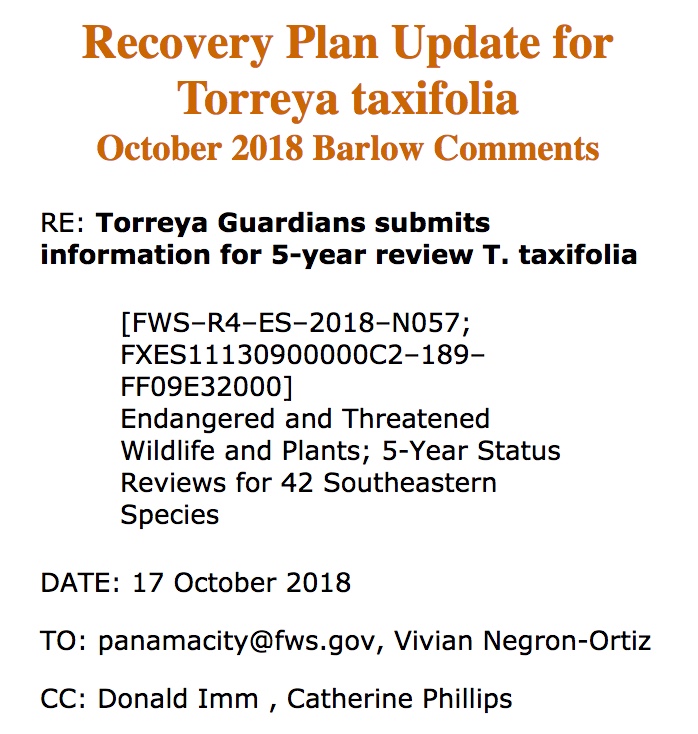
• October 2018, Connie Barlow submitted Comments for the Recovery Plan Update:
 |
|
In her comments, Barlow pointed to several informative webpages on the Torreya Guardians website that should be taken into account in updating the plan, notably:
• Learnings
• Historic Groves
Since then, another webpage of actions has been added:
• Seed-Planting Experiments (a.k.a. "Freeplanting")
As well, this Brink of Extinction page was revised March 2019 in order to better lay out the argument (with sources linked) in favor of assisted migration of Florida Torreya.
|
Barlow's filing also stated, "Please add me to your e-list for receiving whatever communications you routinely send to your science advisors and area stakeholders. All citizens in the USA are stakeholders for endangered species. We Torreya Guardians have demonstrated our concern and care for this tree."
• A final excerpt from my chapter in the 2009 book already excerpted and cited highlights the deep-time perspective
called forth by immersion in paleoecological literature (especially Quaternary timeframe):
 |
|
"Deep Time Lags: Lessons from Pleistocene Ecology",
by Connie Barlow, 2009, (9 pp. pdf)
Chapter 10 of Gaia in Turmoil: Climate Change, Biodepletion, and Earth Ethics in an Age of Crisis,
Eileen Crist and Brruce Rinker, eds., MIT Press
EXCERPT: ... In conclusion, the deep-time perspective that comes naturally to those who work in the realm of geophysiology can now become the lens
through which conservation biologists and other biodiversity activists
go about their work. Specifically, the deep-time perspective encourages conservationists to revise the parameters we use for judging which species
are native to a region. It also encourages us to be mindful of time lags in biological adjustments to shifts in climate, and thus in how we read the past and how we prepare for the future.
|
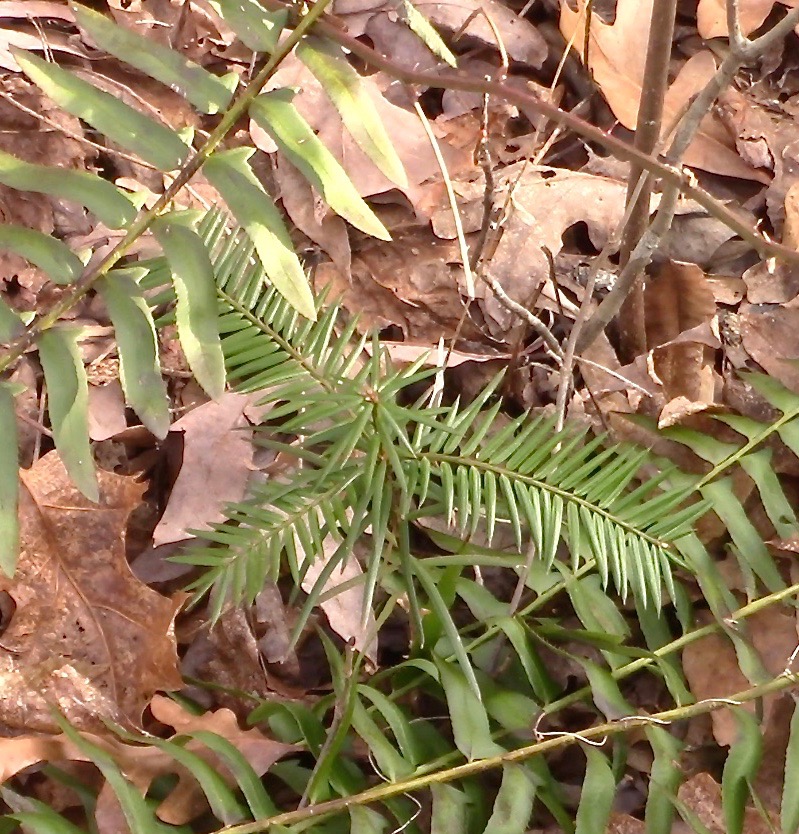
PHOTO ABOVE: This herbivory-free "freeplanted" torreya emerged from seed that had inadvertently been planted by Barlow right next to an evergreen Polystichum fern in NE Alabama. A major learning accrued: Planting seeds (at least 3 inches deep for protection against seed predators) and alongside evergreen ferns provides excellent camouflage for escaping herbivory by deer.
6C. BARLOW ADVOCACY UPDATE, 2022
• UPDATE: 19 MAY 2022 Connie Barlow submitted a 2-page "Request" for the (newly appointed) director of the U.S. Fish & Wildlife Service to review the citizen accomplishments of Torreya Guardians. Barlow concluded this way:
"REQUEST: Please have a high-level, policy staff person visit the Torreya Guardians website: http://www.torreyaguardians.org/ From the home page, click on the link titled, "Case Study of Agency Failure." As well, our "Historic Groves" link is intended to be a strong and visually rich survey of how well the climate in the Appalachians and northward supports this glacial relict's health: notably its ability to fight a range of native diseases that have made the species functionally extinct in its historically native range. As well, do take a look at our documentation of what we have learned, especially to educate and guide volunteer planters via our "Propagation" page. Finally, please consult with USDA climate lead, Chris Swanston, who is well situated to educate conservation scientists in FWS about the forestry research scholarship that has welcomed "assisted migration" as a climate adaptation tool for timber management and forest ecosystem services. A well-regarded summary of the forestry science on this topic is a wikipedia page I coauthored in 2021 with a Canadian: "Assisted migration of forests in North America." I look forward to the possibility of Florida torreya becoming a highlighted achievement of FWS for the 50th anniversary of the ESA, instead of a sad example of ongoing climate denial and hostility toward citizen contributions."
• UPDATE: 8 AUGUST 2022 Connie Barlow submitted a comment on the proposed federal regulation to eliminate "historical range" as the sole locus for endangered species recovery. After voicing a YES to the proposal, she posted a 5-page PDF that offered RECOMMENDATIONS FOR IMPLEMENTATION:
1. Create implementation frameworks and policies that are distinct for plants.
2. Encourage nongovernmental entities to use the ESA "exception" for plants.
3. Follow the lead of the USDA Forest Service [in their own "assisted migration" terminology and actions.
4. Facilitate respectful dialogue and understandings of worldview differences.
• Barlow Comment, 5-page PDF here or here
• Barlow summary of key institutional comments among the 553 posted (10 pages PDF)
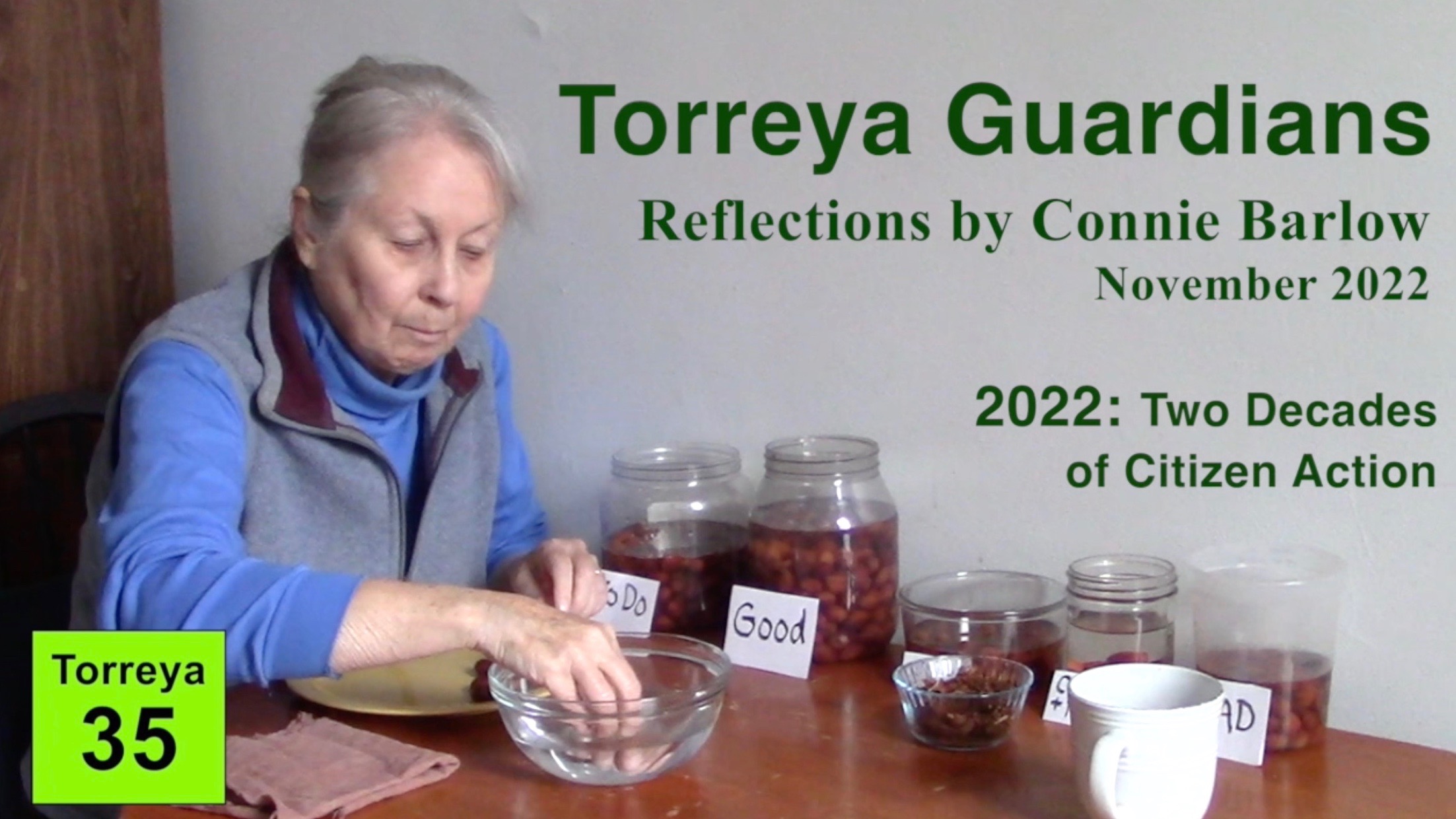
• UPDATE: 15 NOVEMBER 2022 Connie Barlow posted on youtube a richly illustrated HISTORY OF TORREYA GUARDIANS: VIDEO EPISODE 35: Torreya Guardians - Reflections by Connie Barlow
 |
|
While cleaning and sorting torreya seeds freshly harvested from a private home in Clinton, NC, Connie extemporaneously delivers the history of significant beginnings, achievements, and frustrating institutional obstacles that she and other volunteers encountered during nearly two decades of action and advocacy in behalf of this endangered subcanopy tree.
The first 5 minutes is where she explains the importance of the paleoecological understanding of Florida Torreya as a glacial relict. Later, she offers why this deep-time understanding helps distinguish ULTIMATE from PROXIMATE causes of extinction.
|
VIDEO: 43 minutes, with timecoded table of topics in the youtube caption. Access the full list of TG videos.
• BACK TO MAIN TABLE OF CONTENTS
* * * * *
End of "At the Brink of Extinction — Why"
SUPPLEMENTARY MATERIALS BELOW
Classic Botany Papers Describe Torreya as Glacial Relict
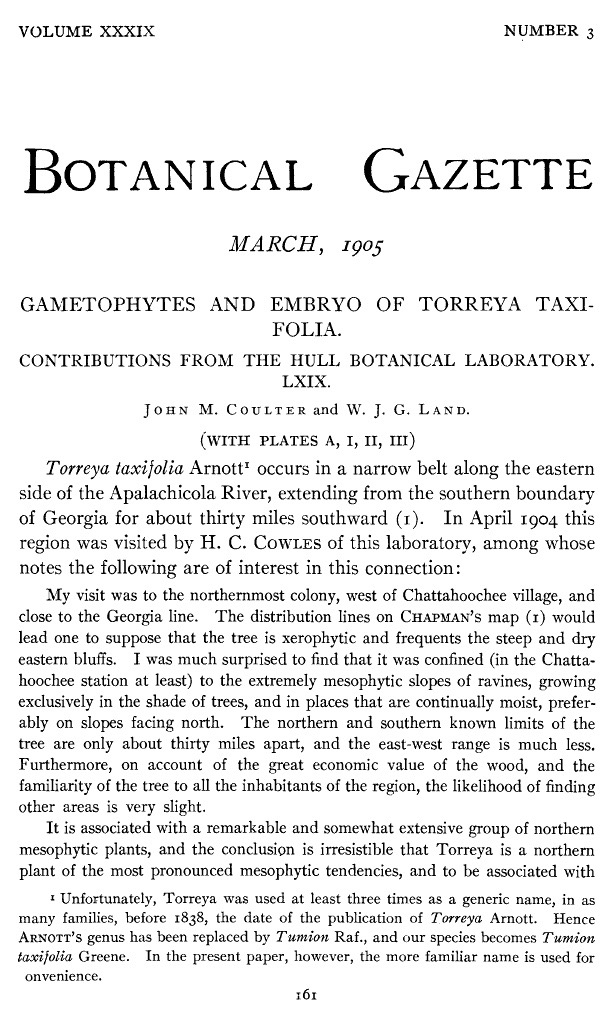
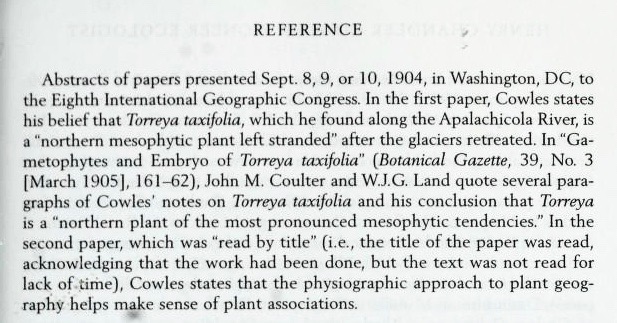
| EDITOR'S NOTE: This 1905 publication contains the first suggestion that Torreya's preferred habitat lies northward of its endemic Florida range. Access online the entire report.
 |
|
| 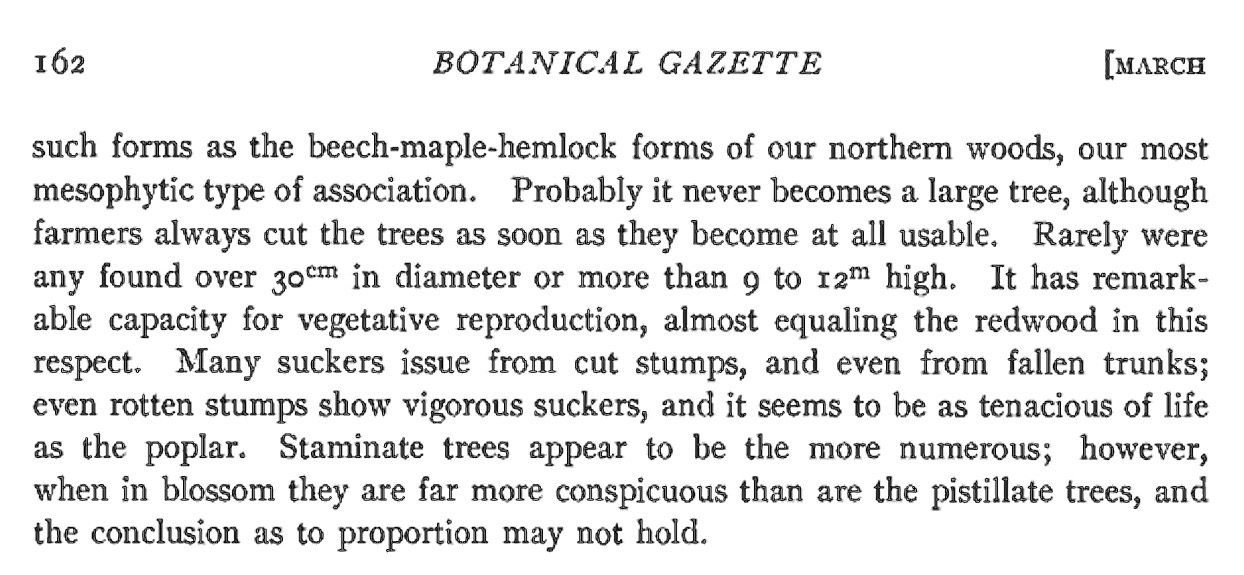
Note that in this 1905 report, the author posits that
"It is associated with a remarkable and somewhat extensive group of northern mesophytic plants, and the conclusion is irresistible that Torreya is a northern plant of the most pronounced mesophytic tendencies, and to be associated with such forms as the beech-maple-hemlock forms of our northern woods, our most mesophytic type of association."
|
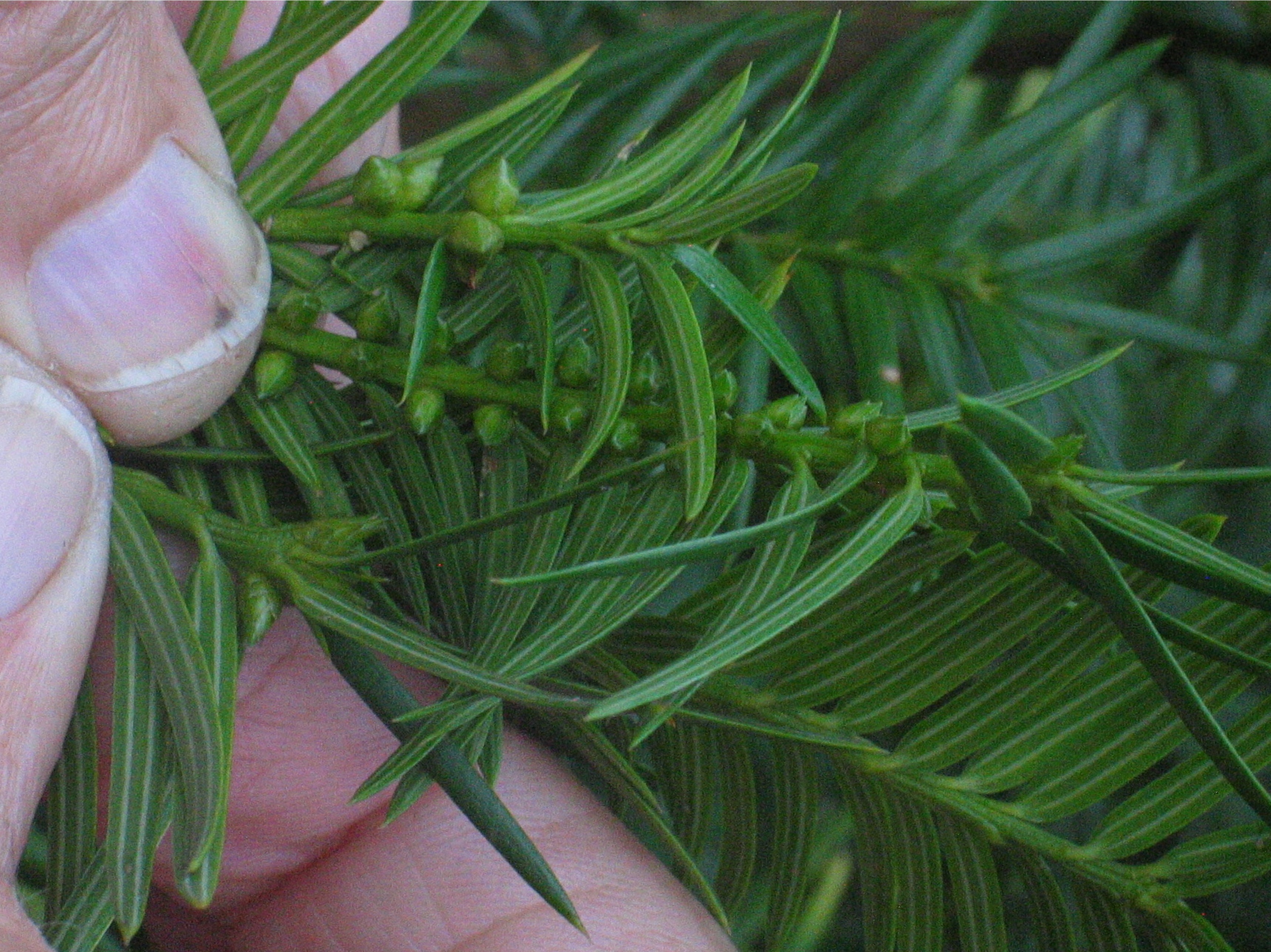
PHOTO ABOVE: In 2013 AJ Bullard demonstrated on his Torreya taxifolia tree in Mt. Olive North Carolina that this species actually will produce both female cones (top branchlet) and male cones (middle branchlet) on a single individual. Lower left branchlet shows vegetative buds.
In an email to Lee Barnes on 9/29/16 Frank Callahan wrote of his mature Florida Torreya trees in Medford OR: "Both of these trees exhibit male and female 'flowers', which is unusual for this taxon."
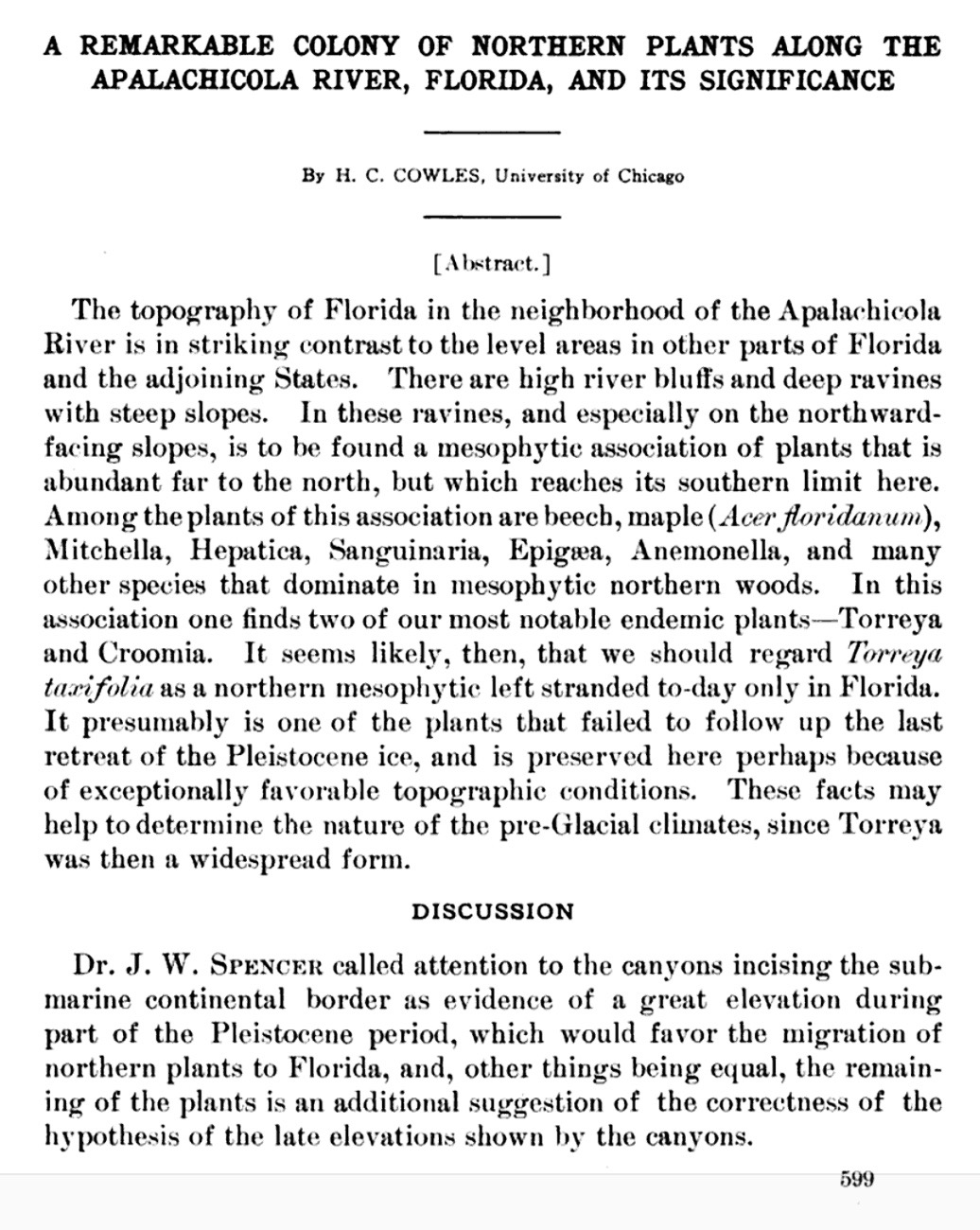
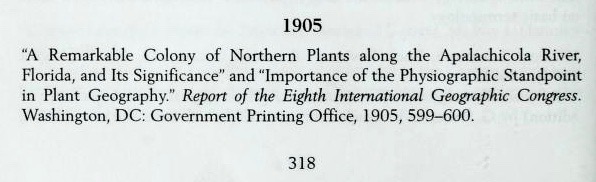
"A Remarkable Colony of Northern Plants Along the Apalachicola River, Florida, and Its Significance"
by H. C. Cowles, 1905
Report of the Eighth International Geographic Congress
Held in the United States
 |
|
KEY SECTION:
"In this association one finds two of our most notable endemic plants — Torreya and Croomia. It seems likely, then that we should regard Torreya taxifolia as a northern mesophytic left stranded to-day only in Florida.
"It presumably is one of the plants that failed to follow up the last retreat of the Pleistocene ice, and is preserved here perhaps because of exceptionally favorable topographic conditions."
__________
|
 |
|
Scientific Papers of Asa Gray, Vol II, 1841-1886", selected by Charles Sprague Sargent, 1889.
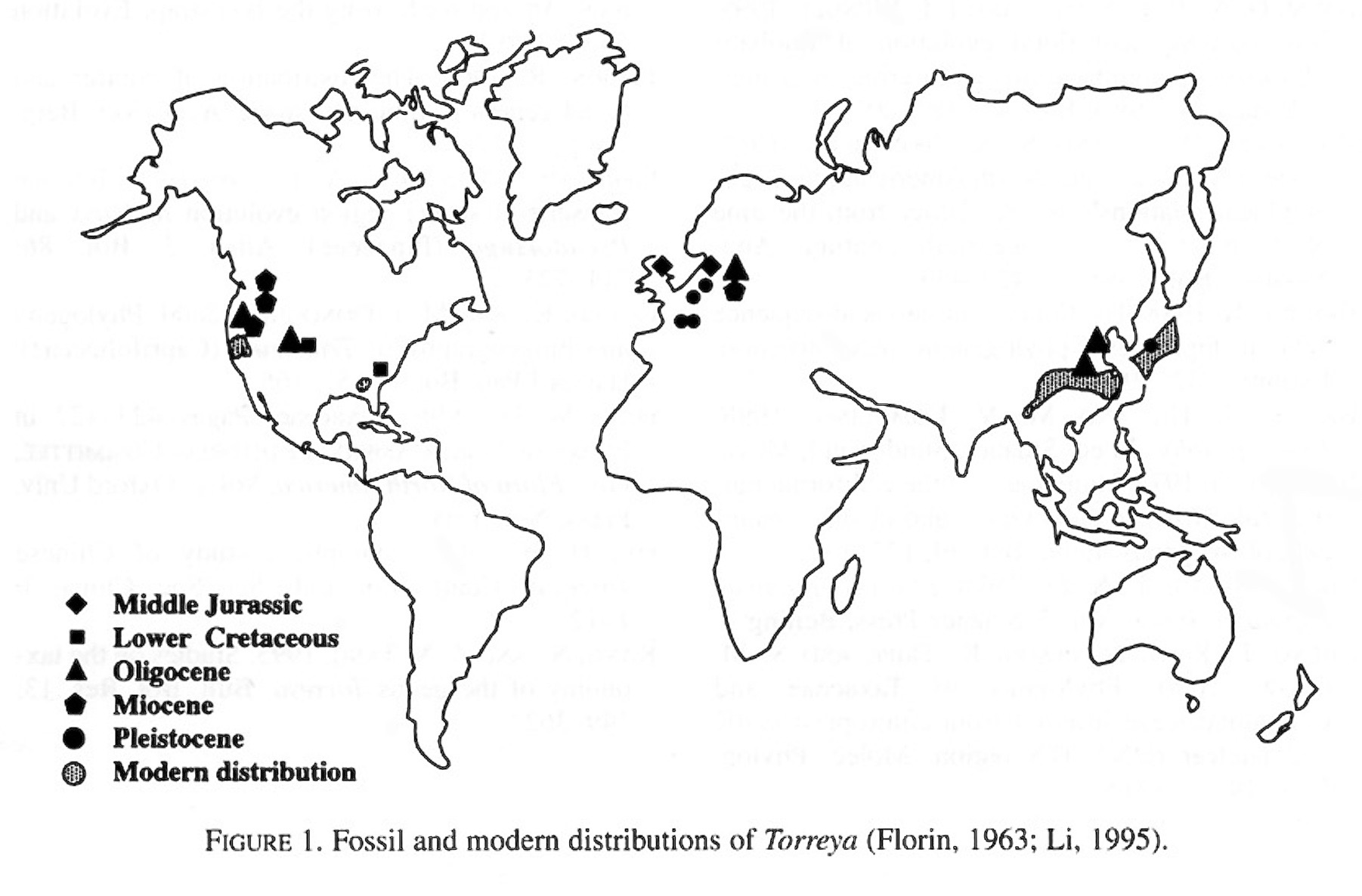
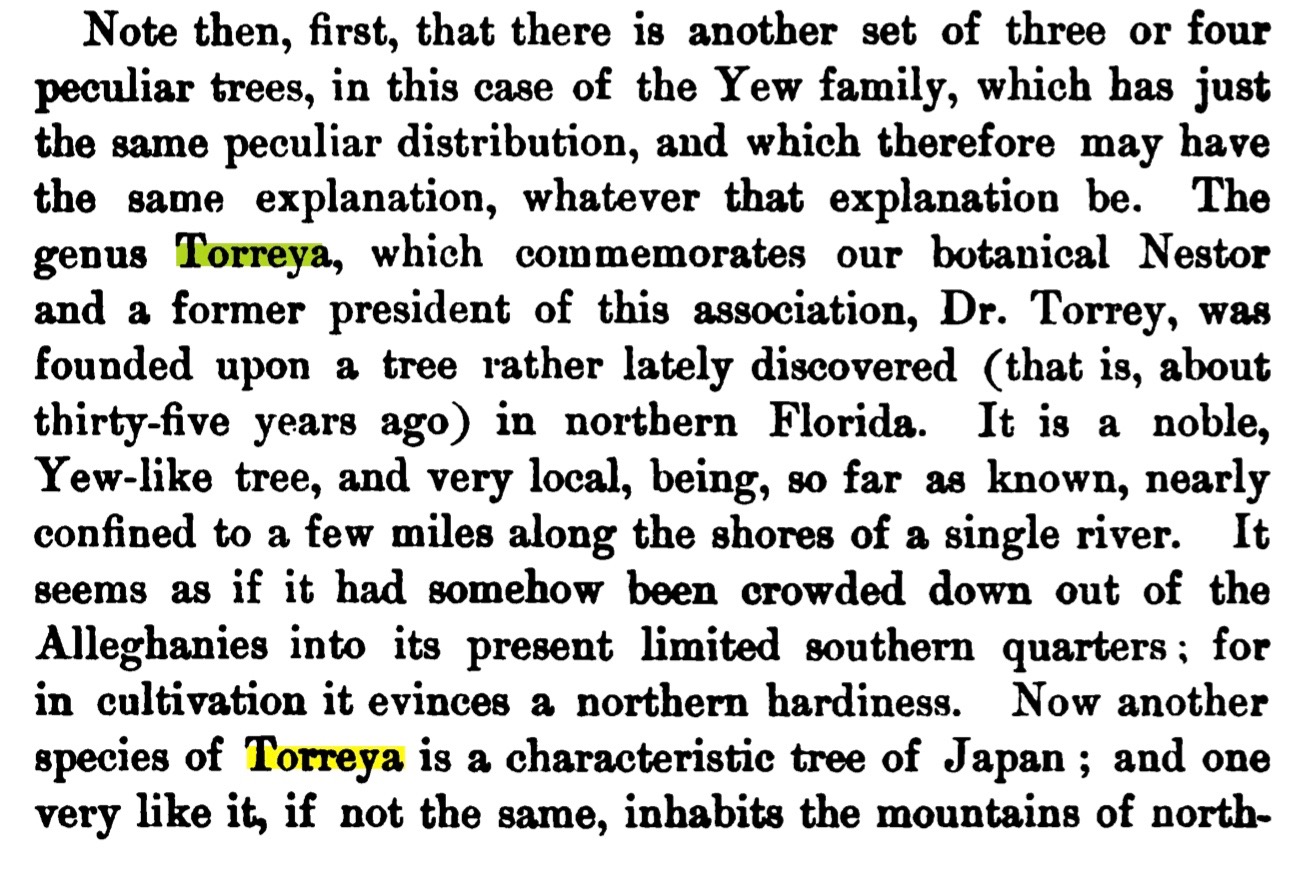
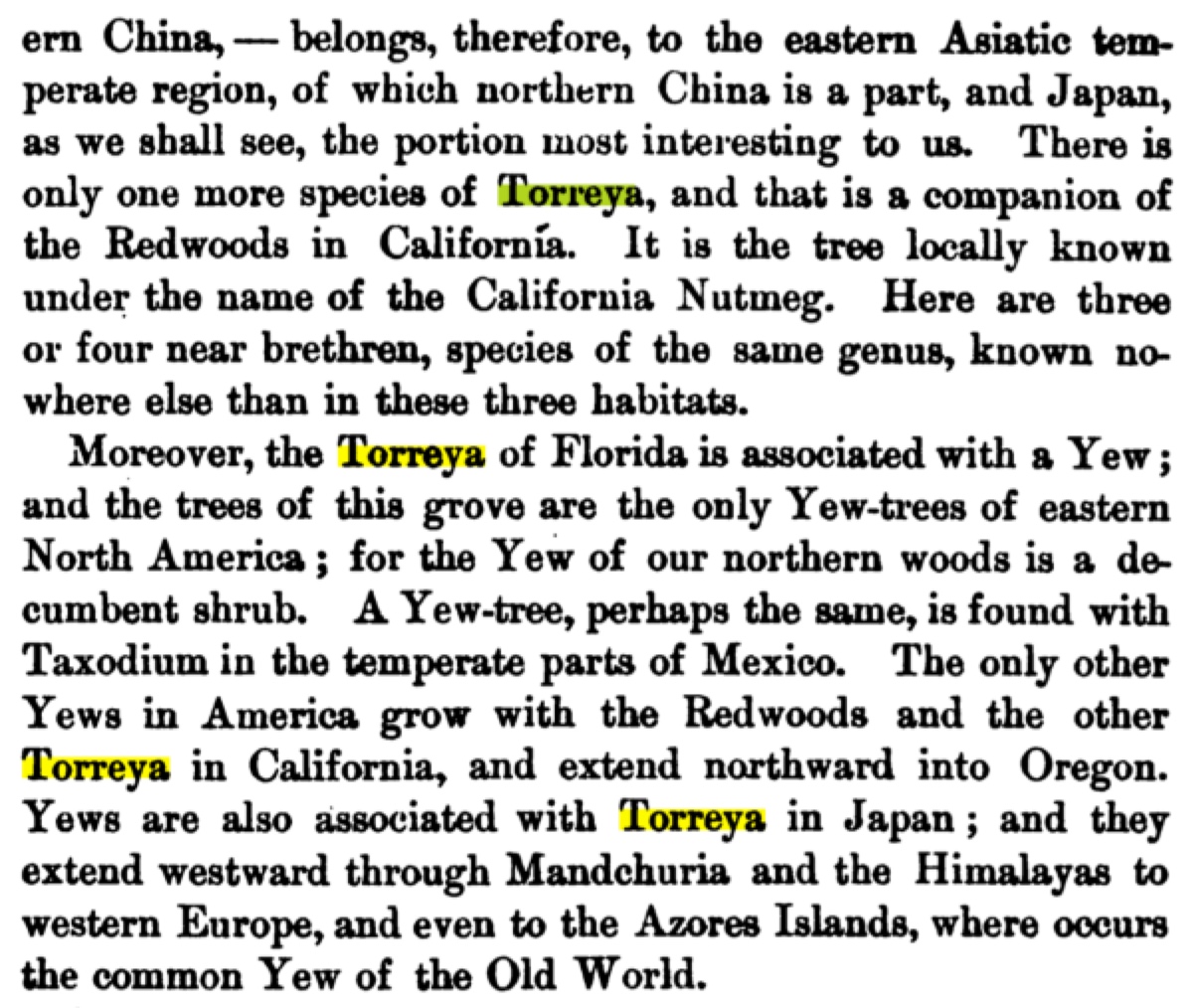
Editor's note: Genus Torreya is one of several plant taxa scrutinized by Asa Gray for the remarkably disjunct ranges including eastern Asia, eastern USA, and (to a lesser degree) California, along with fossil evidence in western Europe. Images below are drawn from his 1872 paper titled "Sequoia and Its History". These excerpts below will begin with p. 149 of the original document:
... In the tertiary period, the geological botanists assure us, our own very Taxodium or Bald Cypress, and a Glyptostrobus, exceedingly like the present Chinese tree, and more than one Sequoia, coexisted in a fourth quarter of the globe, namely, in Europe! This brings up the question: Is it possible to bridge over these four wide intervals of space and the much vaster interval of time, so as to bring these extraordinarily separated relatives into connection? The evidence which may be brought to bear upon this question is various and widely scattered. I bespeak your patience while I endeavor to bring together, in an abstract, the most important points of it.
Some interesting facts may come out by comparing generally the botany of the three remote regions, each of which is the sole home of one of these genera, i.e., Sequoia in California, Taxodium in the Atlantic United States, and Glyptostrobus in China, which compose the whole of the peculiar tribe under consideration.
|
 |
|
 |
A few pages later Asa Gray offers a paleoecological explanation:
"...My speculation was based upon the former glaciation of the northern temperate zone, and the inference of a warmer period preceding and perhaps following. I considered that our own present vegetation, or its proximate ancestry, must have occupied the arctic and subarctic regions in Pliocene times, and that it had been gradually pushed southward as the temperature lowered and the glaciation advanced, even beyond its present habitations; that plants of the same stock and kindred, probably ranging round the arctic zone as the present arctic species do, made their forced migration southward upon widely different longitudes, and receded more or less as the climate grew warmer ... so that different species of the same genus, as in Torreya, or different genera of the same group, as Redwood, Taxodium, and Glyptostrobus, or different associations of forest trees, might establish themselves each in the region best suited to their particular requirements, while they would fail to do so in any other. These views implied that the sources of our actual vegetation and the explanation of these peculiarities were to be sought in, and presupposed, an ancestry in pliocene or still earlier times, occupying the higher northern regions.
"The genealogy of the Torreyas is still wholly obscure; yet it is not unlikely that the Yew-like trees, named Taxites, which flourished with the Sequoias in the tertiary arctic forests, are the remote ancestors of the three species of Torreya, no severally in Florida, in California, and in Japan..."
Editor's note: For more detail on the fossil evidence of genera extant in eastern North America and eastern Asia, but now lost to Europe, access Asa Gray's 1878 paper "Forest Geography and Archaeology", republished in the same volume in pdf as above (Torreya is included in that paper.) I will close these excerpts first with a paragraph admirable for the breadth of knowledge and attention to deep-time mysteries that, alas, have gone missing among the credentialed in charge of the fate of Torreya today. Then, with a paragraph whose beauty and heart remind us of how diminished the human quest for knowledge became when "natural history" was left behind in favor of the more precise and quantitative inquiries of "science." A century and a half ago, Asa Gray wrote (p. 161):
"... I must refrain from enumeration of the angiospermous or ordinary deciduous trees and shrubs, which are now known, by their fossil remains, to have flourished throughout the polar regions when Greenland better deserved its name and enjoyed the present climate of New England and New Jersey. Then Greenland and the rest of the north abounded with Oaks, representing the several groups of species which now inhabit both our eastern and western forest districts; several Poplars, one very like our Balsam Poplar, or Balm of Gilead-tree; more Beeches than there are now, Hornbeam, and a Hop-Hornbeam, some Birches, a Persimmon, and a Planer-tree, near representatives of those of the Old World, at least of Asia, as well as of Atlantic North America, but all wanting in California; one Juglans like the Walnut of the Old World, and another like our Black Walnut; two or three Grapevines, one near our southern Fox Grape or Muscadine, another near our northern Frost Grape; a Tilia, very like our Basswood of the Atlantic States only; a Liquidambar; a Magnolia, which recalls our Magnolia grandiflora; a Liriodendron, sole representative of our Tulip-tree; and a Sassafras, very like the living tree...."
"... I, for one, cannot doubt that the present existing species are the lineal successors of those that garnished the earth in the old time before them, and that they were as well adapted to their surroundings then, as those which flourish and bloom around us are to their conditions now. Order and adaptation did not wait for man's coming, nor were they ever stereotyped. Organic nature, — by which I mean the system and totality of living things, and their adaptation to each other and to the world, — with all its apparent and indeed real stability, should be likened, not to the ocean, which varies only by tidal oscillations from a fixed level to which it is always returning, but rather to a river, so vast that we can neither discern its shores nor reach its sources, whose onward flow is not less actual because too slow to be observed by the ephemera which hover over its surface, or are borne upon its bosom."
Excerpts from a detailed chapter on Florida Torreya (2015, by Kara Rogers, University of Arizona Press) are accessible at the google books site, page 101, for The Quiet Extinction: Stories of North America's Rare and Threatened Plants.
|
|
"In 1955, officials at Torreya State Park, in the heart of Florida torreya habitat, reported a steep decline in the tree's populations. . . Seemingly overnight the situation had turned dire. Adult populations had been decimated, and there was no indication that the species was reproducing. Florida torreya, Kurz and Godfrey warned [1962], was on the brink of extinction. . . . The disease seemed to be worse for trees that received full sunlight than for those in more shaded areas. But the result was still the same. . . The only individuals that were spared the disease were seedlings younger than six months. They presumably were started from seeds left behind by dead adults. By the 1990s, however, virtually all adult trees in the wild had been killed, and between 1,000 and 1,350 juveniles remained. Many young trees displayed symptoms of the disease, and over time their stems were killed off, one by one. The likelihood of their survival being prolonged depended in part on the size of their main stem. A larger main stem meant a more promising outlook, at least for a while. But once the main stem died or when a tree was down to three or fewer stems, each a foot and a half tall or less, death ensued.
|
"By 2010, among wild populations of Florida torreya, only six plants were able to produce cones." Note: Several pages of detailed disease descriptions and experiments then follow.
"Possibly also affecting the survival of Florida torreya is damage to protective communities of mycorrhizal fungi that associate with Florida torreya. Nearly all of its mycorrhizal associates belong to the genus Glomus, which contains a number of species that help defend trees against root pathogens. The abundance of those fungi, however, appears to be greater among garden explants than among trees in native habitats. Wild Florida torreya currently inhabit heavily shaded areas, which, combined with the presence of disease, may limit the trees' ability to support beneficial mycorrhizal fungi.
Note: Several pages follow that detail current management projects attempting to restore Florida torreya in its historically native range. The remainder of the chapter highlights the work of Torreya Guardians, as imaged below:
2015 ADDENDUM by Connie Barlow:
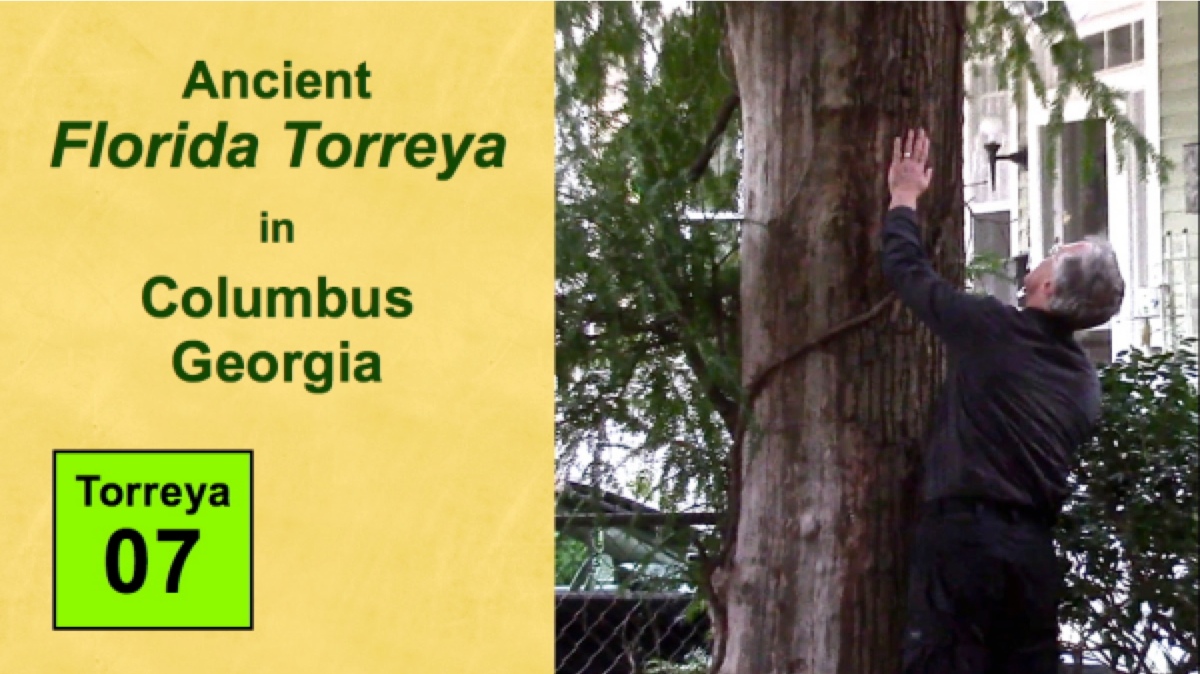
Supplemental hypothesis on why Florida Torreya was "left behind" in its peak glacial refuge of Florida's Apalachicola River: Might Torreya taxifolia have become stranded in its peak glacial refuge, not so much because of the slow seed-dispersal capacities of squirrels (as hypothesized by Barlow here and here) but because of the absence of northward flowing rivers between Florida and the southern Appalachians? Barlow arrived at this hypothesis during a field visit to the largest remaining Torreya taxifolia in existence: the one along the Chattahoochee River, in the front yard of an historic-register home at the riverfront. (Click on video below.)
 |
|
While visiting the sole remaining T. taxifolia in Columbus GA, Connie Barlow was struck by its location along a free-flowing section of the Chattahoochee River. The Chattahoochee is the main conduit between the peak-glacial plant refuge in n. Florida and the Appalachian Mountains. Might Torreya taxifolia have been "left-behind" in its Florida refuge because the Chattahoochee River flows southward? The tree could have dropped seeds into the river for a speedy journey south, but it would have been utterly dependent on the slower actions of squirrels for the the return trip north.
Visit the webpage that includes info, photos, and video of this oldest tree.
|
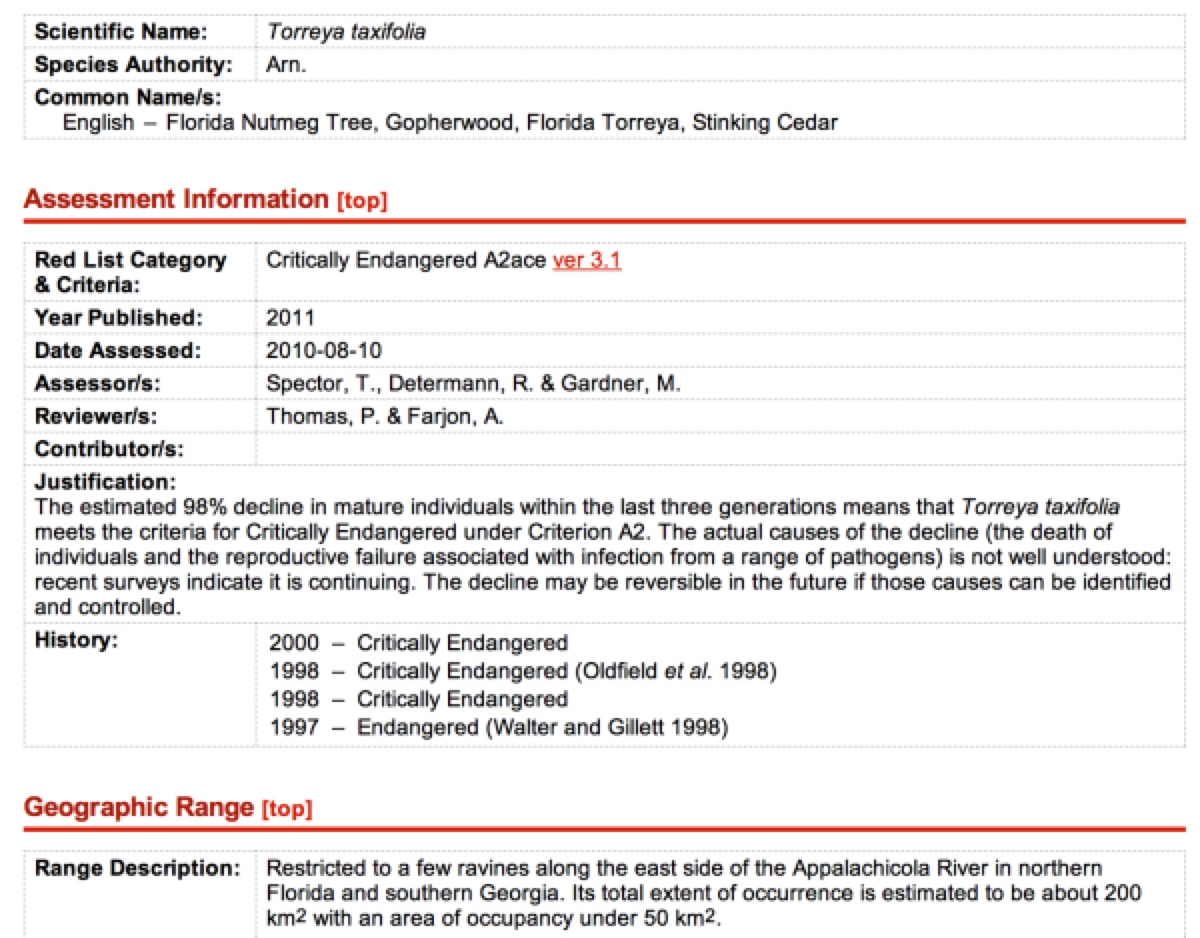
The International Union for the Conservation of Nature (IUCN) monitors endangered species via its IUCN Red List of Threatened Species. An update of its "critically endangered" Torreya taxifolia IUCN listing in 2011 includes these entries:
The estimated 98% decline in mature individuals within the last three generations means that Torreya taxifolia meets the criteria for Critically Endangered under Criterion A2. The actual causes of the decline (the death of individuals and the reproductive failure associated with infection from a range of pathogens) is not well understood: recent surveys indicate it is continuing. The decline may be reversible in the future if those causes can be identified and controlled.
Restricted to a few ravines along the east side of the Appalachicola River in northern Florida and southern Georgia. Its total extent of occurrence is estimated to be about 200 km2 with an area of occupancy under 50 km2.
The current population is estimated to be between 500 and 600 trees. Of these, less than 10 are known to produce male or female cones (this species is dioecious). Individuals persist as stump sprouts. Before the start of the decline in the early 1950s, the population was estimated to have been more than 600,000. Since then there has been a decline of more than 98%.
Torreya taxifolia occurs along limestone bluffs on the Appalachicola River in a region with a warm and humid climate, occasionally influenced in winter by cold waves from the north that dip temperatures below the freezing point. It grows mostly in the shade of wooded ravines and steep, N-facing slopes under canopy of Fagus grandifolia, Liriodendron tulipifera, Acer barbatum, Liquidambar styraciflua, Quercus alba, and occasionally pines (Pinus taeda, P. glabra). Often these woods are hung with vines (e.g. Smilax spp., Bignonia capreolata). Another rare conifer, Taxus floridana, occasionally grows with Torreya taxifolia.
The most significant current threat to T. taxifolia is the continued reproductive failure associated with fungal pathogens. Individuals do not reach reproductive size before being top-killed. Recent research has identified a previously unknown species of Fusarium that may be the cause (J.A. Smith pers. comm. September 2010). Rubbing by deer is an additional problem as it causes physical damage and may also be a vector for disease transmission. Changes in landuse and fire regimes in surrounding areas along with changes in hydrology and soil chemistry linked to the construction of dams may also be implicated in its historical decline. Augmentation plantings within the natural range have proved to be susceptible to infection: no naturally resistant clones have been identified to date. Population viability analyses indicate that extinction within its native range is inevitable. Below: Sample graphic from the IUCN Red List page for Florida Torreya.
 |
|
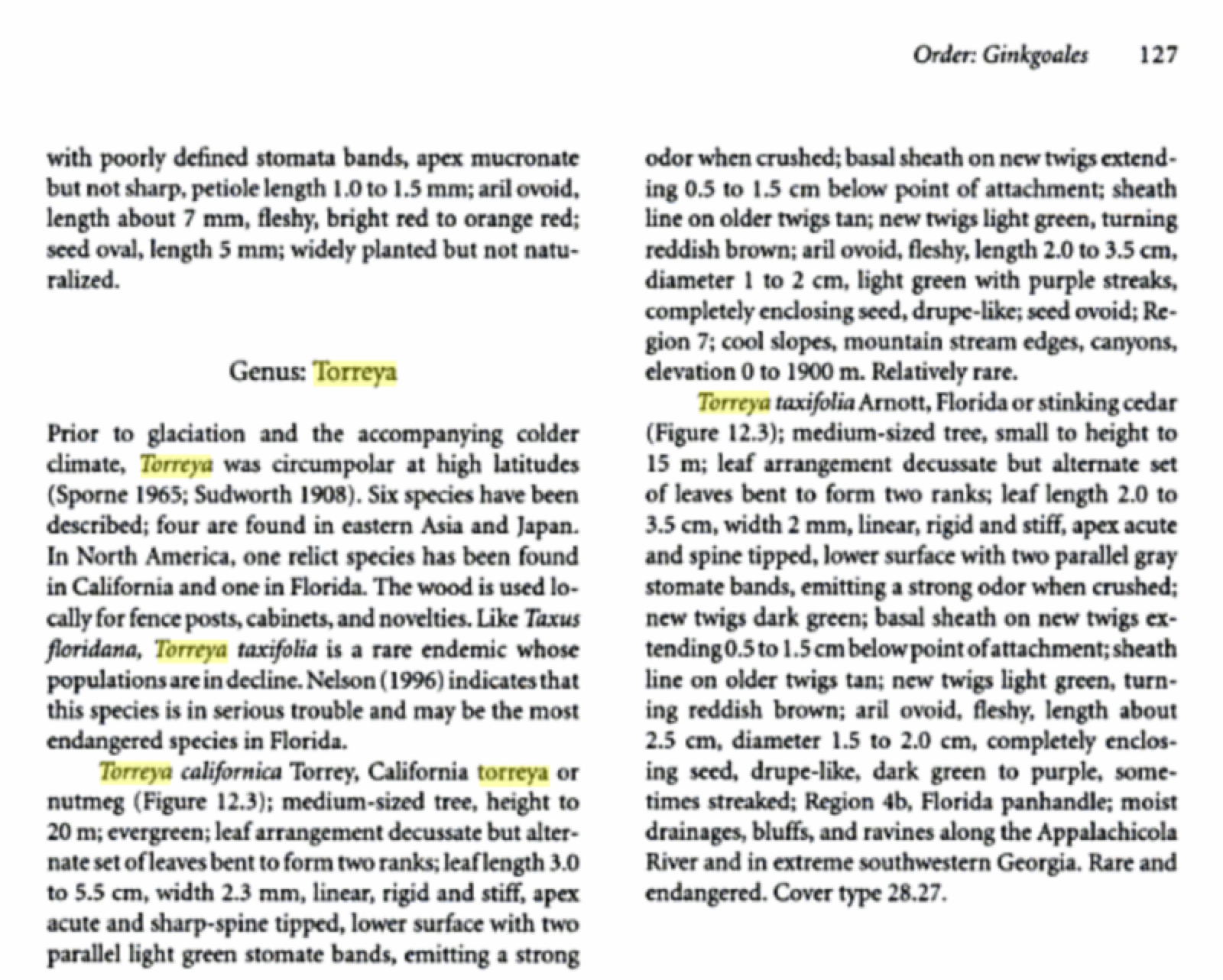
Image left from:
Taxonomy and Ecology of Woody Plants in North American Forests:
(Excluding Mexico and Subtropical Florida)
by James S. Fralish and Scott B. Franklin (Feb 8, 2002)
Hardcover: 624 pages
Publisher: Wiley; 1 edition (February 8, 2002)
Note the first sentence: "Prior to glaciation and the accompanying colder climate, Torreya was circumpolar at high latitudes."
|
 |
|
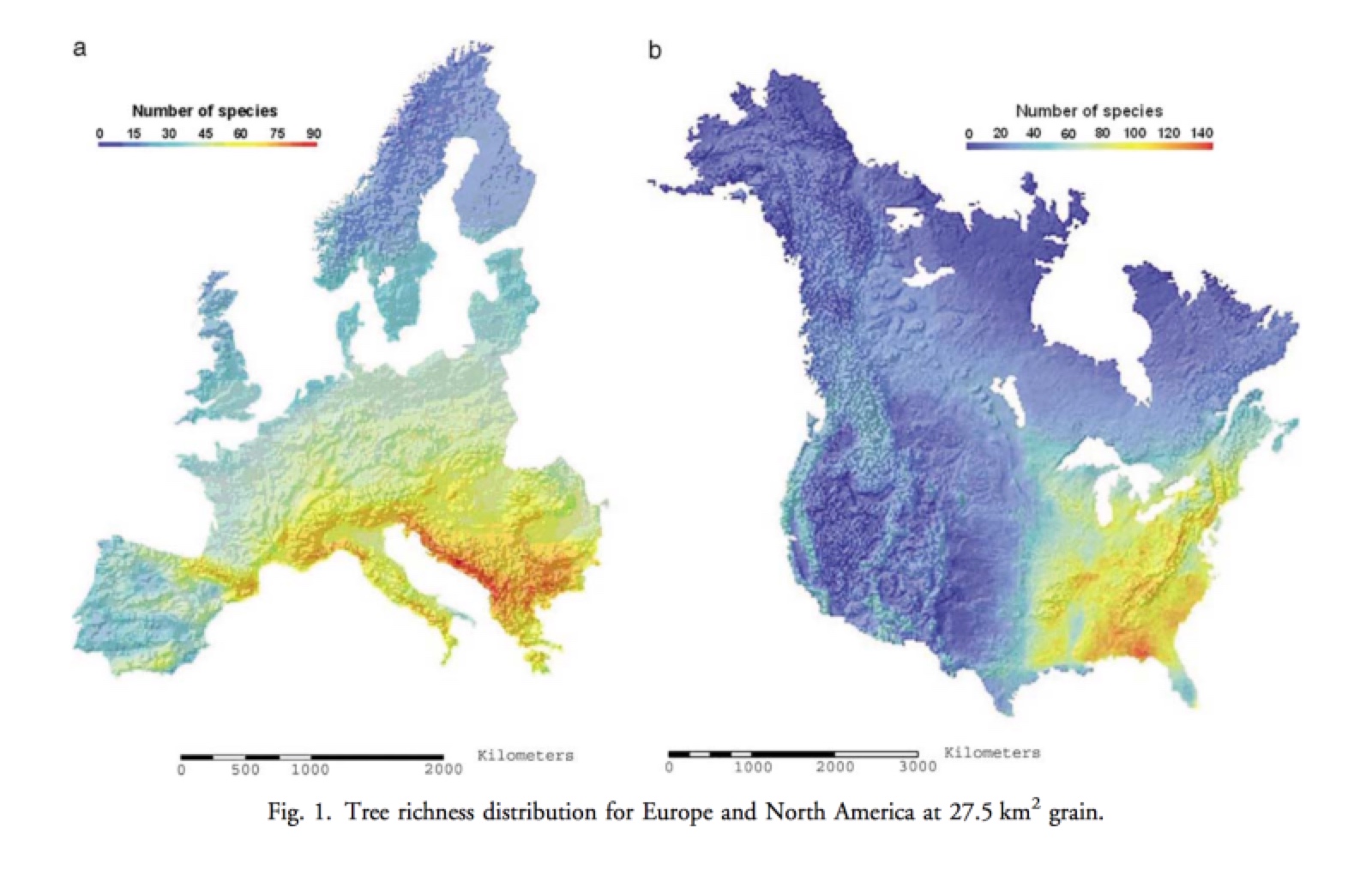
Notice the species richness centered over the Apalachicola region of northern Florida.
Illustration from "Contemporary richness of holarctic trees and the historical pattern of glacial retreat," by Daniel Montoya et al., 2007, Ecography 30:173-182.
|
• BACK TO MAIN TABLE OF CONTENTS
Photos of Diseased Specimens • January 2004
by Connie Barlow • Torreya State Park
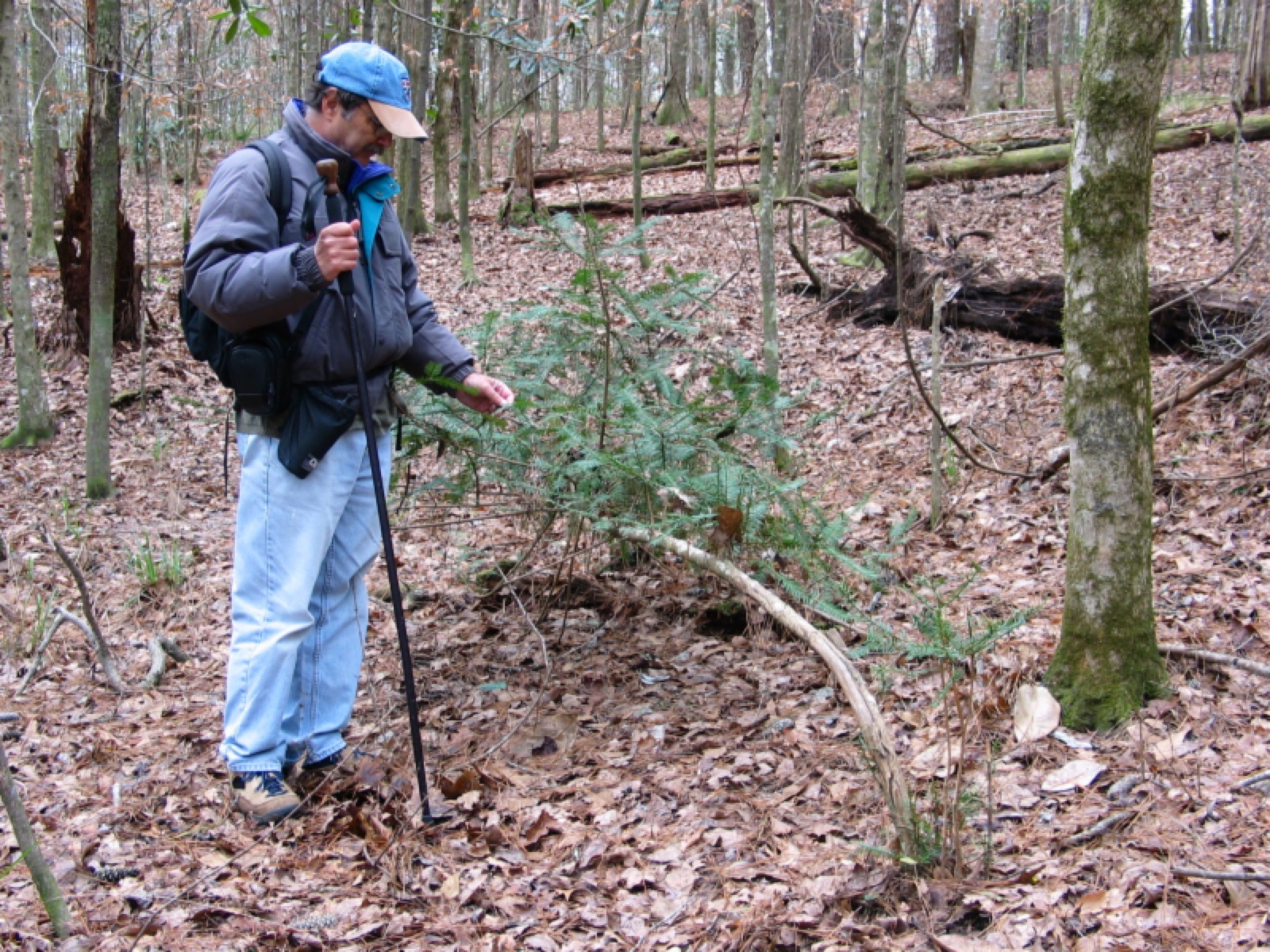
SPECIMEN #1. Steve Urse of Tallahassee with a reclining Torreya stem in an upland area near the ravines.
 |
|
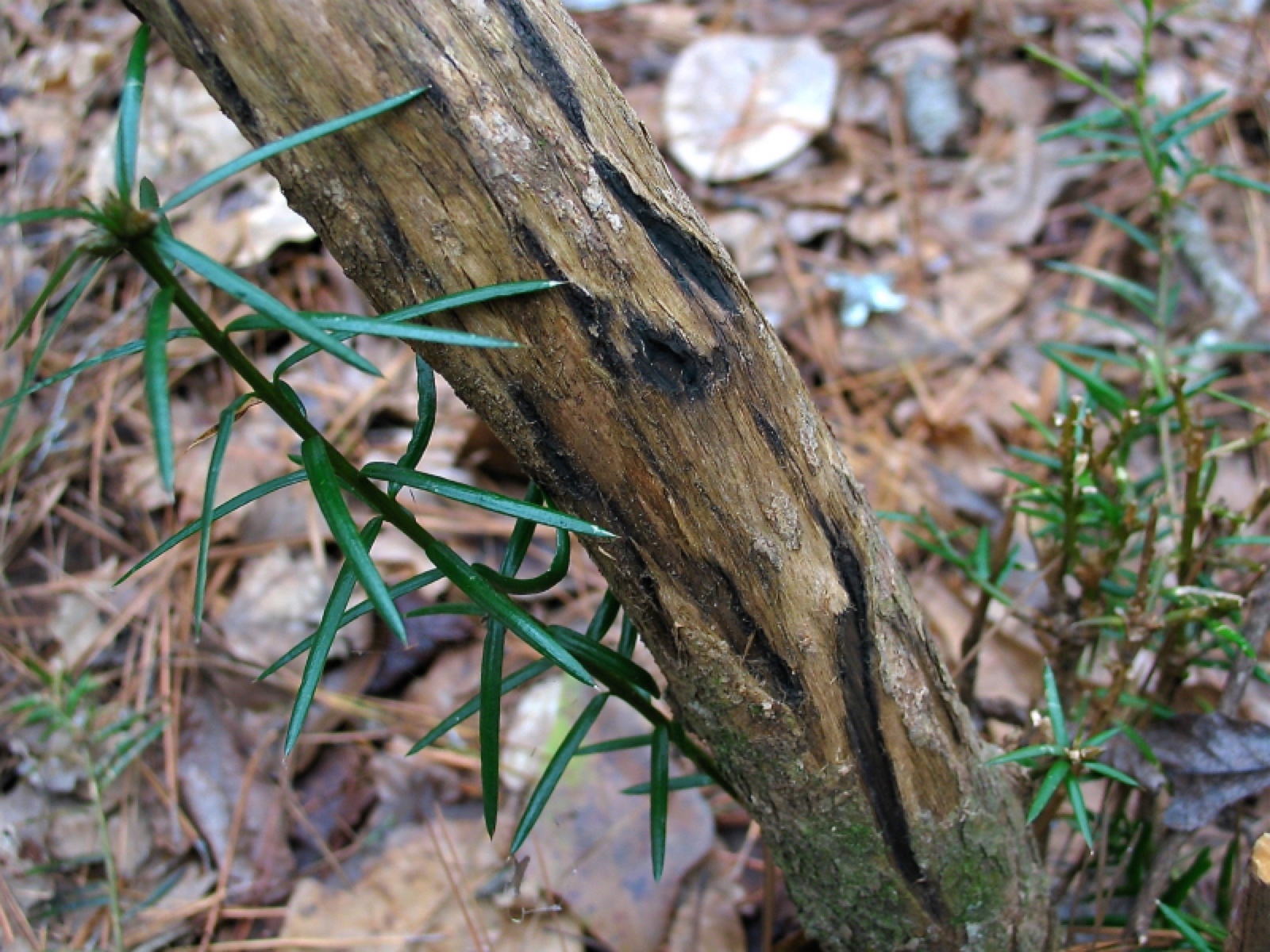
Below: Close-up of the lower stem, with healthy basal sprout on one side and a cluster of basals on the other, cropped by herbivory.
|
BELOW: Base of Specimen #1 in Florida on the LEFT, compared at RIGHT to an herbivore-damaged young stem in California, next to its healthy mature stem (photo 2005 by Connie Barlow).
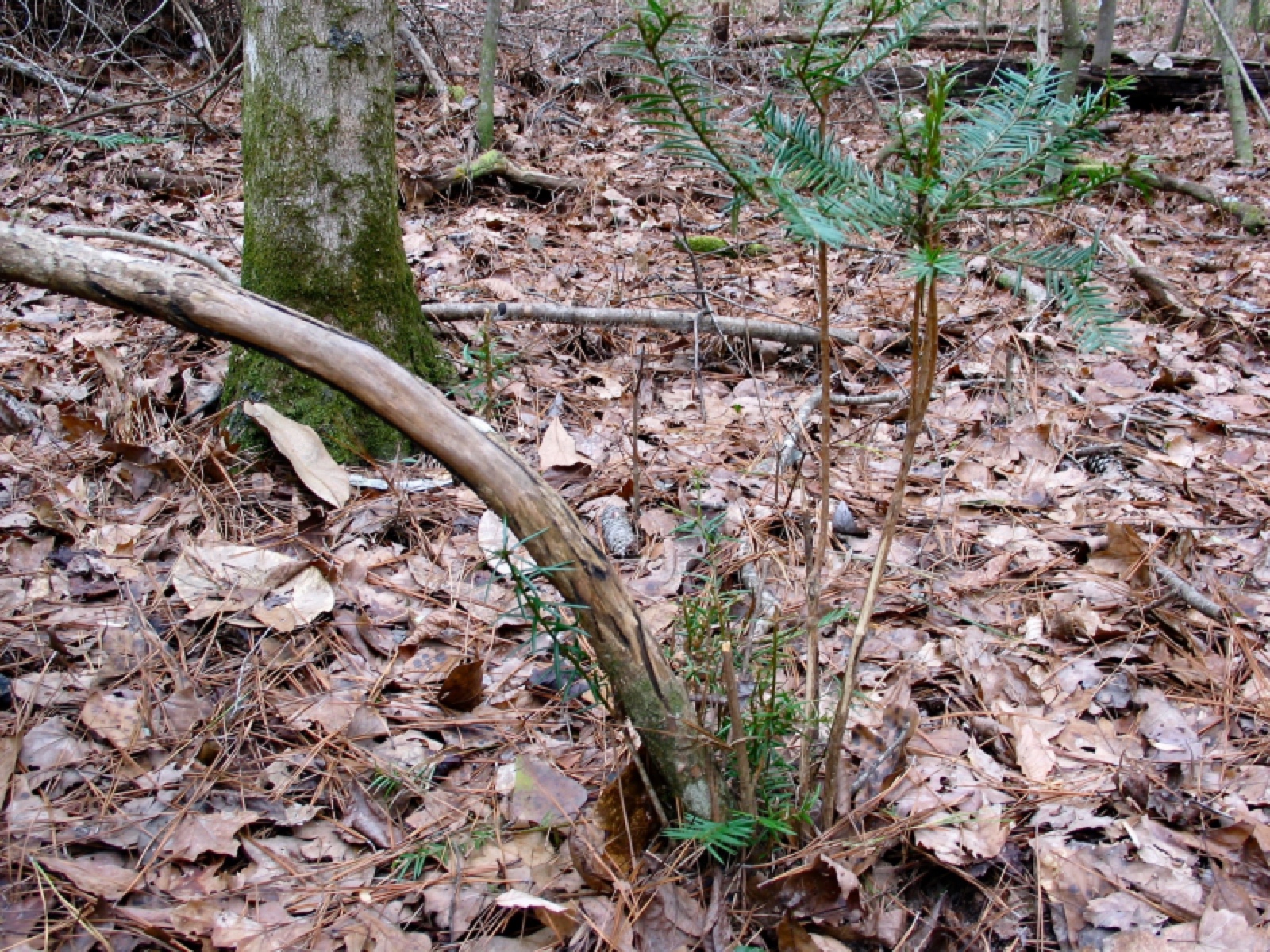
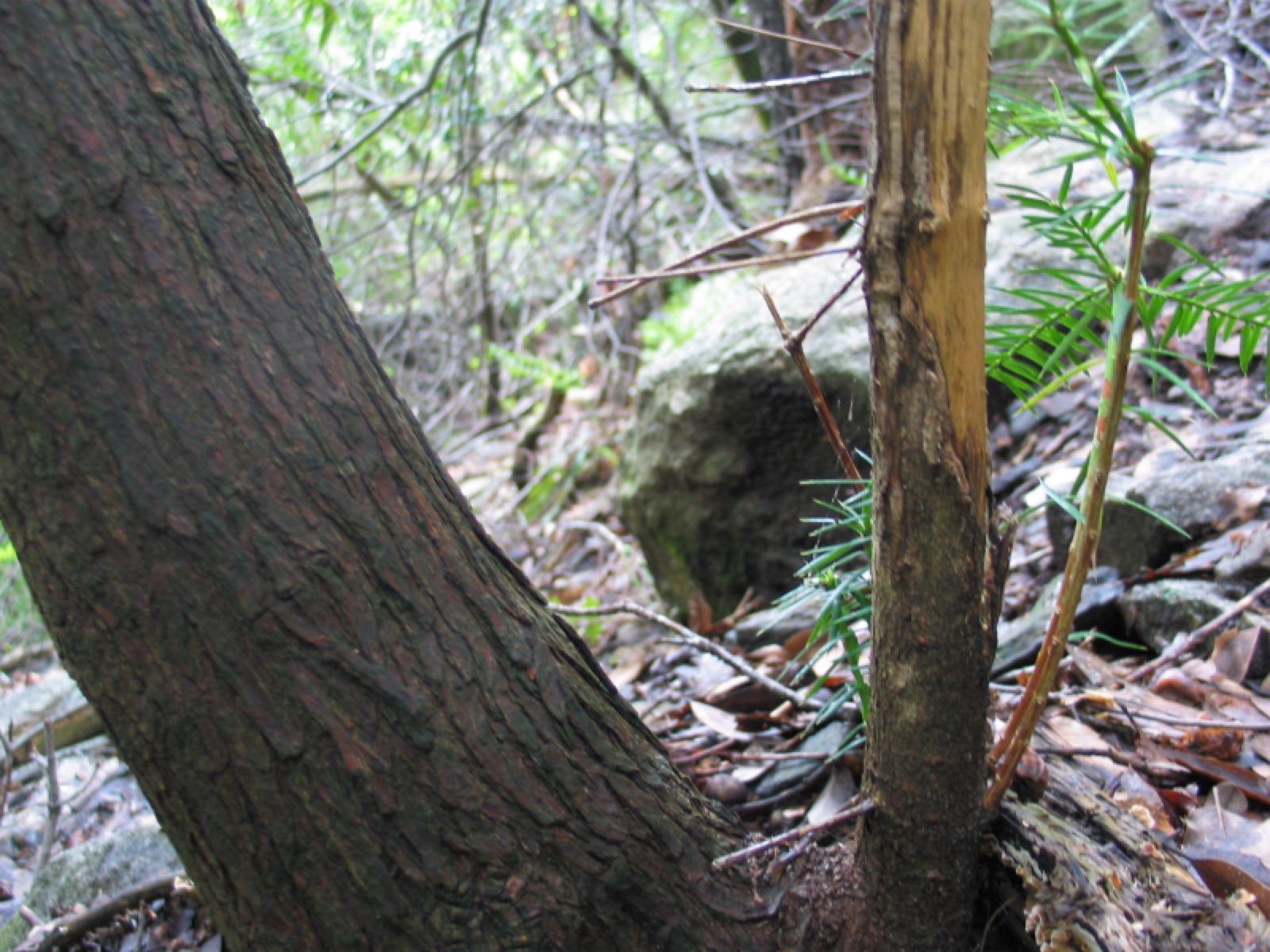
SPECIMEN #2 (January 2004)
Multi-stem regrowth Torreya near bridge over creek. Nearby large-stemmed trees include Bald Cypress, American Holly, American Beech, Southern Magnolia. The five remaining photos show close-ups of diseased areas of stems and leaves.
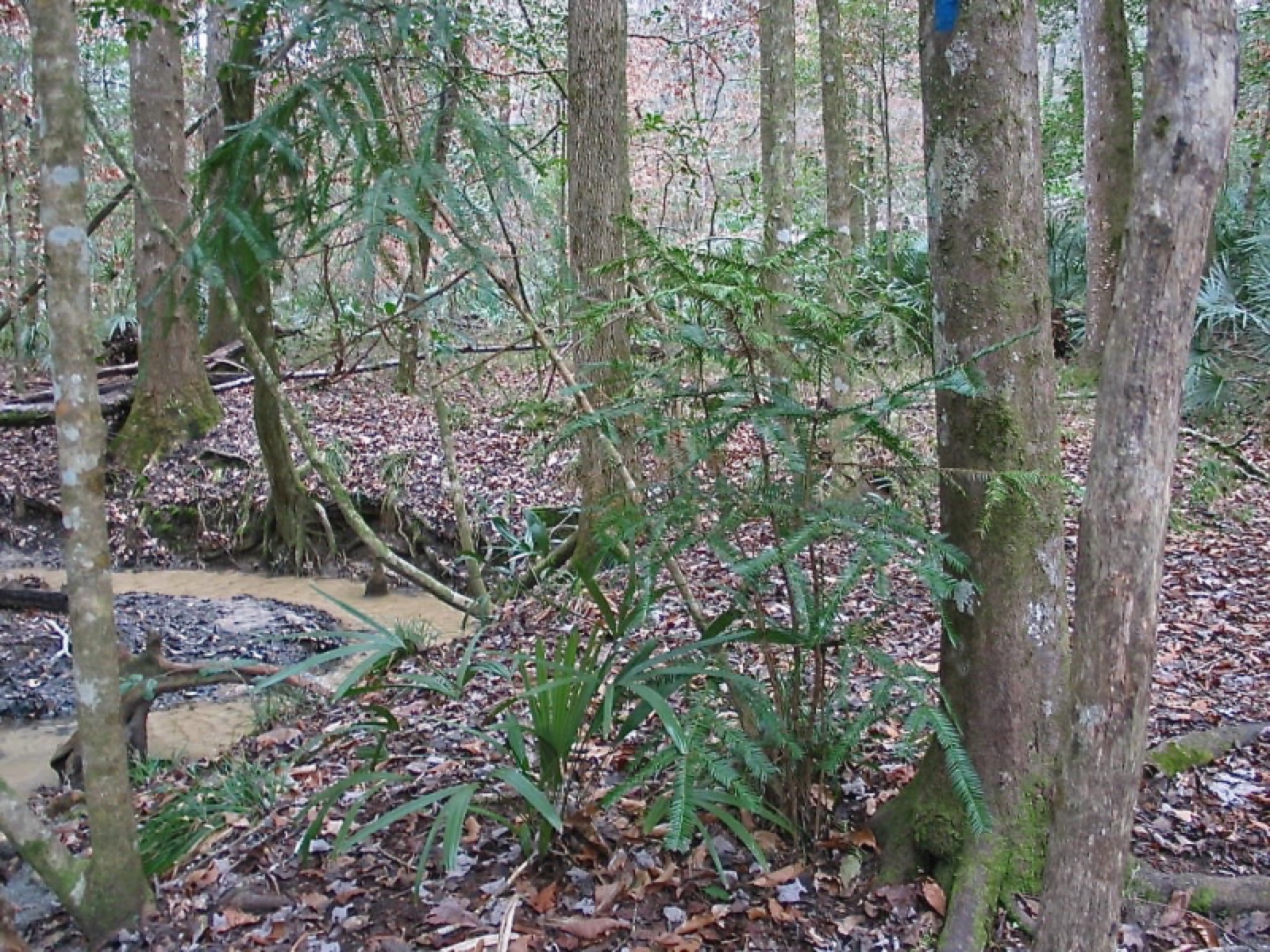
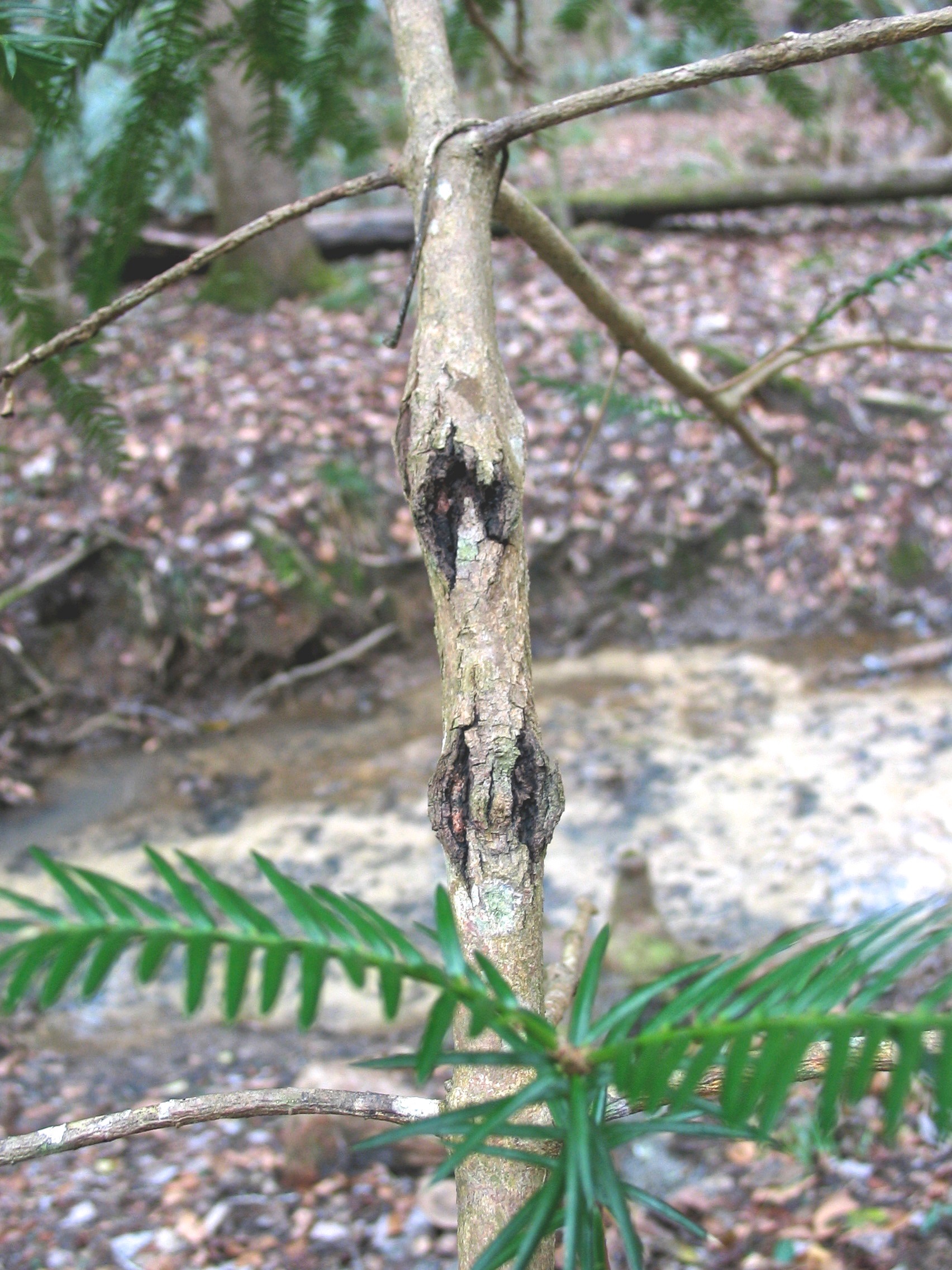
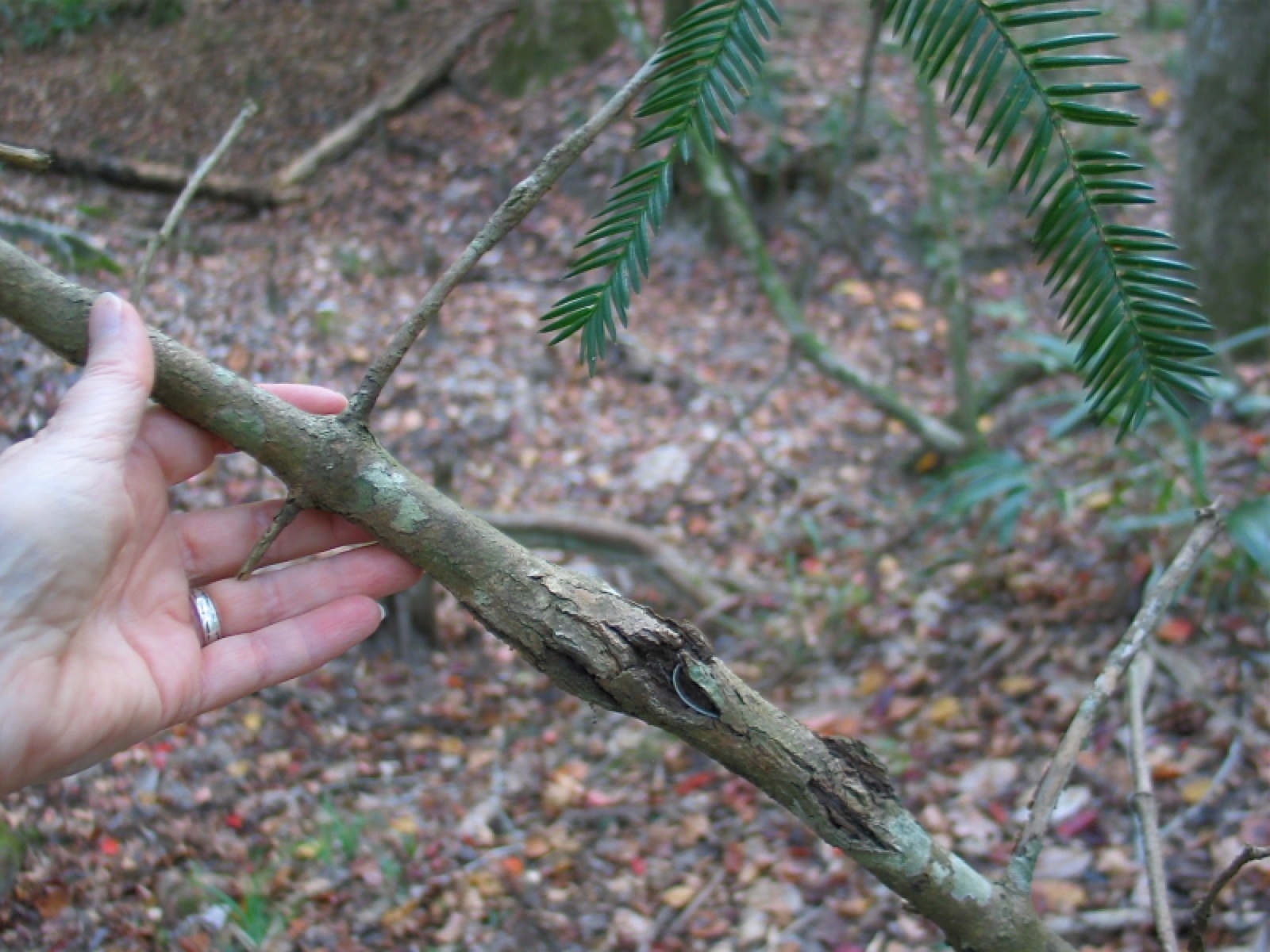
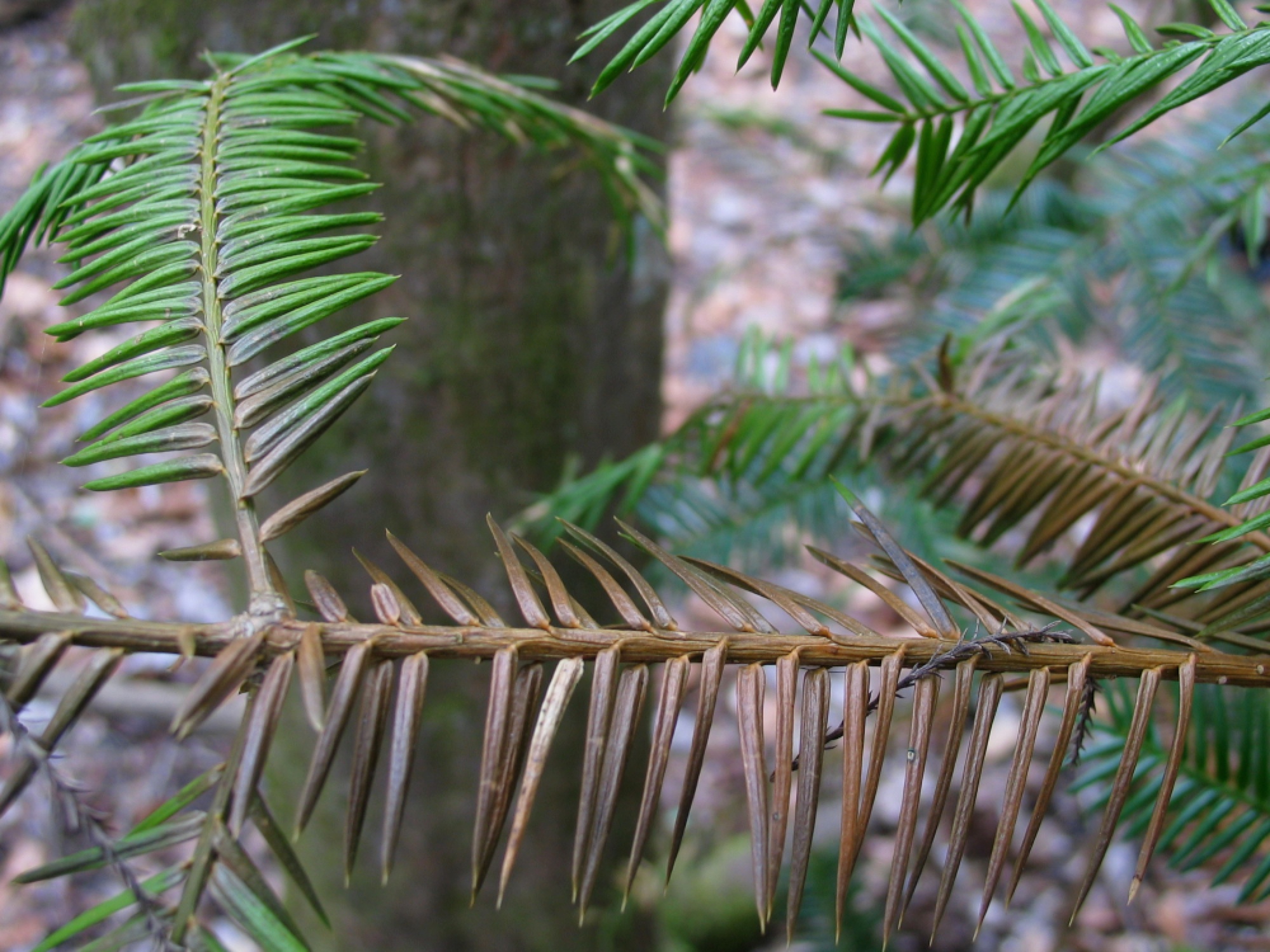
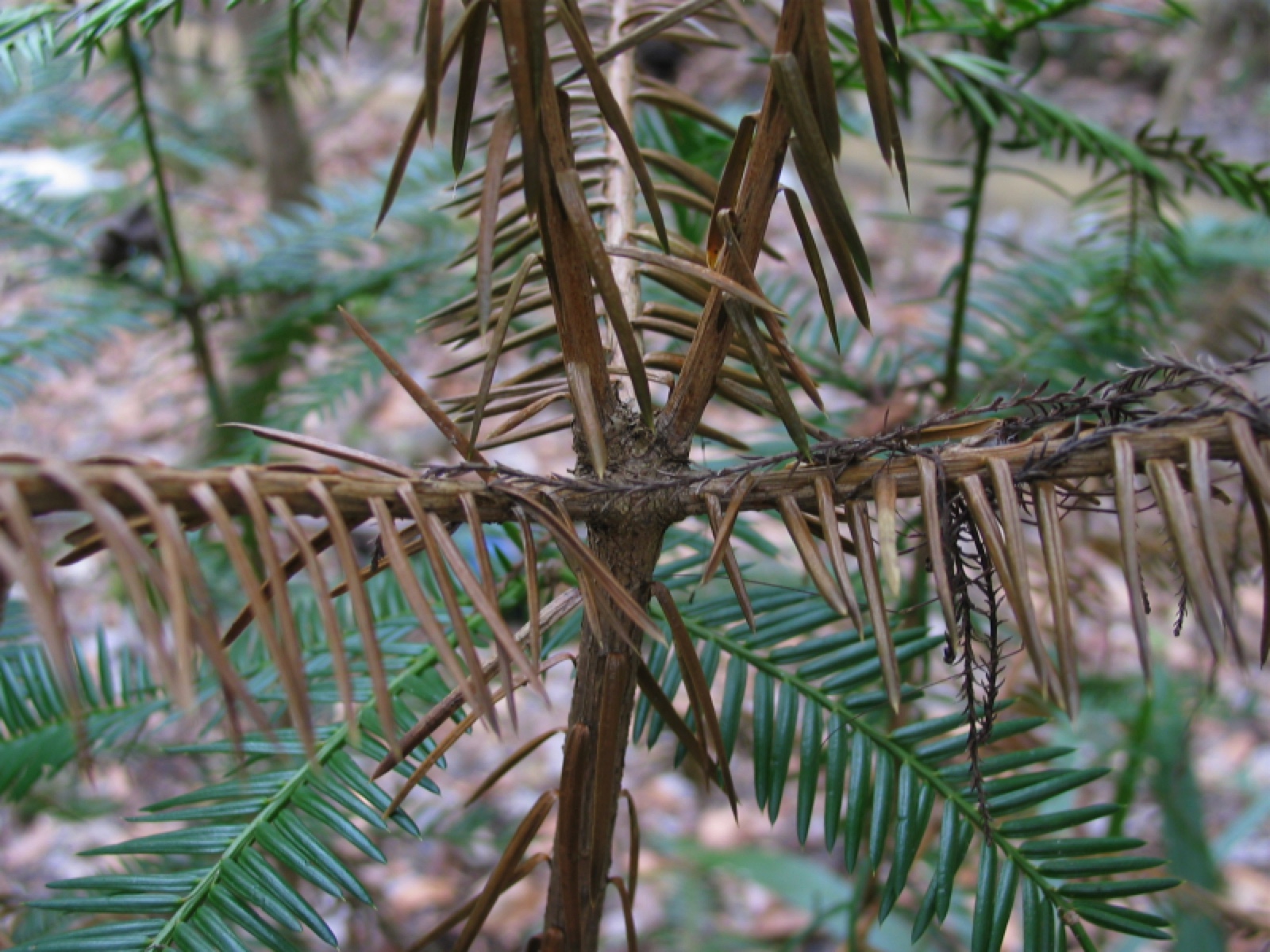
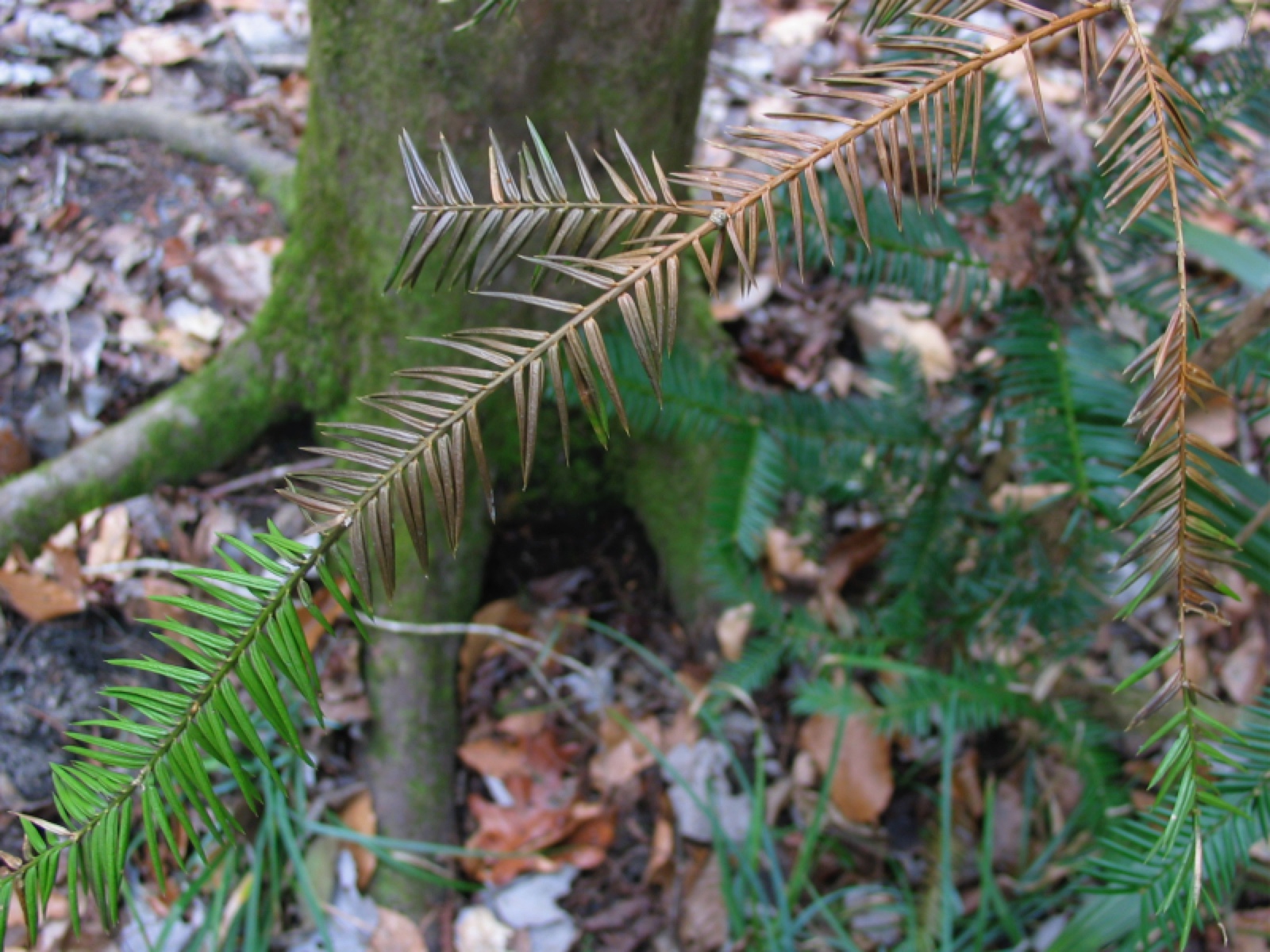
OTHER PHOTOS OF TORREYA IN TORREYA STATE PARK
Note by Connie Barlow: Two early contributors to professional field studies of Torreya taxifolia, Mark Schwartz and Sharon Hermann, published in 1999 a paper on their study of Torreya californica in the field: "Is Slow Growth of the Endangered Torreya taxifolia (Arn.) Normal?", Journal of the Torrey Botanical Society. Their final paragraph:
In aggregate, the results of this work suggest that the observed low growth rates of T. taxifolia might not be indicative of disease-induced stress. The similarity between T. taxifolia and T. californica growth rates and patterns is consistent with the hypothesis that T. taxifolia is growing normally within its environment. The infrequent expansion of terminal buds may simply be the way that these trees naturally grow in low
light environments. Evidence of suppression and release growth pattern in tree rings, along with a preliminary observation that trees in high light
environments grow more frequently than those in low light, support the hypothesis that growth in T. taxifolia is light limited. Given the continued lack of an identified primary disease agent, we recommend pursuing further tests of the light limitation hypothesis, and management to increase light levels above extant trees in the wild.
Barlow adds: This is a helpful paper. My own natural history observations in 2005 (at a greater number and diversity of sites than the quantitatively driven experimental approach undertaken by Schwartz and Hermann) would add two interpretations: (1) Genus Torreya evolved as a definitive sub-canopy species (as are other members of the yew family); presumably with the assistance of mycorrhizae it is capable of living a very long time in a seemingly stunted state, until a canopy opening enables growth and also seed production on the individual branches that can access sufficient sunlight. (2) With the rare exception of the immense Torreya trees found along Swanton Creek north of Santa Cruz (which is artificial, given that the canopy redwoods were removed in the early 20th century, thus artificially releasing a population of subcanopy Torreyas to grow tall and to seed), Torreya seems to do best on extremely steep slopes, where the usual canopy giants (Coast Redwoods and Douglas-fir) are not found.
Access my PHOTO-ESSAYS OF CALIFORNIA TORREYA GROVES or my 2-part NARRATED VIDEO OF TORREYA CALIFORNICA.
"Coevolution of Cycads and Dinosaurs" paper by George E. Mustoe, The Cycad newsletter, March 2007.
Barlow and Martin 2004 proposed that Torreya taxifolia might have gotten trapped in its peak-glacial pocket reserve (in northern Florida) for lack of its coevolved seed disperser, and thus was unable to geographically respond to the warming interglacial climate. The above paper suggests that another taxon of gymnosperm that thrived (along with genus Torreya) in the Jurassic period might have suffered from an inability to easily track climate change when the seed-dispersing dinosaurs died out.
|
Access in PDF two articles, for and against assisted
migration of Torreya taxifolia, published as the featured
Forum in the Winter 2005 issue of Wild Earth. Download
the pro and con articles separately for printing on standard
size paper. Or, for viewing the 2-article Forum as it
appeared in publication (wide-screen, with all illustrations),
download the "Forum."
|
FOR assisted migration, by Connie Barlow & Paul Martin
|
ANTI assisted migration by Mark Schwartz
|
FORUM (both articles for wide screen)
|
Standards for Assisted Migration (by Barlow & Martin 2004)
|
"Rewilding North America" — The 18 August 2005 issue
of the prestigious science journal, Nature contains an advocacy
article that proposes "rewilding" close-kin of some of the
large mammals that went extinct in North America at the
end of the Pleistocene, 13 thousand years ago. By comparison,
the proposal to "Rewilding Torreya taxifolia" looks mild! To access
this amazing article, you can view or download it at
http://rewilding.org/pdf/Pleistocene-Re-wildingNorthAmerica1.pdf.
|
• BACK TO MAIN TABLE OF CONTENTS
The Apalachicola as a Peak Glacial Habitat
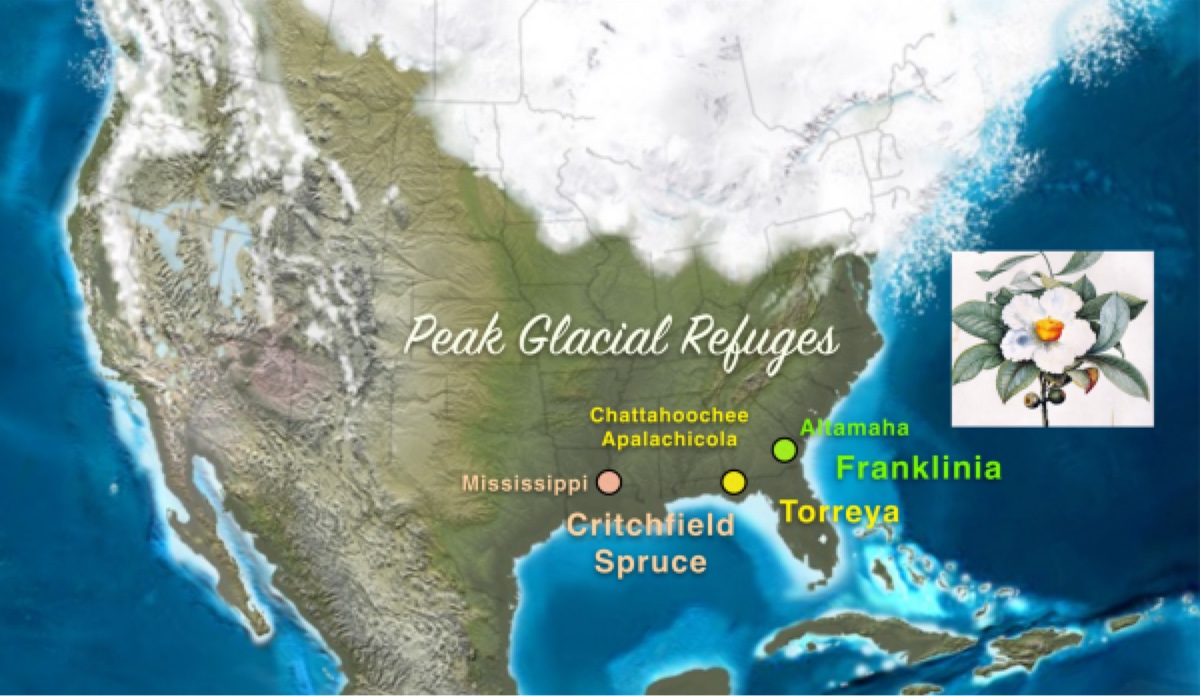
Palynologist Hazel Delcourt, botanist Rob Nicholson, and others have each independently concluded that the Apalachicola habitat in which T. tax is found is one of a small group of "pocket refuges" along the Gulf (and southern Atlantic) coasts in which the vast majority of warm and cool temperate plant species found crucial refuge when the Pleistocene continental glaciers achieved their peak advances during the past 2 million years. Without these refuges, it is likely that North America would have lost not only Torreya taxifolia but also its tuliptrees, sweet gum trees, bald cypress, hemlocks, and a host of shrubs and forbs (such as mayapple). How do we know this? Because Europe lost these species, presumably owing to unfortunate geography: southward migration blocked by the Mediterranean, Black Sea, Carpathian Mountains, etc.

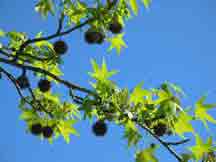
ABOVE left: Tuliptree. ABOVE right: Sweetgum
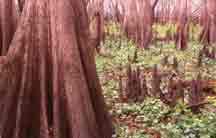
BELOW left: Bald cypress (Taxodium) BELOW right: Franklinia

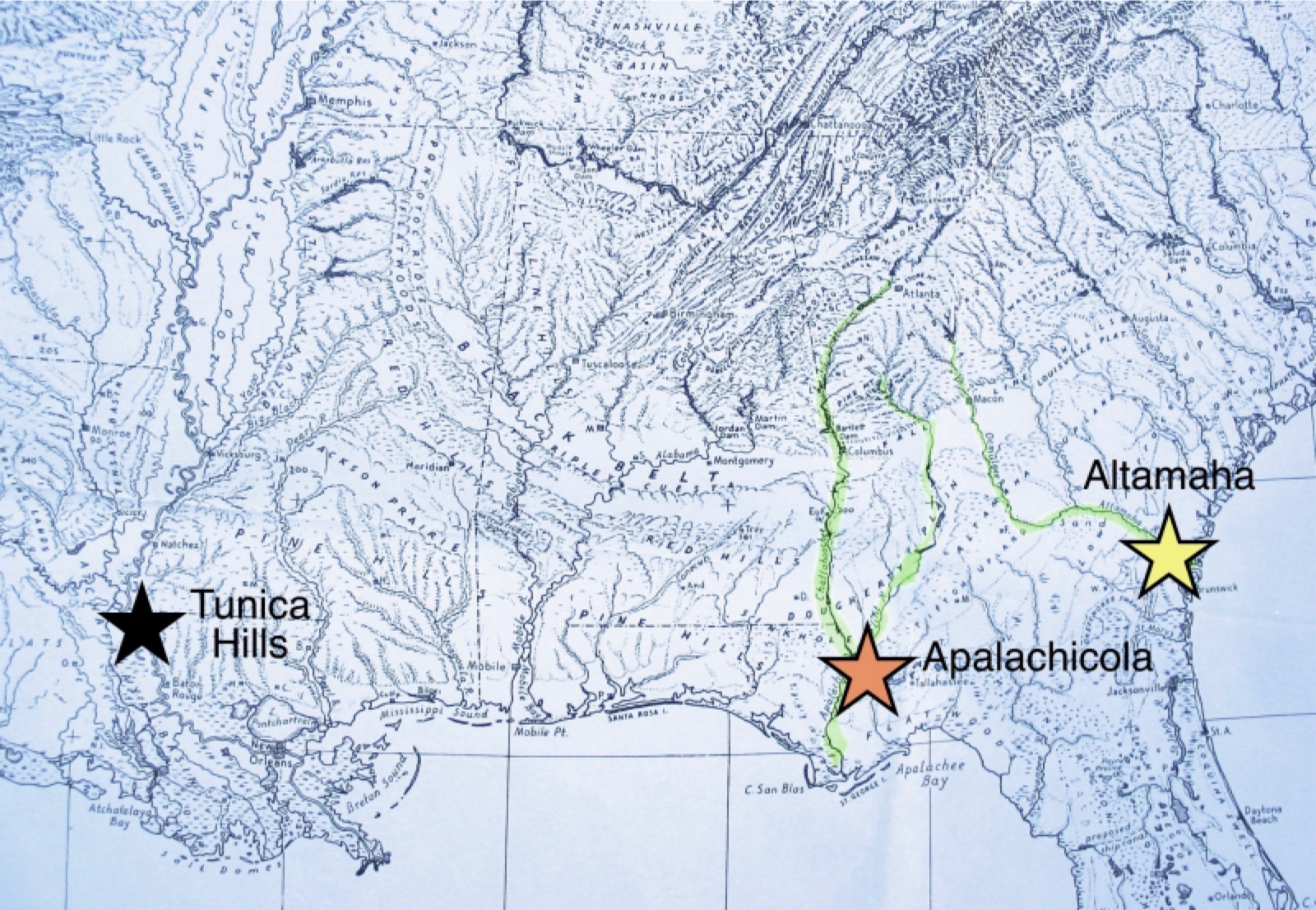
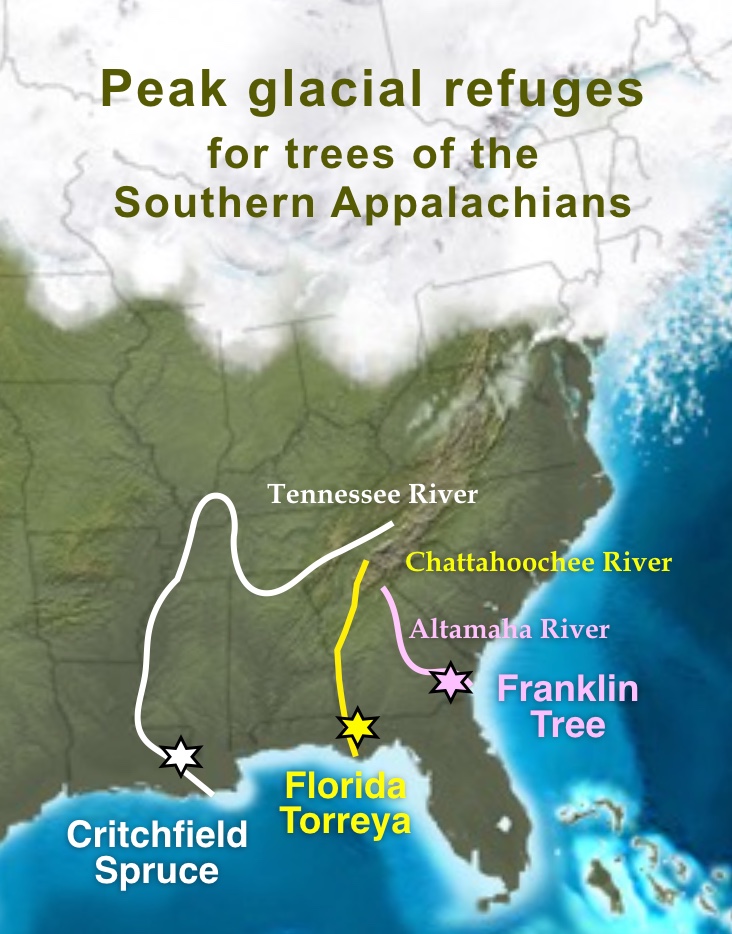
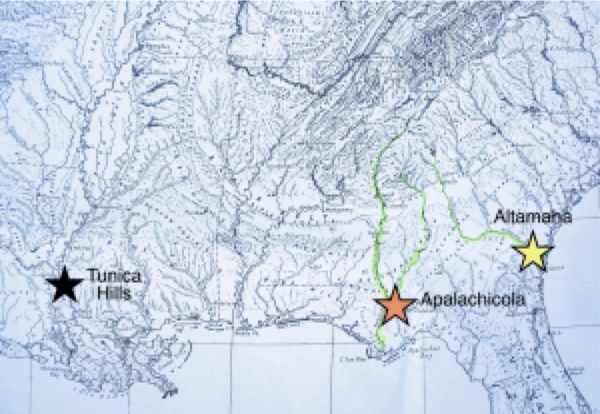
Indeed, the species name of Franklinia, Franklinia alatamaha derives from the only place this lovely tree was found — the Altamaha River of southeastern Georgia — before it vanished from the wild. The Altamaha River thus joins the Apalachicola (and the Tunica Hills of Louisiana) as a peak-glacial pocket refuge for plants of eastern North America.
ABOVE: Two of the three crucial peak-glacial pocket refuges include the Apalachicola River of the Florida panhandle and the lower reaches of the Altamaha River of southeastern Georgia (both shown in yellow; orange denotes the section of the Apalachicola containing T. tax).
|
|
|
"A Remarkable Colony of Northern Plants Along the Apalachicola River, Florida, and Its Significance"
by H. C. Cowles, 1905
Report of the Eighth International Geographic Congress
Held in the United States
KEY SECTION:
"In this association one finds two of our most notable endemic plants — Torreya and Croomia. It seems likely, then that we should regard Torreya taxifolia as a northern mesophytic left stranded to-day only in Florida.
"It presumably is one of the plants that failed to follow up the last retreat of the Pleistocene ice, and is preserved here perhaps because of exceptionally favorable topographic conditions."
|
Where Should "Native" Range Be During an Interglacial?
If the Apalachicola is, in fact, peak-glacial habitat for Torreya taxifolia, then we might conjecture that, for some reason, Torreya taxifolia (as well as the equally endemic, though not equally stressed, Florida yew) was unable to migrate north in tandem with a warming climate during the past 15,000 years. Thus where might its "native" range be at this point in an interglacial?
Return to HOME PAGE