Rewilding Torreya taxifolia
Status of Rewilding Project
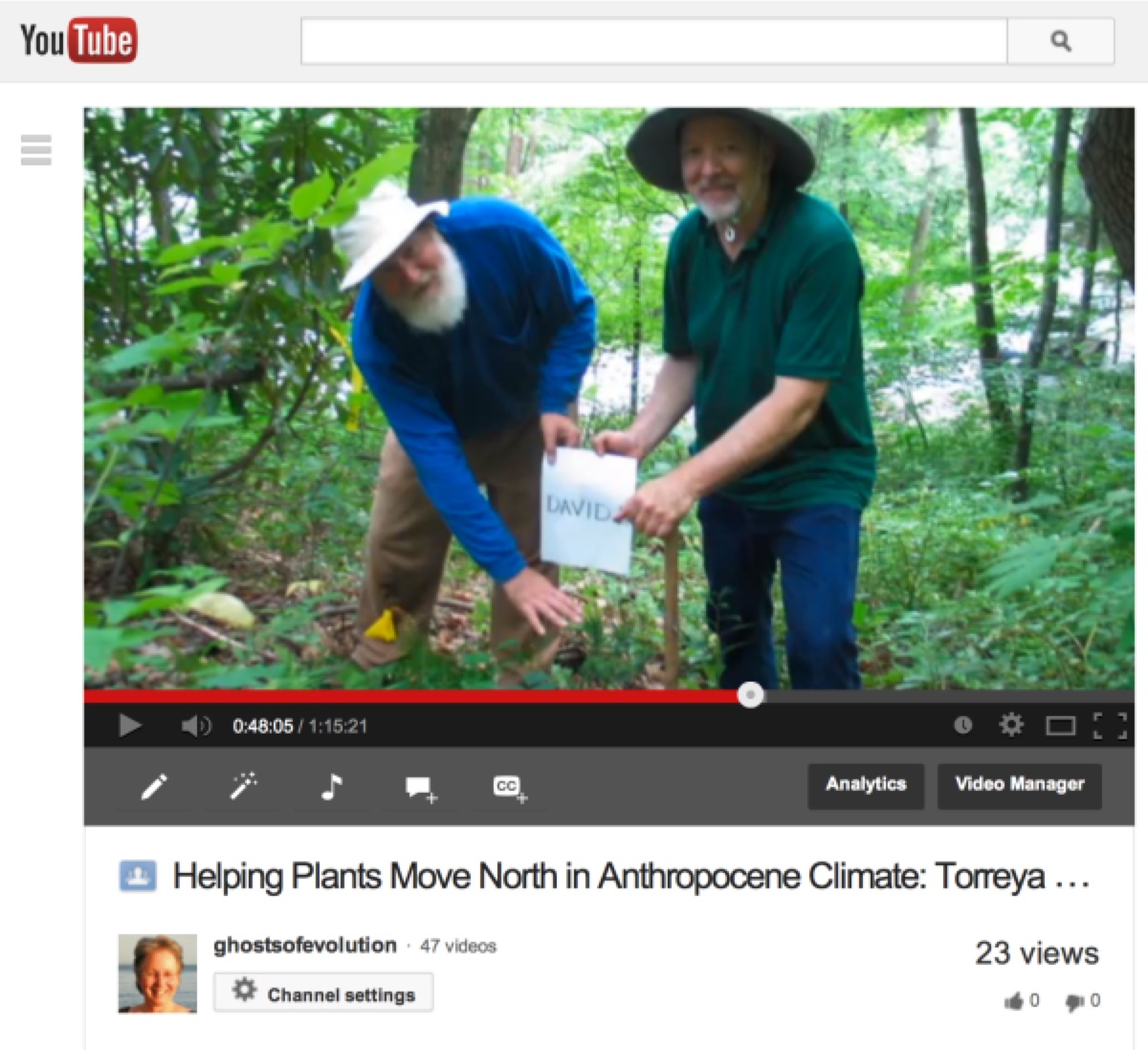

are posted within the LEARNINGS webpage
"Assisted migration" for climate-endangered Florida Torreya inadvertently began 90 years ago, when botanist Thomas Harbison planted this conifer species on his mountainside land in Highlands, NC. April 2015, Torreya Guardians documented this gone-wild grove — likely, the best and oldest example of how this ancient native lineage grows beneath a deciduous canopy and its slow dispersal by squirrels. Connie Barlow narrates with camera; Jack Johnston explores and measures the Torreya grove and surrounding plants.
First video-documentation of fate of historic 2008 rewilding action of the endangered Torreya taxifolia from Florida to North Carolina. Connie Barlow films and narrates a survey of the 21 plants in wild forest on the slope of Eaglenest Mountain, near Waynesville. Most important results are both positive and negative, which help us ascertain the habitat preferences of this species (moisture, shade, slope, aspect).
Thomas Mesko receives 43 Torreya taxifolia seeds from Connie Barlow, drawn from the 2014 harvest of Torreya Guardians. This video documents seeds being planted generally on north-facing slopes, between 1,600 and 1,800 feet elevation on Thomas's 50 acres of forested property along Wolf Creek, in the North Carolina section of the Ocoee Watershed.
Clint Bancroft shows Connie Barlow the 9 Florida Torreyas he has planted on his 18 acres in southeastern Tennessee (plus 2 more in pots). At 1,100 ft elevation, and in a mixed deciduous/conifer forest, all the Torreyas look healthy. In closing, Connie gives Clint 40 seeds from the fall 2014 Torreya Guardians' harvest. Clint demonstrates his rodent-proof outdoor shelter for germinating those seeds.
Thus, a new page of "assisted migration in MICHIGAN has been added to the website. Go directly to the 30-minute video of the Ludington seed planting experiment.
Connie Barlow led field assessment work on April 23 and 25 of the seedlings we had "rewilded" in 2008 to Waynesville and Junaluska mountainous habitat in North Carolina. Lee Barnes, Michael Dowd, Sara Evans, Janet Manning, and Jane Stoffer also helped with the fieldwork. Our findings were three-fold: (1) Corneille Bryan Native Garden plants are thriving;
(2) Mixed survival rates at Evans property; and (3) leaf bud counts formed the basis of a new quantitative data format, on which we invite others to pose interpretations and recommendations. The 2013 data in table format can be viewed on the "learnings" page of this website.
In May 2010 USF&WS staff overseeing the recovery plan under the Endangered Species Act for Torreya taxifolia gathered a meeting of researchers, managers, and landowners to review their actions to date and recommend future actions for an update of the recovery plan. Though not active within the terms of the management plan, Torreya Guardians was invited to participate, so Russell Regnery and I (Connie Barlow) listened and shared our thoughts by phone call-in during the day-long conference. We felt welcome and well heard. Afterwards, I decided to follow-up with print commments of my own and to alert several scientists with expertise in this realm of the opportunity to send in comments as well. Two did so. I have added a new page to this website titled, Torreya taxifolia Recovery Plan Under the Endangered Species Act: Spring 2010 solicitation of comments on assisted migration, which contains six links, including: Comments by Connie Barlow; Comments by Prof Sarah Reichard; Comments by Josh Donlan (of Advanced Conservation Strategies).
Mike Heim's photos with captions and his accompanying essay in PDF on his "Tertiary Rewilding in Northern Wisconsin" have now been posted on this website. Genera being tested onsite include Torreya, Taxus (floridana), Taxodium, Ginkgo, Cephalotaxus, Shortia, and more. Heim takes a deep-time perspective in assessing which genera might have been "native" to northern Wisconsin in past interglacials and even more distant warm times.
During the winter 2009/10 one Torreya dropped needles and died after a growing season in the ground. Three had roots eaten away by voles and toppled due to the rootless condition. None of the Biltmore fall 2009 seeds have germinated to date. [Jack is stewarding 50 of those seeds on his property in NE Georgia. Torreya seedlings commonly require 2 winter season before they will germinate.]
A few rooted cuttings from last fall are green but have no new growth. I expect some to grow later. The total count of seedling trees here is 24. The tallest tree is about 2 feet. [Editor's note: Jack Johnston's work with Torreya is feautres in the May/June 2010 issue of Audubon Magazine, in the article titled "Guardian Angels".]
Click for the detailed Report of 2009 Seed Distribution filed by Lee Barnes.
I went by Sara Evan's property on Eagles Nest to check the Torreya. All but two looked great. The snow did not knock over the plants quite as much as at the Bryan Nature Garden. I'm guessing the snow was not as "wet" at the higher elevation. My friends at Grass Roots nursery near Junaluska measured lows of 0 degrees F., but I don't think it was quite as cold at Lake Junaluska. I measured 9 degrees F. as a low on the porch at my house in Waynesville. By the way, Lake Junaluska is mostly frozen over; I think I've only seen that 2-3 times in the last 30 years.
"I just cleaned 301 seeds that are ready for distribution. There were 115 "floaters" and 186 "sinkers." I've downloaded Connie's list of Torreya Volunteers and also will look at my list of geographically important volunteers and Botanical Gardens that were sent poor quality seeds in the past (we really need folks with facilities to germinate and raise seedlings for several years prior to transplanting into the wild.) I'm wanting to get seeds out so that folks can stratify in situ, fluxuating day/night ground temperatures (per Determann's recommendations). I'm a little concerned about the large number of "floaters" (seeds that float in water), but personal communications with Dr. Ed Croom indicates his contacts with Maclay Gardens (FL) who had good germination with floaters.
UPDATE: We received notice that of the autumn 2009 seed crop from the Biltmore that we distributed, 4 of the seeds distributed to an arboretum in Switzerland germinated in the spring of 2011. Among those 3 had been "floaters" and 1 was a "sinker."
"We collected 300 (more or less) seeds from our Torreya trees this fall." [Note: Connie Barlow and Lee Barnes responded in the affirmative that we are interested in distributing those seeds.]
Final report is that no Torreya taxifolia seedlings germinated for 2009. I lost one of last year's small seedlings (from 2008 seed harvest) to voles. All other seedlings (from 2008 harvest) are prospering.
An article by Sidney Cruze reports on the assisted migration issue in the context of the actual plantings of "Florida" Torreya that Torreya Guardians did in North Carolina (Waynesville area) exactly one year ago. (The article cannot be accessed online.)
I finally got up to the Evans property site to check on the 21 Torreya taxifolia seedlings we planted there July 2008. All look great, including the "runt" of the original transplants. I'm enclosing some photos of the Torreyas there, including the seedling named Celia, who just missed getting hit by a fallen branch. In general, the plants at this location were with 2+ inches of new growth, a bit less than growth at Lake Junaluska (site number 1 of the 2008 Waynesville seedling plantings), presumably due to higher elevation and slightly later bud-break.
I'm sad to report that we have lost a total of 3 of the ten Torreya seedlings at Lake Junaluska [planted as seedlings July 31, 2008]. The loss appears to be from voles eating the bark. I'll send some photos when I get a chance. We are placing short wire-cages of 1/2 inch hardware cloth/rabbit wire around the remaining plants there. I'll try to get up to the Evans property set of trees in the next few days to report and get some photos. The remaining plants at Lake Junaluska have flushed out with 3-4 inches of new growth. The plants in the sunny area are doing the best, or at least seem to have the thicker foliage.
Seedling No. 31, "Celia," was donated by Atlanta Botanical Garden. It grew from one of many seeds produced by the Garden's "potted orchard," which was grown from branchlets harvested in 1991 from living original, wild trees in the Apalachicola pocket reserve. The branchlets were cloned, so this particular seedling represents the first generation of captive produced seeds from the original wild genotypes.
Editor's Note: Russell will be sending more information and photos of the site and plantings, so that we can put up a webpage dedicated to following events at this additional new site for assisted migration.
Squirrel pressure at Smithgall is tremendous. They will take every seed. I'll try to harvest seeds, of course, but it is hit or miss as to how many and how ripe they may be. I must harvest early due to squirrels.
Lots was happening leading up to that historic event. You can gain a sense of the preparation by viewing the CHRONOLOGY of events leading up to the rewilding action.
Also, an important academic paper, "Assisted Colonization and Rapid Climate Change," was published July 18 in the world's premier scientific journal, Science. You can learn about that document and the media attention it unleashed by visiting, our ANNOTATED LIST OF ARTICLES ON ASSISTED MIGRATION.
That paper also signalled a shift in terminology. What once had been "assisted migration" now is "assisted colonization." You can sample the arguments for and against the shift in terminology at our What's in a Name? webpage.
EMAIL SENT TO ALL FRIENDS OF TORREYA GUARDIANS
Dear Torreya Guardians,
PS from Connie:
In early December 2007, I visited Ron Determann and David Ruland at the Atlanta Botanical Garden and toured their Torreya taxifolia propagation facilities. Most impressive! I have added to this website a catalog of advice for propagating this endangered tree from seeds and from branch cuttings, and have embellished the page with lots of photographs.
This month I received inquiries from 2 print journalists and 1 radio journalist who wanted to learn more about our efforts to rewild Torreya taxifolia. It seems that with the new interest in assisted migration in a time of global warming, journalists are looking for some actual instances of people actually intentionally doing it, in behalf of a species. Well, we are the closest it comes — and yet we aren't quite doing it yet either. With the little seed stock of this highly endangered plant that we have access to, we are still at the stage of passing seed on to individuals and institutions who commit to nurturing groves of this species. Not until those groves start producing seed themselves will we have enough seeds to gamble on planting some in wild forested landscapes on private lands, where they can grow (or not grow) as circumstances allow, and so that squirrels can become natural dispersers of the 3rd generation seeds, rather than us.
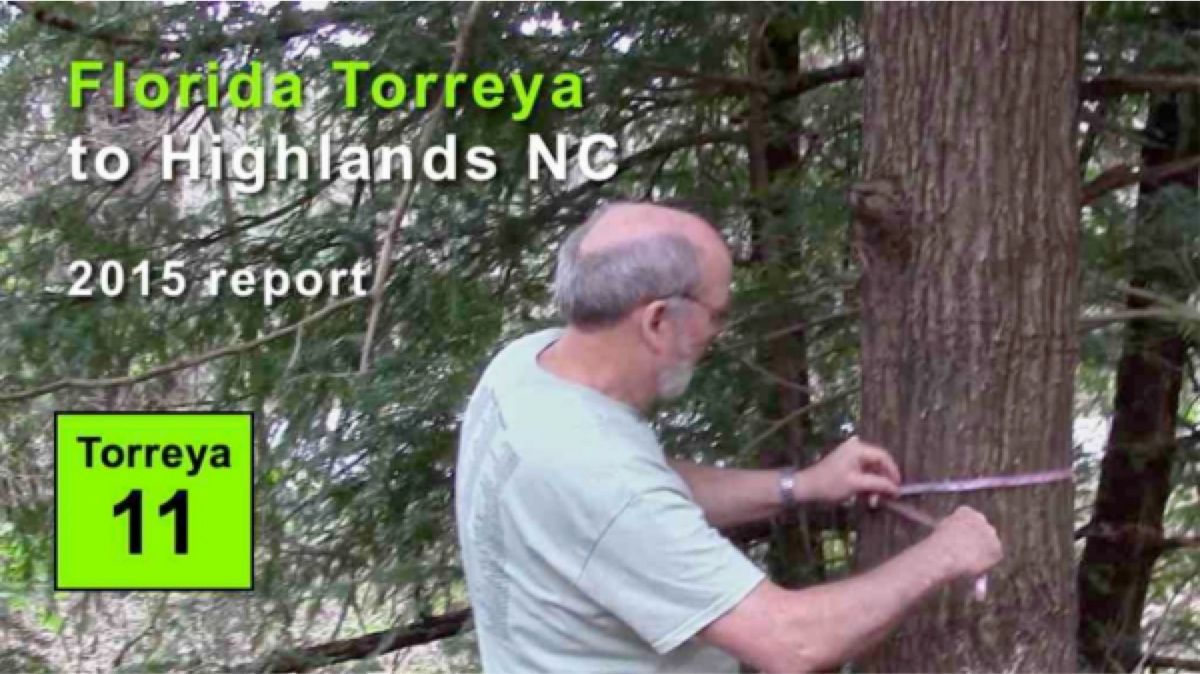
11: FL Torreya to Highlands NC: 90 years of de facto rewilding (2015)
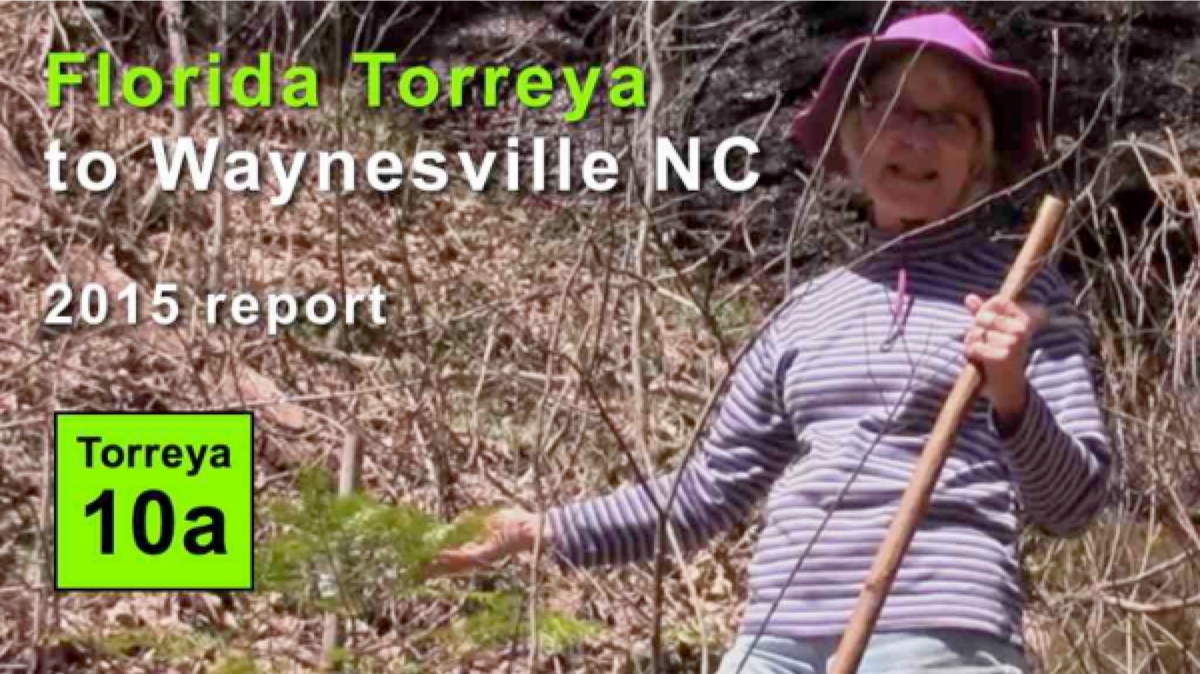
10: FL Torreya to North Carolina: 2015 progress report (Waynesville, NC)
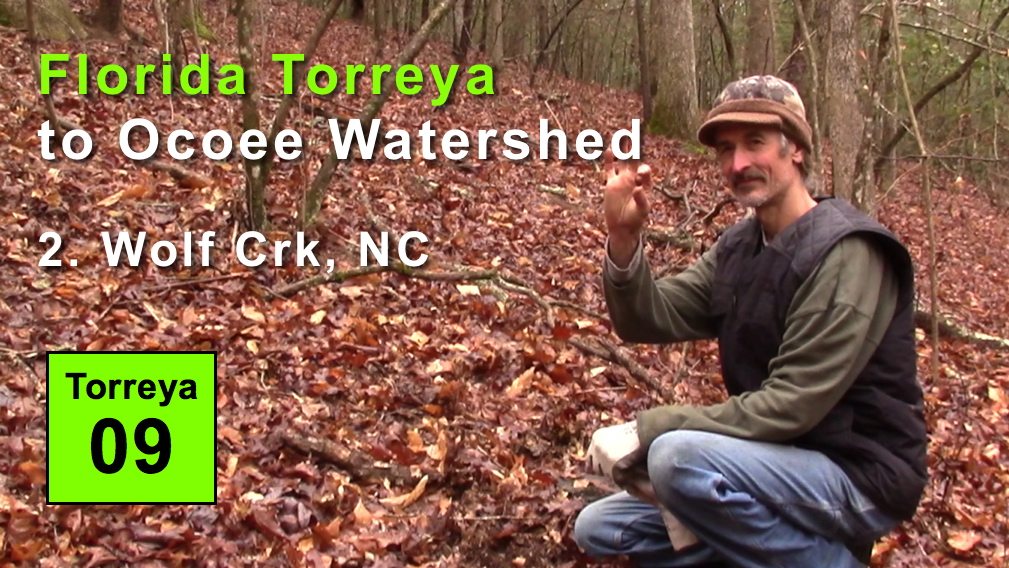
09: FL Torreya to Ocoee Watershed 2: Wolf Creek, NC 2015
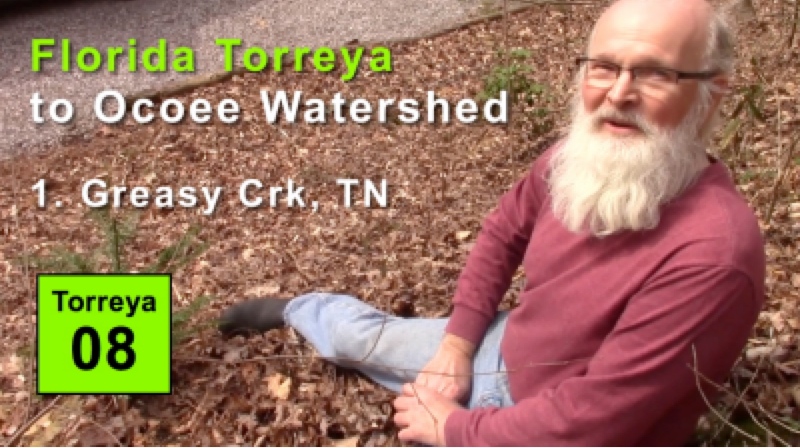
08: FL Torreya to Ocoee Watershed 1: Greasy Creek, TN 2015
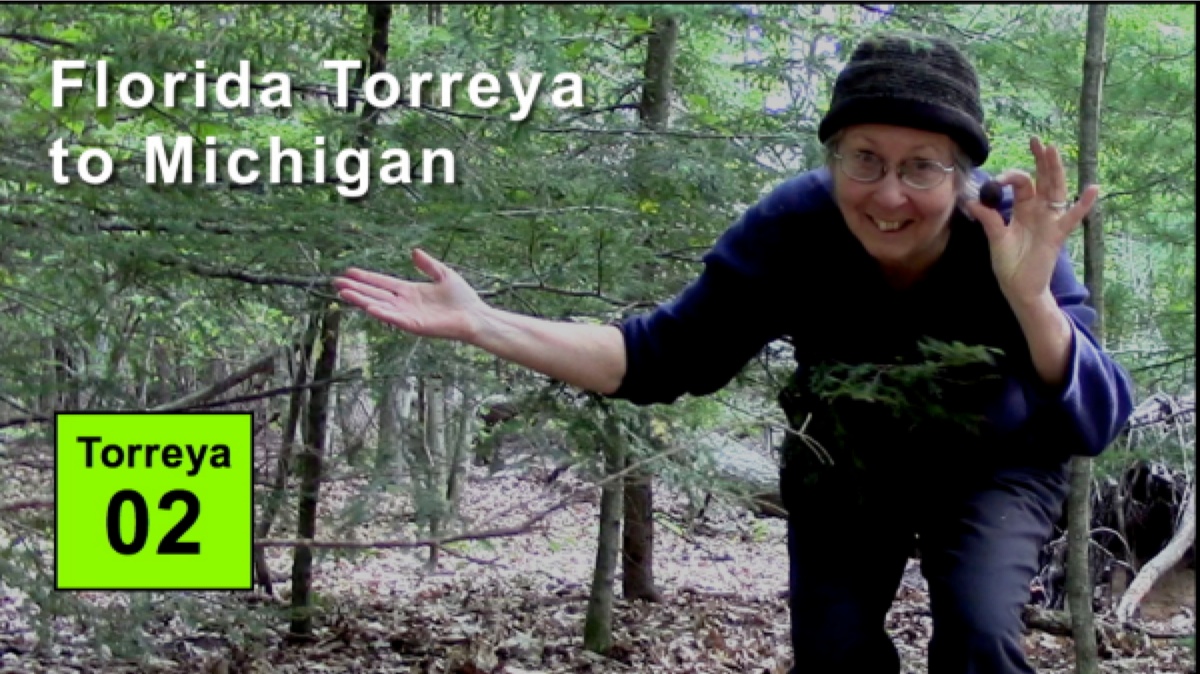
Connie Barlow planted 30 seeds from the autumn 2013 harvest into a private regrowth forest near Ludington Michigan in September 2014. Halsey Barlow had already planted 40 seeds in the spring of 2014 into her father's regrowth forest near Alpena Michigan.
Following a voluminous 2013 harvest of seeds accessible to Torreya Guardians, I decided to experiment with planting seeds directly into naturally forested landscapes. In prior years, recipients of seeds have germinated their seeds in pots or soil patches protected from squirrels by wire mesh and other devices — as the seeds may take several years to germinate naturally, and during that time squirrels tend to dig up the seeds (as squirrels find Torreya seeds tasty). So I experimented with 3 ways to use natural materials to prevent predation by squirrels. The 3 methods are: (1) burial beneath a log, (2) cover the buried seed with a rock, and (3) protect the buried seed with a thatch of branches. Because the seeds are very large and thus contain a store of energy, it should be no problem for a germinating seed to grow sideways 6 inches underground before it finds an opening to turn upward and reach the air. Click to see photos of the 3 methods of natural protection against squirrels.
In late October I was able to accomplish in North Carolina:
Seeds from the 2013 fall harvest, available for germination and planting by Torreya Guardian volunteers.
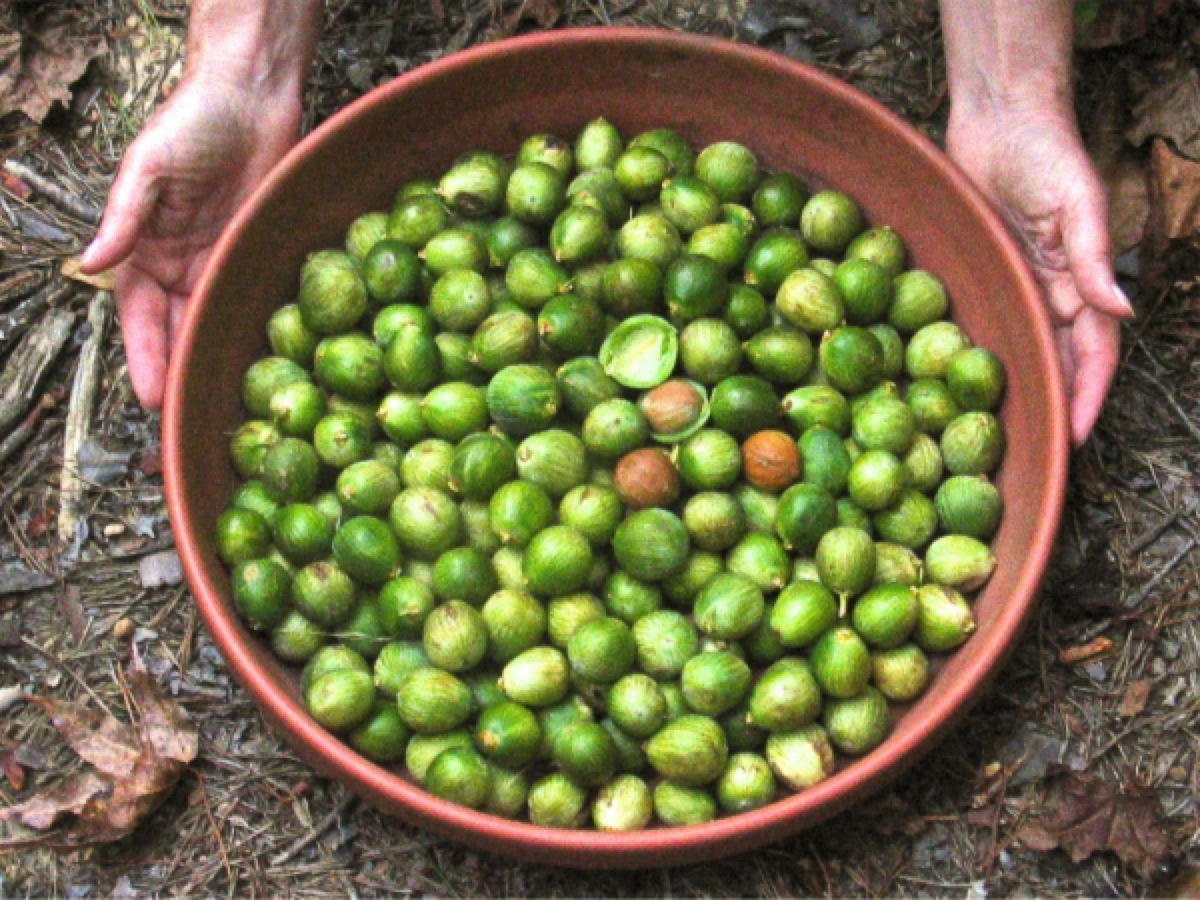
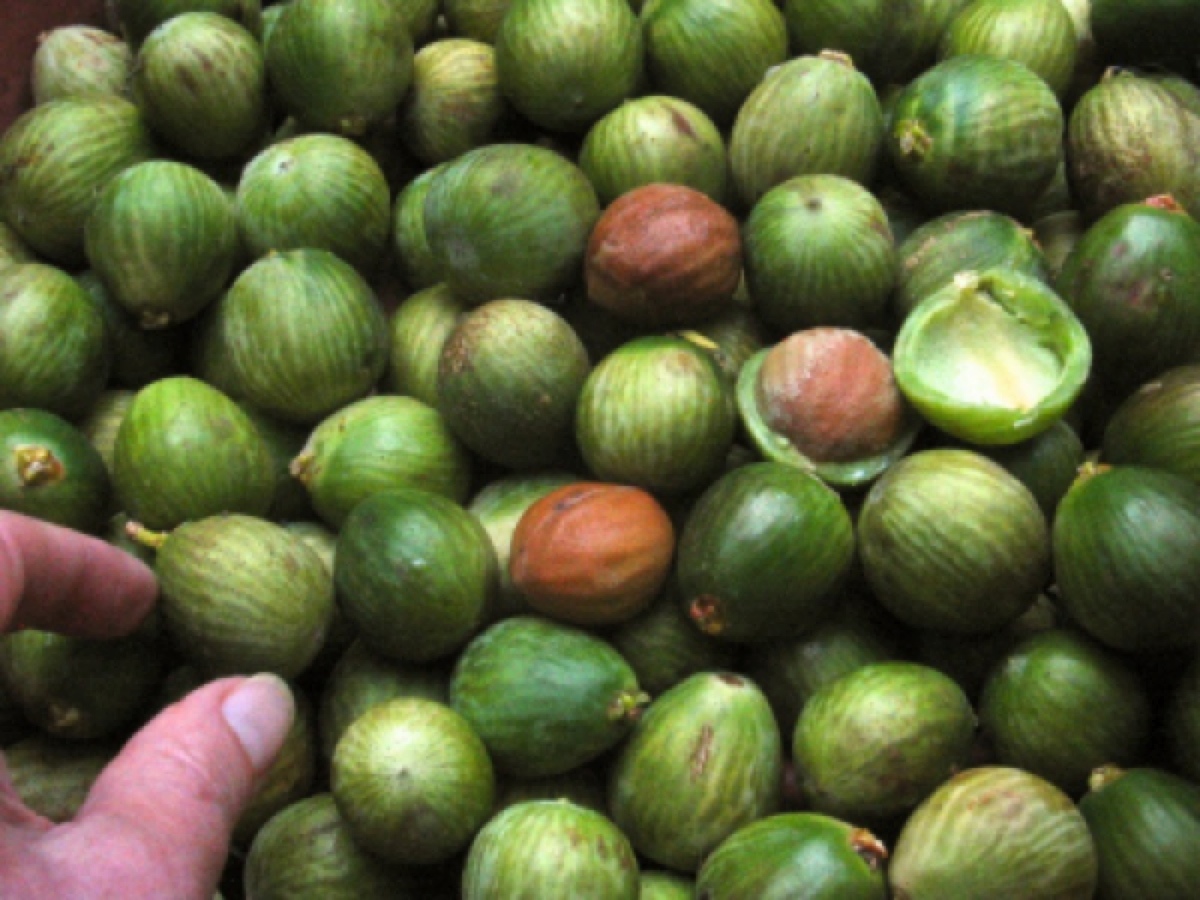
Zev Friedman, with Living Systems Design" in Asheville received 200 seeds from the fall 2011 harvest. Because Living Systems Design "supports landowners and local communities in restoring prosperity and abundance to the places we all live", Zev's idea (for clients he works with who have forested lands) is to see if Torreya taxifolia can take the place of the once-magnificent hemlock trees that have died off in the mountains of North Carolina. As of August 2013, Zev reports, "I've got approximately 60 Torreyas coming up from the 2-year old seeds, so am going to be distributing those soon!
Summary: Strong growth of the 4 seedlings planted in full sun; poor results for the one specimen planted in the shady woodlot. The single specimen planted from a rooted branchlet is branching out nicely. Seeds from the fall 2011 harvest that were planted in the nearby Secrest Arboretum (Wooster, Ohio) are beginning to put down roots (but no above-ground growth yet). See photo essay on the Ohio page.
"Seeds were not planted until December 2011, and two had started to germinate before I planted them. I had kept them in a ziploc bag in my basement. Seeds were planted in two outdoor seed beds — one at the garden and one at home (ten each) — in about 3 inches of fafford germinating mix, layered over 6 inches of a mix of old and new potting soil. The 2 pre-germinated seeds were among those planted at the garden. All of the 5 seedlings are in the bed at the garden. The seedlings are about six inches tall. I am hoping to have more come up in the spring of 2013." ADDENDUM: By late April 2013, 7 more seeds had germinated outdoors. Check out the photos of this on the PROPAGATION page.
Following our usual protocol, 4 of the landowners received 20 seeds each, while Zev Friedman received 200 for the second year in a row. Zev is a permaculture and forestry consultant in the Asheville NC area, who is collaborating with many private forest owners in the region for testing Torreya taxifolia as a possible (once-native) replacement for dead and dying hemlock trees in the region.
Following the photo-documentation during the site visit made to Waynesville (and Junaluska) in late May 2012, 15 Torreya seeds from the 2011 harvest were individually planted by Connie Barlow in favorable habitats upslope of the 21 seedlings introduced on the Evans property in 2008. Access a photo-essay of the 2012 seed planting.
In late May 2012 Connie Barlow and Lee Barnes (along with Sara Evans) made a site visit to the 21 seedlings planted in 2008 on the Evans property near Waynesville NC and the 10 seedlings planted in 2008 in Junaluska NC. Connie took many photographs and has updated both the Waynesville main page and the Junaluska main page, along with the webpages focused on each specimen. She also has posted, for the first time, an aggregate status report of WHAT HAS BEEN LEARNED to date about Torreya taxifolia habitat preferences, and what questions remain.
[excerpt from the April 2012 newsletter of the Land Trust for the Little Tennessee River "On a beautiful spring morning, Boy Scouts from Troop 235 recently helped plant 31 seedlings of "Stinking Cedar" (Torreya taxifolia) at LTLT's Tessentee Bottomland Preserve (in North Carolina). Naturalist Jack Johnston provided the seedlings, which he grew from seed at his home in northern Georgia. The Scouts, Dylan Ford and Joel Rogers, worked under the direction of Jack and LTLT's Dennis Desmond. Scout leaders Conda Bradley and Peggy Pyeatt also assisted, as did LTLT member Russ Regnery. Jack and Russ are part of a loosely organized group who call themselves the Torreya Guardians. The group is working to move this tree species to cooler climates. Known more commonly today as the Florida torreya, the conifer is poised on the brink of extinction in its tiny native habitat, the sharp-sloped ravines along a short stretch of Florida's Apalachicola River and its headwaters just across the Georgia border. To learn more about this species, visit www.torreyaguardians.org. The hope is that these planted trees will grow and produce seed for further propagation of the species."
Approximately 700 seeds from the Fall 2011 harvest were distributed by Torreya Guardians to private landowners in two categories: (1) those who already are growing T. taxifolia on their lands: Clayton GA, Waynesville NC, Lake Junaluska NC, Spencer NC, and Cleveland OH, and (2) those who will begin to grow T. taxifolia by using this seed distribution: Brevard NC, Bat Cave NC, Watauga County NC, Asheville (multiple landowners), and Nashville TN. In addition, a landowner in Apopka FL with native gopher tortoises on his large property is testing (a) whether the tortoises choose to swallow the flesh-encased seed, and (b) if they do, whether tortoise digestive juices yield earlier germination (first spring instead of second spring).
Check out the new link on our homepage that now has distinct pages for these three additional states. If you click on Ohio, you'll learn that T. taxifolia ("Florida Torreya") easily made it through -13F temperatures in Cleveland in the winter of 2008/2009. We believe this is the farthest north T. taxifolia site in north America.
A private landowner in Spencer, NC, who received 10 seeds from Torreya Guardians from the 2005 Biltmore harvest reports: "Of the ten Torreya taxifolia seeds harvested in the fall 2005, I had 4 come up — all in 2007." All four are still alive and well, and one even produced its first seed this year (a single seed), after having been treated with gibberellic acid foliant spray.
Chuck Dayton sent me 4 photos he took of fresh growth this spring on Torreya specimens there. Click and scroll to the bottom of each page to see the four (as well as previous photos of each specimen) Joanna Macy Tree, Maxilla Evans Tree, Charles Darwin Tree, Julia Butterfly Hill Tree
On September 22, 2010 Connie Barlow and Michael Dowd visited the rural home of Jack Johnston in the NE corner of Georgia, which is the southernmost expression of the Appalachian Mountains. Jack has successfully planted seedlings purchased from a nursery, and has successfully germinated seeds. He is still working on techniques to successfully root and outplant cut branchlets of the tree. Click for Photo-essay of that visit.
On September 22, 2010 Connie Barlow and Michael Dowd visited the 10 Torreya taxifolia trees that had been planted as seedlings in August 2008 by Russ Regnery on his own rural property (4,000 foot elevation) near Highlands NC. Photo-essay of that visit requires you to scroll down on the page until you see pictures. Only one tree has died thus far, and that was because of a phosphate-rich fertilizer supplement.
On September 23, 2010 Connie Barlow and Michael Dowd visited the 21 Torreya taxifolia trees that had been planted as seedlings July 2008. Only one tree has died thus far. It was a full-sun day, and Connie photographed each tree between 11 am and 2 pm, so the photos are great for seeing how mottled the forest floor is. You can see the captioned photos by clicking on each of the individual trees at the summary webpage. Connie surmises that deciduous full canopy is excellent drought protection in summer, and seedlings grow well in full sun of early spring and late fall. Also, oaks were masting, so the huge acorn crop suggested to Connie that Torreya seeds buried by squirrels in an oak mast year might escape predation during the winter and spring.
The dead plant was the runt of the plantings and has looked pretty weak since the plantings. (Click here for more detail and photos of the tree, alive and dead.) It might resprout from the base in the spring, but I doubt it. I'll look closer at it next time I'm up there, maybe next week. The other weak plant was the second smallest transplant; it does have green needles at the base and I do expect it to leaf-out in the spring. Both of the plants were in the sunnier location.
All in all, I think we had excellent survival rates with no care after first month of hand-watering during a drought. The rest of the plants look firmly established and I expect all to grow and prosper. This proves to me that Torreya can be successfully rewilded as transplants. Time will tell if they will successfully reseed themselves at our two plantings. (Torreya seeds have been spread hundreds of feet from the mother trees by squirrels at Biltmore Estate for many years.)
I am saving some of the seeds from the Biltmore Estate to grow seedlings for a couple of years prior to transplanting at these two sites to try to introduce some genetic diversity (seeds from Biltmore and Woodlanders Nursery are from different sources, as well as the plant "Celia" that Connie got from Atlanta Botanical Gardens and carried across the country and back.) Same with seeds to Jack Johnson to add to his established plantings in North Georgia. We received 301 seeds from Biltmore Estate just before Christmas and I'm in the process to sending them out to Botanical Gardens and individuals at locations farther north. I want to get them to folks who can "ground stratify" them, exposing them to natural alternating day/night temperatures that greatly improve their germination based on Atlanta Botanical Gardens experience.
I'm wanting to keep some seeds for planting with our Waynesville sites: (I'm set-up to ground stratify seeds and grow to transplant size) so that we can increase genetic diversity here. I also want to send a good number of seeds to Jack Johnston who has had good germination procedures. I'm thinking 25-50 seeds for Waynesville and same for Jack.
I've attached photos of the 3 Torreya seedlings (of the 10 planted at the Lake Junaluska site) that died during their first winter: Chauncey, Asa, and Croom. These three were all at the lower end of the Corneille Bryan Native Garden. If you look closely at the photos, you can see gnaw marks by relatively small paired teeth, which confirms my belief that this was vole damage. I carried hardware "cloth" wire to Janet to make wire cylinders to protect the remainder of plants at the Gardens and will run by and get pictures of the barriers. Editor's note: Click to access the photos and ongoing status report tree by tree: Chauncey Beadle Tree, Asa Gray Tree, Hardy Croom Tree, Celia Hunter Tree
Finished planting [2008 Smithgall Woods] Torreya seeds just before dark today. The seeds are somewhat smaller than 2007 seeds. I suspect the drought was the problem. We need to communicate about germination next summer. I am using my old seedbeds to save time, so they are packed with seeds. If there is good germination next summer it will be from 2007 seeds. Some of the seeds aborted before maturity this year [on the Torreya taxifolia trees at Smithgall woods]. They probably fell off due to drought.
There will not be any available seed from the Torreyas this year. Any seed formed were either aborted due to the drought or squirrels got to them before we could. Some of the trees are looking very weak and experiencing some dieback and loss of limbs. I hope it is a temporary condition, but they seem a little weaker each year. I am working with our arborist to see if we can do something to help them. He also reported finding no seed on the trees when he checked a month or so ago. That may have been a good thing for the trees in that they needed to reserve their energy in order to survive the drought. I have seen years in the past with few or no seeds followed by a bumper crop the next season. Let's keep our fingers crossed for a good 2009 season!
You can follow the development of the seedlings at the usual site: http://www.pinetum.org/TorreyaGuardians.htm. Any new germination will appear on it, too. This year the seedlings from 2005 Biltmore seed showed an amazing growth: they resumed growth 3 times, while T. californica is growing once and stops.
I received 10 seeds in the most recent distribution. Unfortunately, I have had no germinations, but I will keep them for another winter and see if I get anything in Spring 2009. I remember the website mentioning that best germination results were achieved when the seeds had been exposed to fluctuating cold and warm temperatures. By the time they arrived to me, Spring had pretty much started and there was not too much temperature fluctuation, so maybe that was the problem. Do you happen to know of any examples of seeds germinating after two years when they have not germinated in the first year? [Editor's note: Scroll down to the June 14, 2007 comment below, to learn of 2005 Biltmore seeds beginning to sprout in June 2007!]
Today (Oct. 12) 21 Torreya taxifolia were planted in my yard [hills of northernmost Georgia] in a location that will provide sun. The seedlings are in red clay soil which has been amended with lime. Germination was in mid summer and the seedlings averaged about 5 inches tall. Two seedlings died (root rot suspected) in the germination bed. All 21 seedlings were from seeds harvested in late Sept. 2007 [from trees at Smithgall Woods, NE Georgia, with manager's permission]. The first group was planted immediately last fall without removal of seed coats. The second group was allowed to stay in a warm basement until the seed coats softened. The seed coats were removed and the seeds were washed in soapy water and rinsed. In the two beds there was somewhat better germination when the seed coats had been removed. The harvest date of late Sept. was chosen to get seeds before squirrels. Ideally it would have been better to wait until an October harvest date [for fully ripe seeds].
Torreya taxifolia [purchased from Woodlanders Nursery in Aiken SC] and planted at 5 years of age and now in the ground two years withstood 22 days without rainfall and water this summer. Following a rain event of 5 inches, three of seven plants showed a few twigs with brown needles. I suspect lack of lime due to leaching by rainwater.
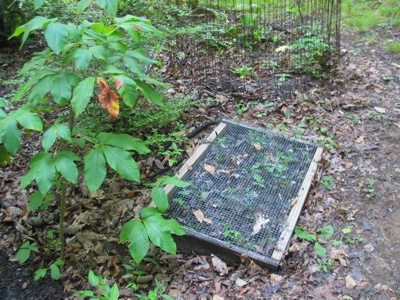
Smithgall Woods 2007 seed harvest sprouting
in northern Georgia (home of Jack Johnston).
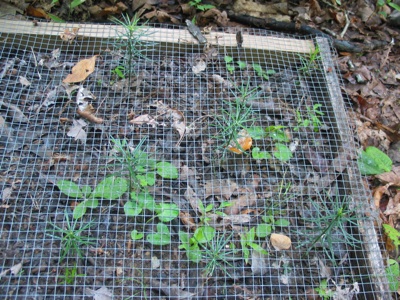
Torreya sprouts. (Mesh deters squirrels from seeds.)
I went up to check the Torreya Wednesday and all look well. I've photographed them and will sort and distribute those photos in the next few days. We have received enough rainfall the last two weeks that I have not had to water the plants for three weeks. I'll continue to monitor the plants and look forward to showing them to Sara. There was a large tree that fell beside one plant, but no damage. The tree was sawed and I counted 110-120 tree rings in a middle section. One can see the growth release (wider growth rings for about 5-10 years) when the chestnut trees died about 70-80 years ago.
Seedlings No. 1 through 30 were purchased from Woodlanders Nursery in Aiken, South Carolina. The nursery owners wrote, "I believe all of the Torreya we have propagated and distributed in recent years (including the ones you refer to) were seedlings from plants here in Aiken. Years ago on a nearby estate we planted two female trees and a male. The females were cutting-grown from the famous old Torreya in Norlina, NC and the male was cutting grown from a specimen at the Henry Foundation in Gladwynne, PA."
Dear Connie,
I planted 10 of the Woodlanders' Torreya within a week or so after I helped with the Waynesville plantings. In general, all that Woodlanders had left were smaller plants (a season younger?) than what we planted as a group, so it will be hard to compare the fate of the two groups, at least for the first couple of seasons. I used approximately a cup of hydrated lime per planting. Until we had rains from the tropical storm Faye, I was watering my 10 plants every couple of days. But now at least there is considerably more naturally occurring moisture in the ground and I have cut back on the hand watering. These 10 are either along a forest edge or grouped further out into the sun of an old pasture/meadow. It will be interesting to see which do better.
All ten are showing at least some new growth, some more than others but it is too early to make any generalizations re edge vs open. All ten have wire 'cages' to help me identify where they are and to keep the occasional animal from running over the seedlings. I clothes-pinned rectangles of fiberglass window screening to the southwest quadrant of the cages to moderate the late afternoon sun until they harden off. I'm glad you have a little more info on the origin of the Woodlanders parent plants; something I was missing.
Keeping my fingers crossed for the future!
Note: Connie Barlow had asked Jack if he plans to harvest T. taxifolia seeds at Smithgall Woods (NE Georgia) this autumn, just as he did in 2007 (after having received permission to do so). His response:
The seedlings look great, and I had fun checking out all their names. I watered them Monday [August 4], and will keep watch. [Janet Manning is director of horticulture at Corneille Bryan Native Garden.]
Hi Connie: Now that you have visited my home [in NE Georgia] you can imagine seeing me carry water up the hill to the Torreya plants and to the new seedlings coming up. Still no rain. I looked at the photos on the website [of the July 30 action in North Carolina] and realized that anyone seeing it would sense a spirit of playful purpose in doing what we did. Nice touch.
I go to see Russell Regnery at his home [in North Carolina] on Thurs. He was able to purchase a few Torreya at Woodlander's Nursery. 4 I think. I left a note for Bob McCartney to send me some too, knowing they would be smaller than the ones we planted. I do not know how many. I hope to get them to Jeff Zahner [in Highlands, NC]. I'll have enough from the seedlings that are coming up. I pick up the plants on Thurs. Maybe Bob had a half dozen.
I was just at [the site of the 3400 foot] property this morning and the Torreya
seedlings look great (!) despite only scattered rain this last week. None
were wilted nor showed any signs of shock. I watered each plant with about
3/4 gallon of water and will water them once a week if we do not get regular
rain. I'll try to get by Corneille Bryan Gardens tomorrow to check with
Janet [Manning] and folks about those seedlings. I now have a white measuring stick
and intend to photograph each plant to document its initial height, double
check labeling and confirm the names Connie has detailed and do mapping. We should
probably want to document height growth each year.
Thanks for everyone's help.
Wow! On July 30, Torreya Guardians undertook the first truly "assisted migration" of the highly endangered conifer, Torreya taxifolia. We planted 31 potted seedlings on two forested sites near Waynesville, North Carolina. This "rewilding" effort was documented by a writer and a photographer commmissioned by Audubon magazine. The article will probably appear in the March 2009 issue. Meanwhile, sample our journey via:
I am just returned from Woodlander's Nursery and have 30 Torreya taxifolia in one gallon pots in my yard. The round trip was 406 miles. It took a lot of time, but I had a nice visit with Bob McCartney. He had additional plants if anyone wants more. I would guess he had about 10 that were a touch scruffy from this seed lot, then about 10 more that looked great but were younger, and a big pot of seedlings that represents another 15 plants maybe.
He took me to see his seed plants which are on a private estate. There are 3 cutting grown plants, one male and 2 females. One of the females was smashed by a falling oak limb and has not recovered. The two females are only about 3 feet tall and sprawl since they are cutting grown. The male is twice that size. It is so dry that the one female with
seeds is aborting most of them. Since Bob has no way to water it, there may not be seeds this year, or certainly only a few.
I'll share a bit of info regarding setting out the plants. I have found it best to get rid of all the material in the pot and try to get the roots in contact with dirt. Once the plant is
in the ground it is difficult to water through the bark mix used for growing. I lost a plant
last summer even though I was watering. When I pulled it up to examine the roots
it was readily apparent that the water was not penetrating well, and that the plant had
died from lack of water.
Also, I am concerned about these 30 plants being planted in the shade. It is probably easier for
the plants to survive the dry weather with shade, but I know they will not prosper unless light reaches the
crowns. I have ample evidence of how important light is due to observations of Stewartia
ovata that I grow. The plants put out leaves and grow a little in the shade, but given sun
they grow fast. I think it is the same with Torreya.
It is interesting to compare the seedlings I brought back today with the ones I have had
in the ground for two years. The ones in the ground are not much taller, but they have a
larger stem diameter. I asked Bob how long he thought it might take for seedlings to flower. He seemed to think about 10
years. However, the seedlings are already 3 years old, and given good conditions maybe less
than 10 years?
Torreya Guardians will be planting 31 potted seedlings on one or more forested habitats on private lands in western North Carolina (near Highlands and Cashiers). Exact lands yet to be determined. July 30 was set as the date for the planting so that Torreya Guardians Connie Barlow and Jack Johnston, as well as a photographer sent by Audubon Magazine, will all be able to converge at the site. For more information, contact: Connie Barlow.
Orion Magazine now has available online a long article that poignantly highlights the controversy over assisted migration of plants in a time of climate change, and Torreya Guardians are the featured group in this effort. Click here for "Taking Wildness in Hand: Rescuing Species", by Michelle Nijhuis. (You can also post a comment there online.)
Subject: 2008 Torreya Guardians Seed Distribution
We are pleased to again offer packets of Torreya taxifolia (Florida Stinking Cedar) seed from the 2007 seed harvest at Biltmore Estate in Asheville, NC. We thank Bill Alexander and his staff for collecting and sharing seeds for this grassroots distribution project. We are releasing 20 packets, each with 5 male and 5 female seeds to allow for better pollination. We are first offering seeds to the 2006 Distribution volunteers since most of them experienced low germination rates from refrigerator stored seeds. Seeds are currently being stored under natural temperatures but should be requested as soon as possible due to my recovery from hip surgery in mid-March.
Thanks to Connie Barlow for her detailed notes taken during her site visit in December 2007 to the Atlanta Botanical Gardens. Ron Determann's generous sharing of their highly successful germination procedures is available from our website http://www.torreyaguardians.org/propagate.html. Connie also has provided additional photographs and additional information on rooting cuttings, as well as, more info on site selection, shading and need for periodic liming. I will provide copies of this information with each mailing.
Key to successful germination is cold stratification to duplicate nature's cycles in ground beds that get the full range of daily temperature cycles (freeze/thaw) vs. constant 40-45 degree F. temperature storage in a refrigerator. The seeds to be distributed have only been partially stratified so you will need to plant them in protected beds where they receive natural temperatures for a month or two. Simple wire screening is recommended to protect from squirrels.
Please email your requests to me and provide complete shipping information. Connie and I are donating all mailing and packing costs and ask that you occasionally report germination status, and plant growth, fruiting, and seed production. Volunteers need to be committed for 10-15 years before good seed production is expected and be willing to further distribute seeds.
Thank you for your interest in preserving our national botanical treasure Torreya.
Happy Trails, Lee
1. This summer, Orion Magazine will be publishing a feature article on Torreya Guardians work in a time of climate change.
2. Also, do periodically check the comments page of our website to see what's happening, along with new ideas.
3. Watch the rewilding page too, especially the July 2007 post I made there about Atlanta Botanical Gardens looking for INSTITUTIONS to send seeds and seedlings to. They've got a huge inventory. Unlike Torreya Guardians, they cannot send seeds to individuals, but nature centers and botanical gardens should contact Ron Determann at Atlanta Botanical Garden directly to participate.
Besides the Biltmore Gardens, where squirrels have, for decades, been engaged in planting seeds on their own, I wasn't aware of any place where rewilding was somewhat occurring — with the possible exception of Smithgall Conservation Area in the southernmost Appalachians of northern Georgia. So I called Ron Determann at Atlanta Botanical Garden, which is superbly successful at producing T. taxifolia seeds from their "potted orchard" of trees cloned some 15 years ago from remaining vegetative tissue from struggling plants in the Apalachicola "native" range. Here is what Ron (who has been working with T. taxifolia since 1989) told me:
First, the Smithgall plantings are not rewilding, because they are planted as a grove and tended in a botanical garden setting there. Technically, rewilding won't happen until the species is returned to wild or semi-wild forest settings and starts distributing from there on its own (via squirrels). Atlanta Botanical Garden actually has an excess of torreya seedlings they would love to provide reputable institutions (at cost of shipping and handling) for safeguarding in a variety of climate settings where they will grow — as a safeguard against species extinction if problems persist in the "native" range, especially because, as with the Apalachicola, "the climate in Atlanta isn't that great for Torreya either." They also have surplus seeds from "indeterminate females", and these they are especially willing to give away. Unlike Torreya Guardians, they are not open to sending seed to individuals in private land settings. But we Torreya Guardians can spread the word among enthusiasts to try to recruit local botanical gardens or nature centers to volunteer to take seedlings, and then we ourselves can volunteer at those centers to nurture those plants.
Also important, Ron told me that Atlanta Botanical Garden has almost 100% success with germination of seed they produce there. Here is how they do it.