 |
|
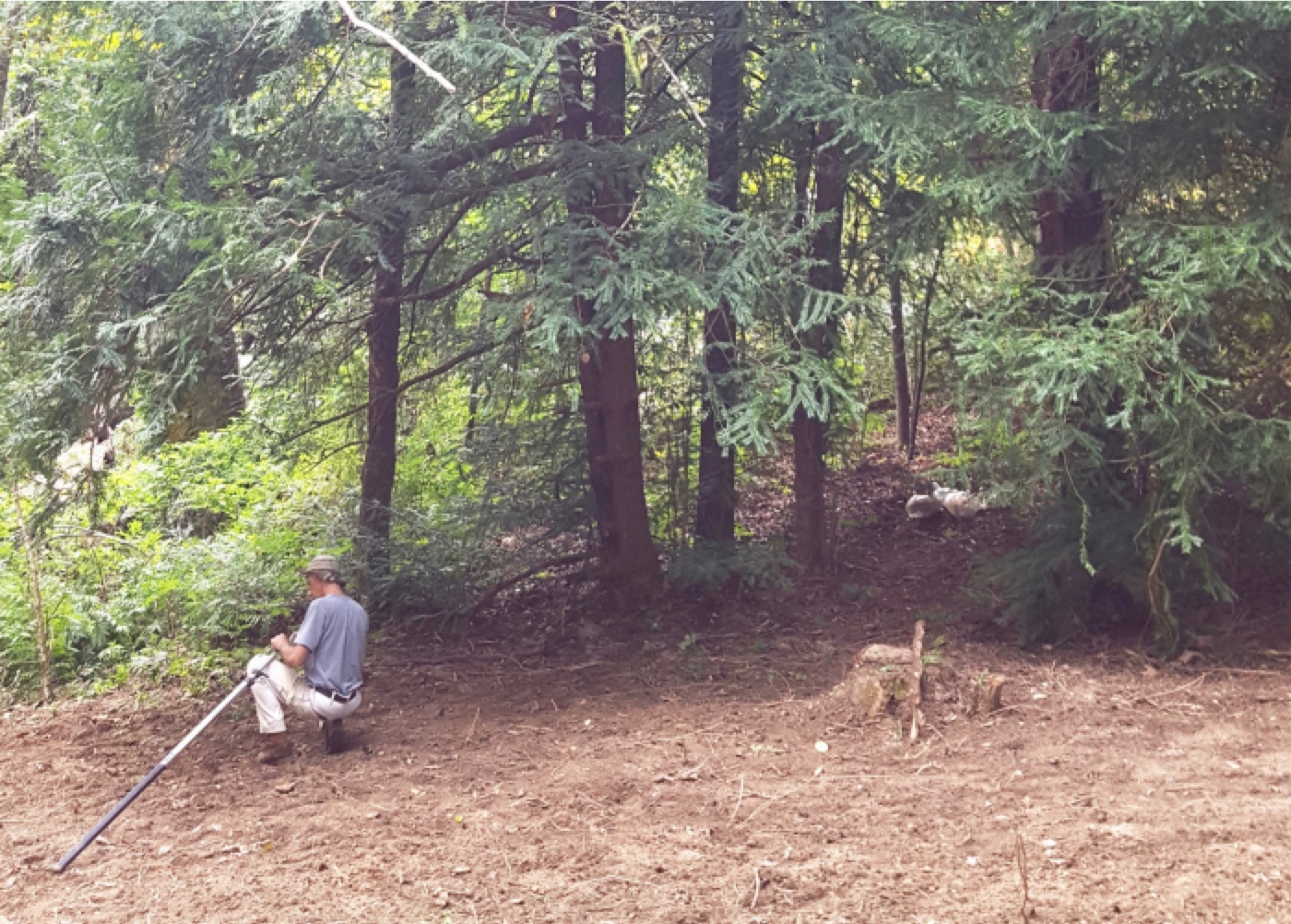
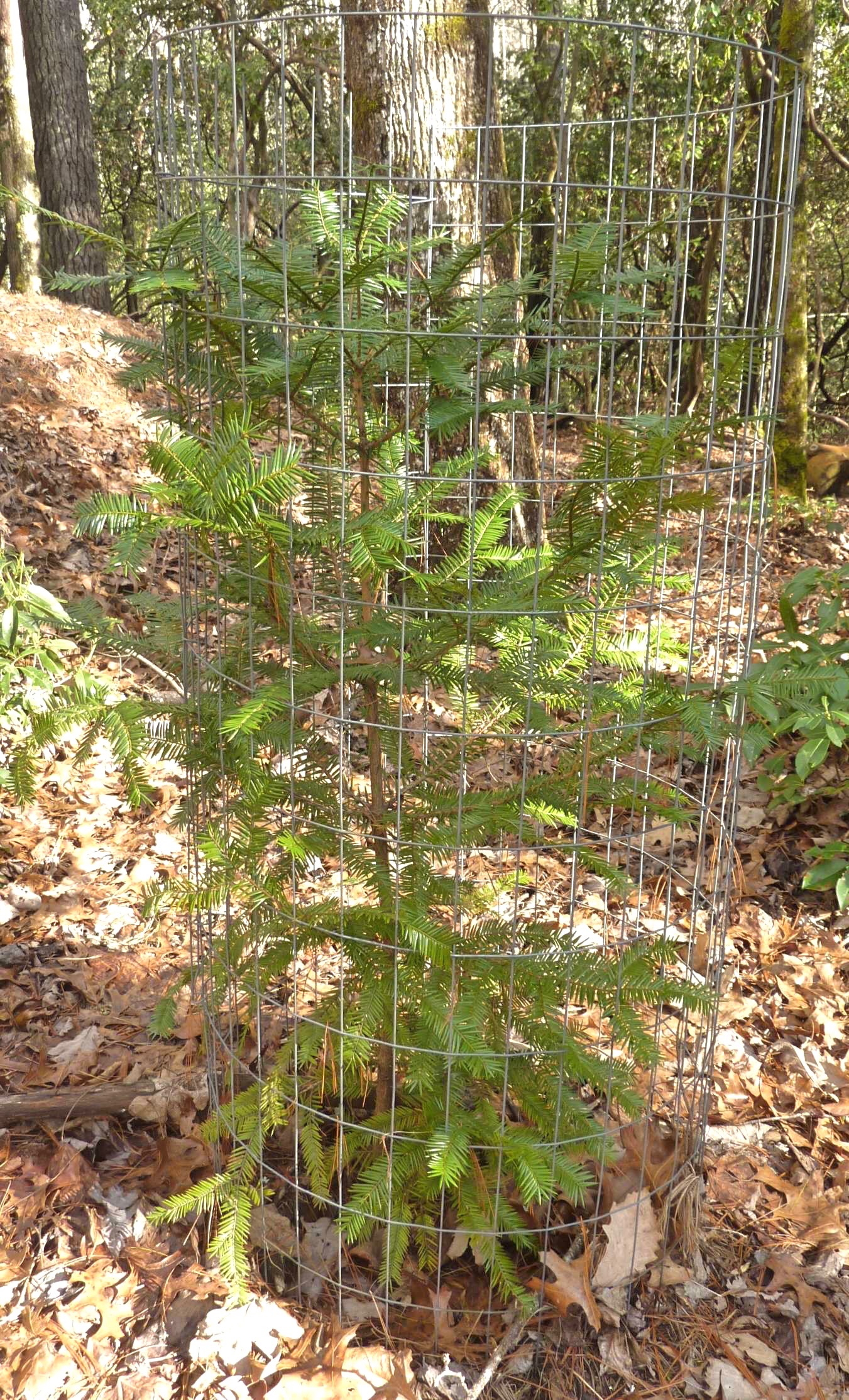
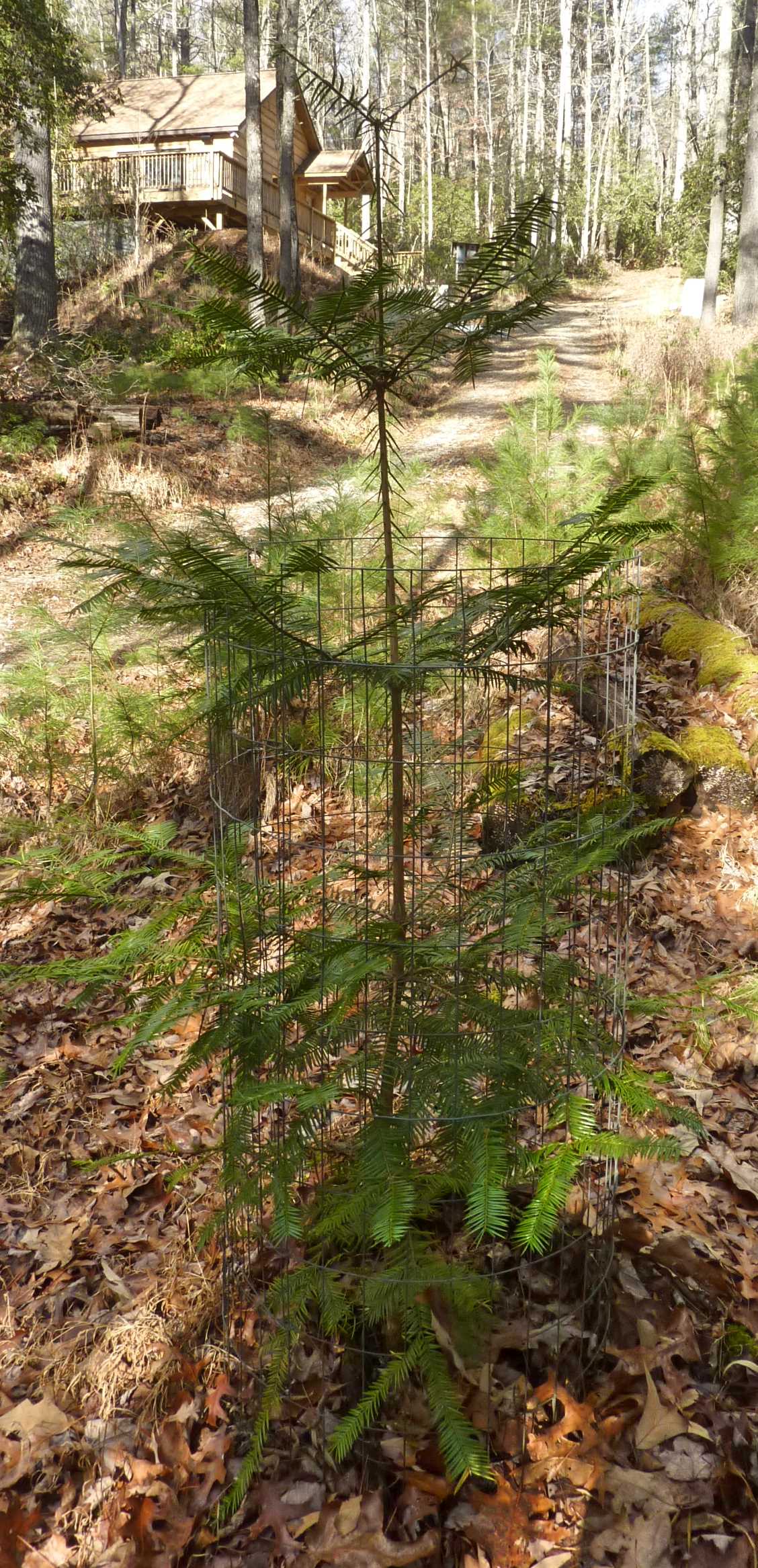
November 2020, Sharon Mohney initiated the first large-scale, within-forest planting within Virginia of freshly harvested Torreya seeds.
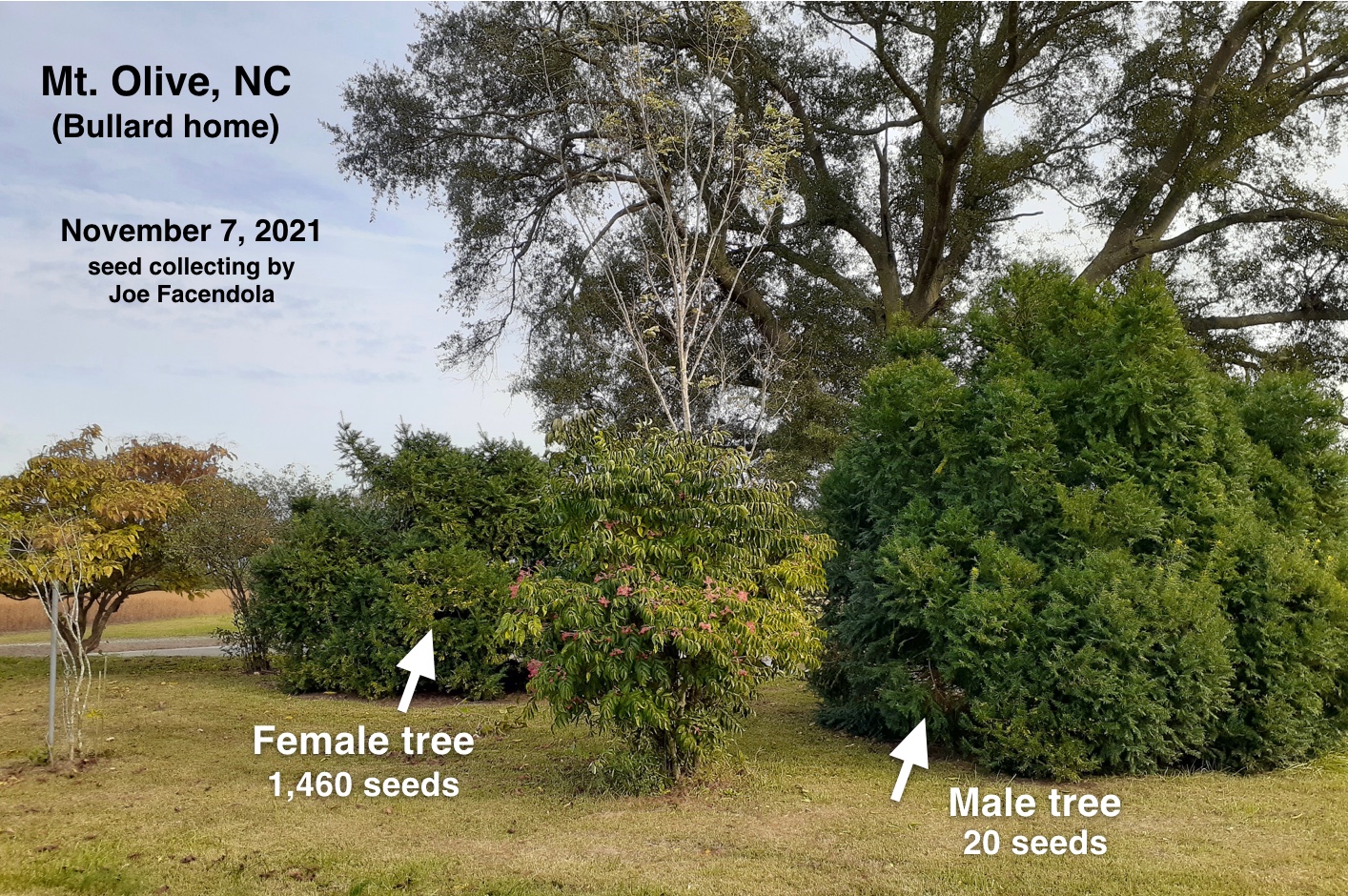
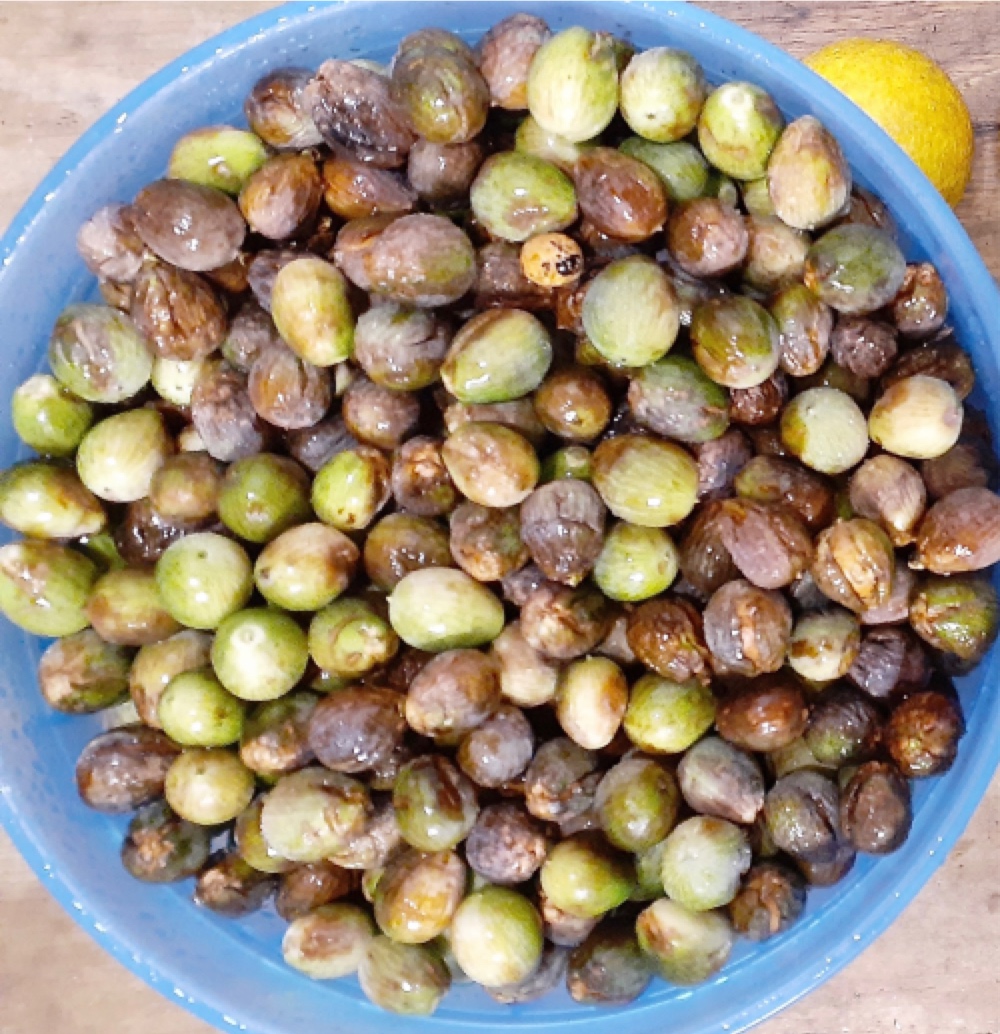
The seeds were donated by owners of mature horticultural plantings of Florida Torreya in Clinton NC and Mt Olive NC. (See the report directly below by Joe Facendola, seed collector.)
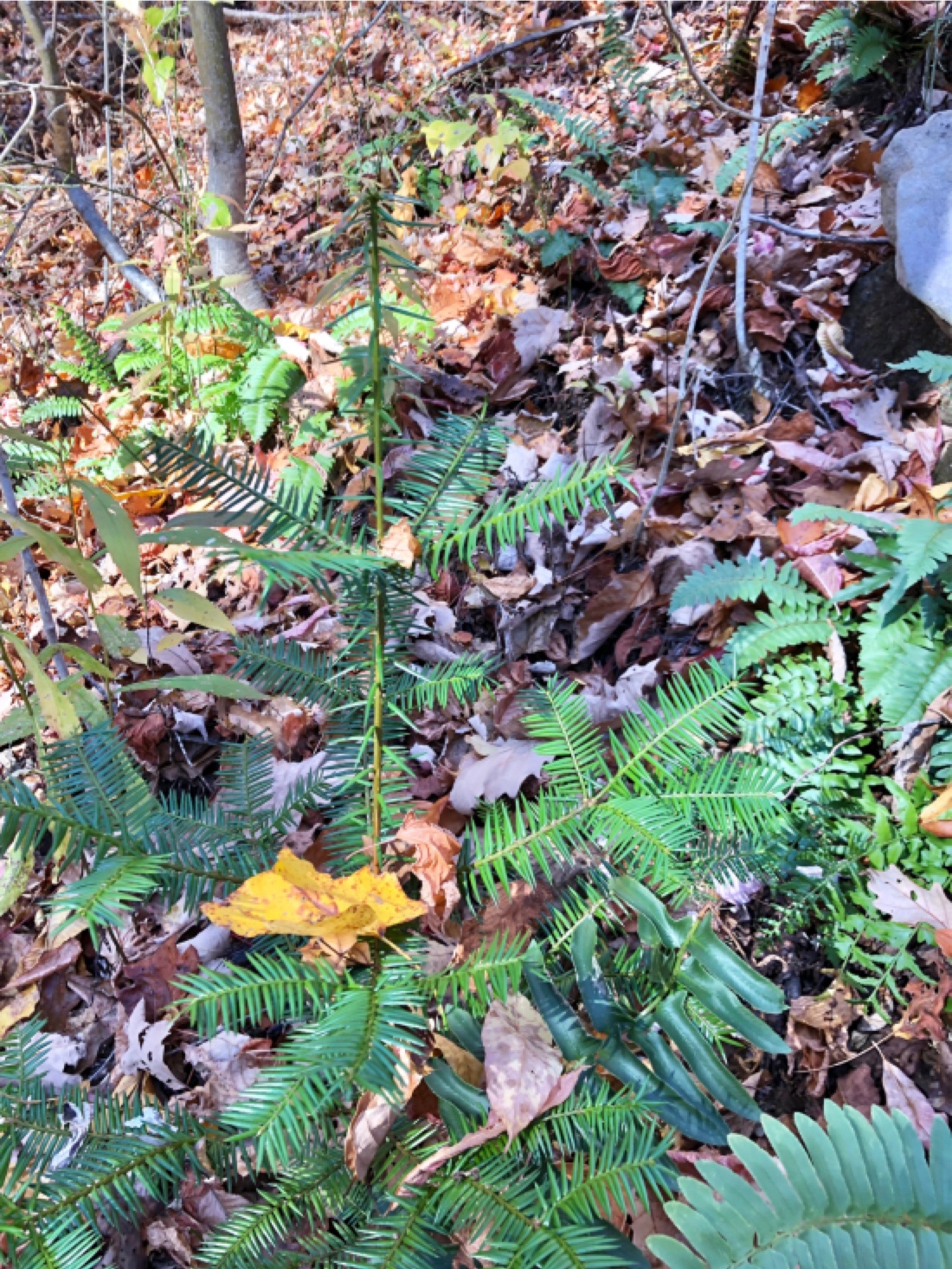
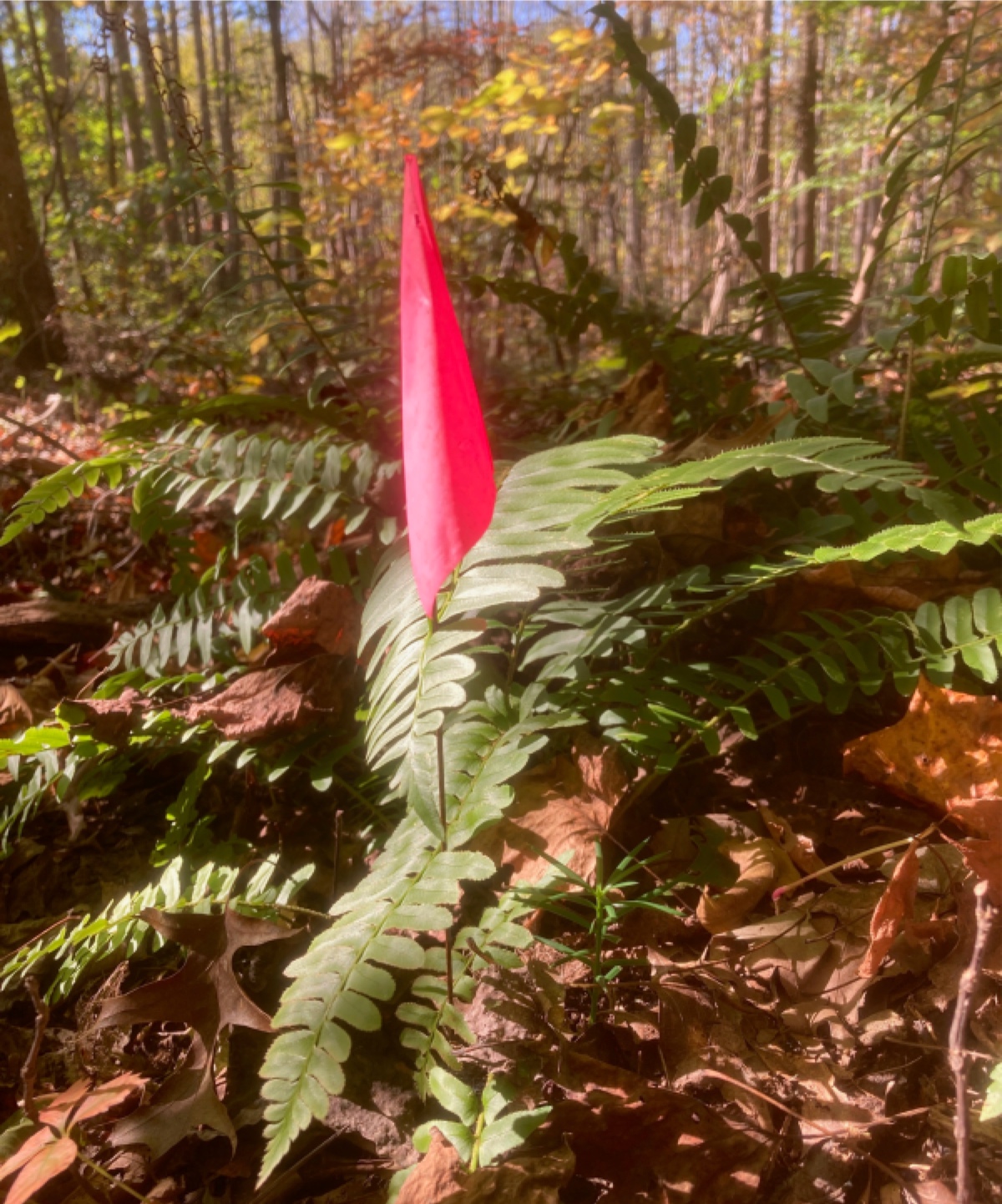
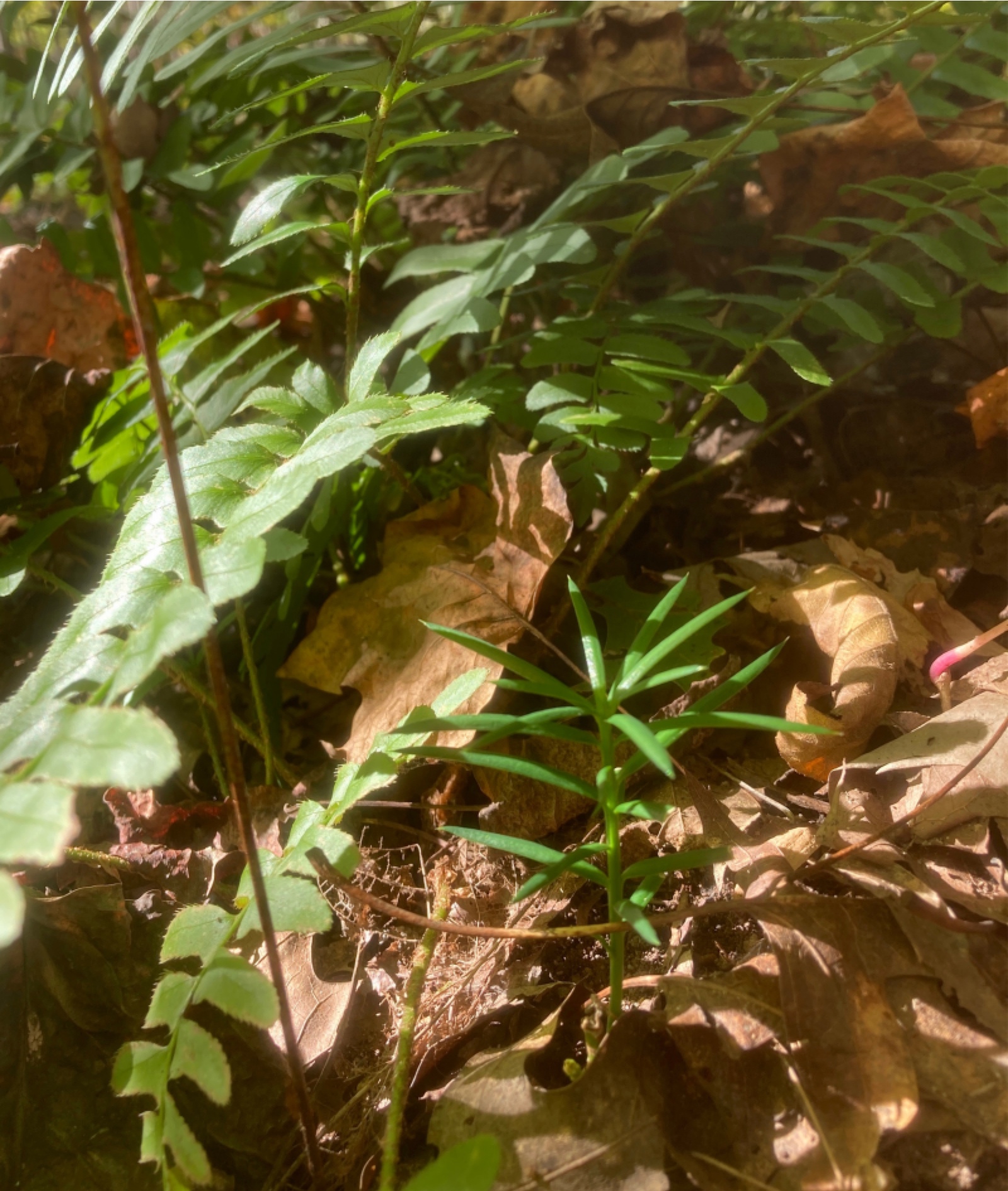
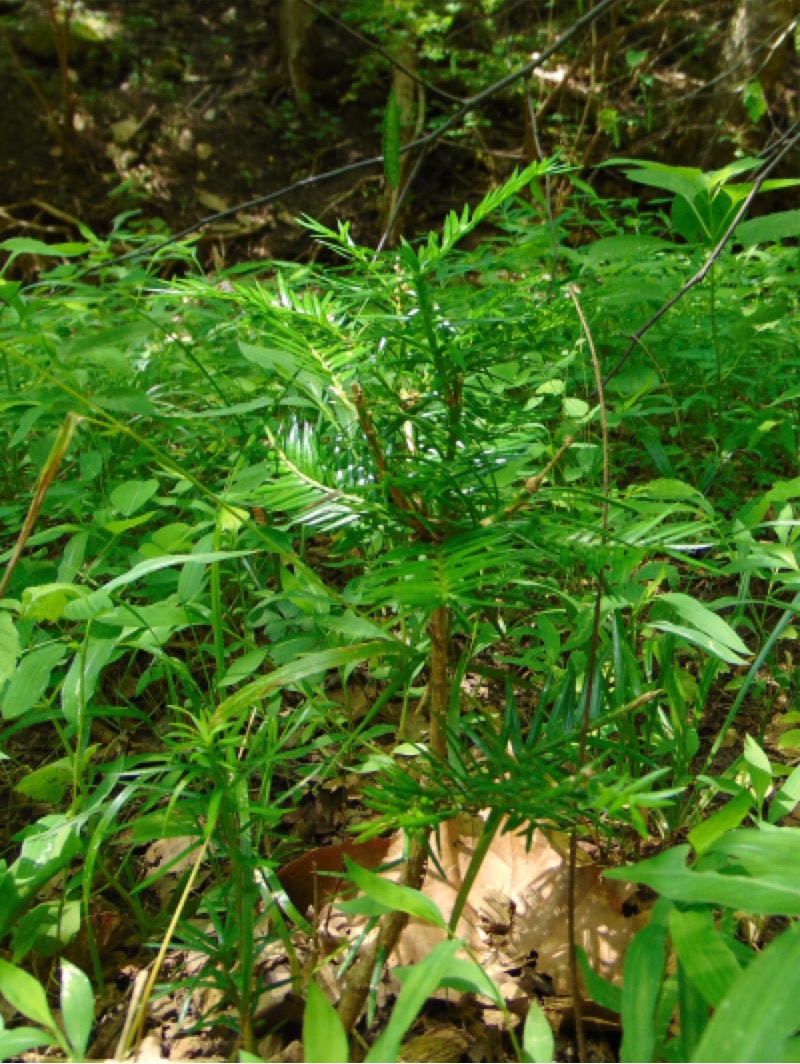
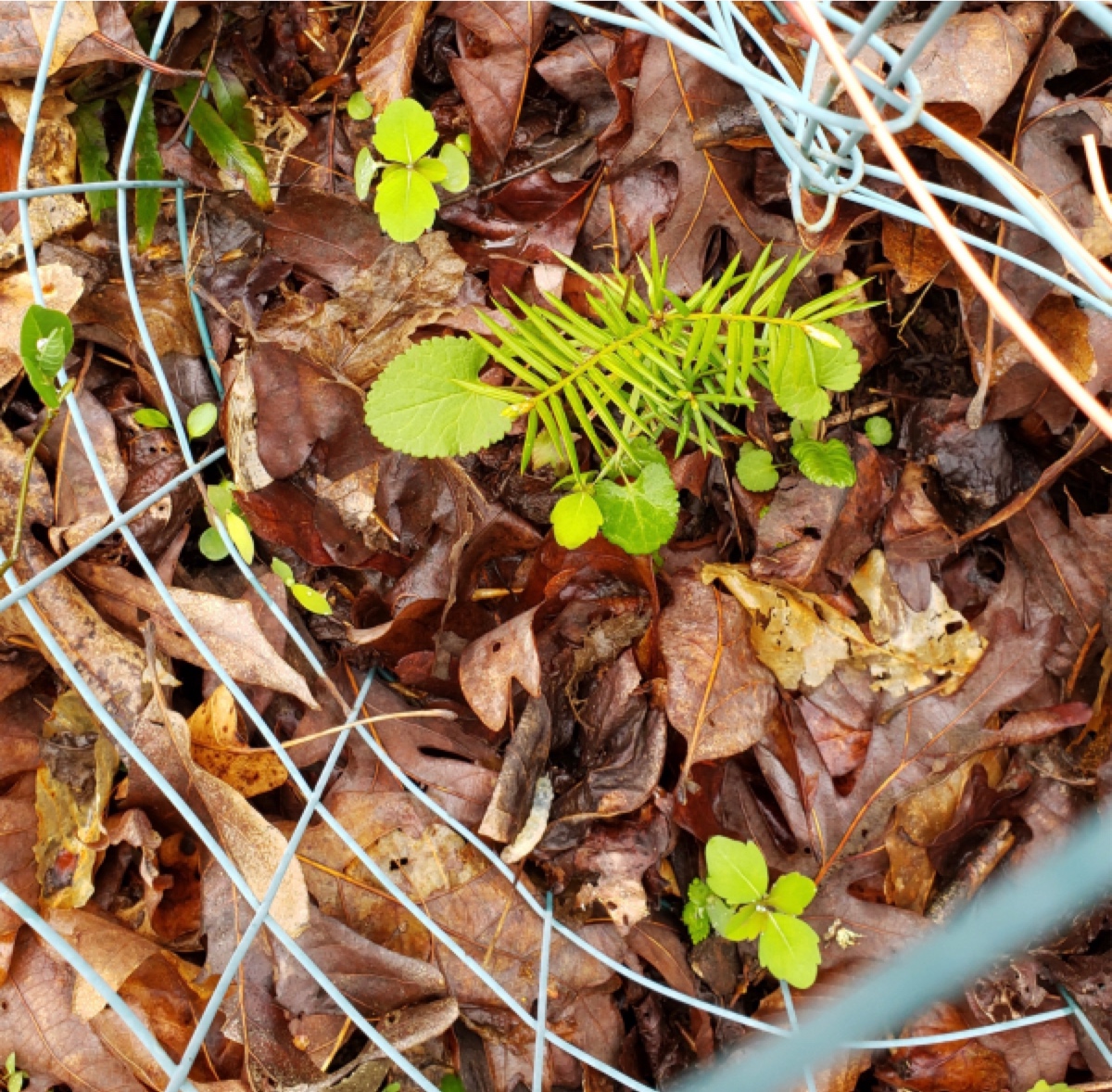
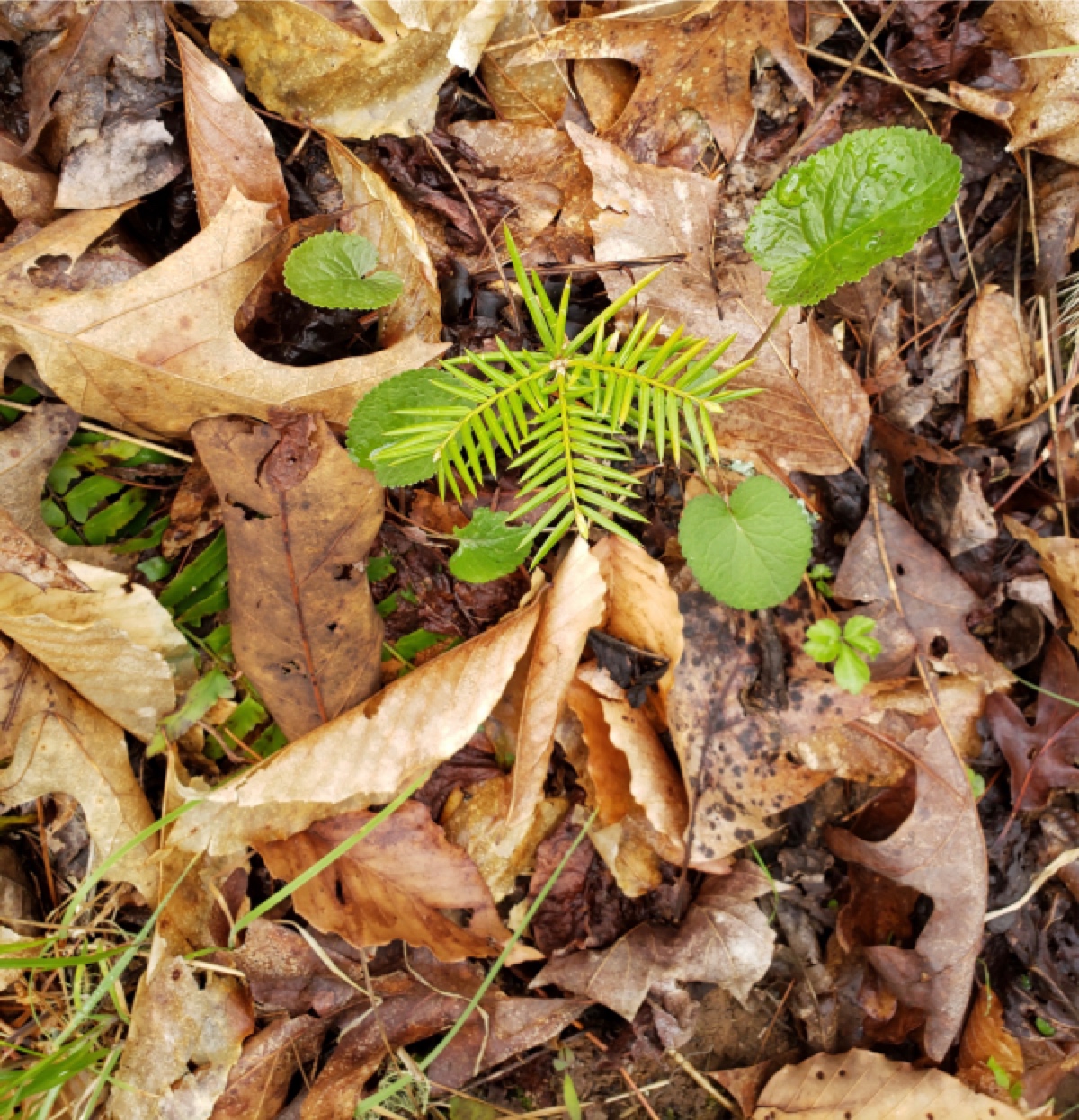
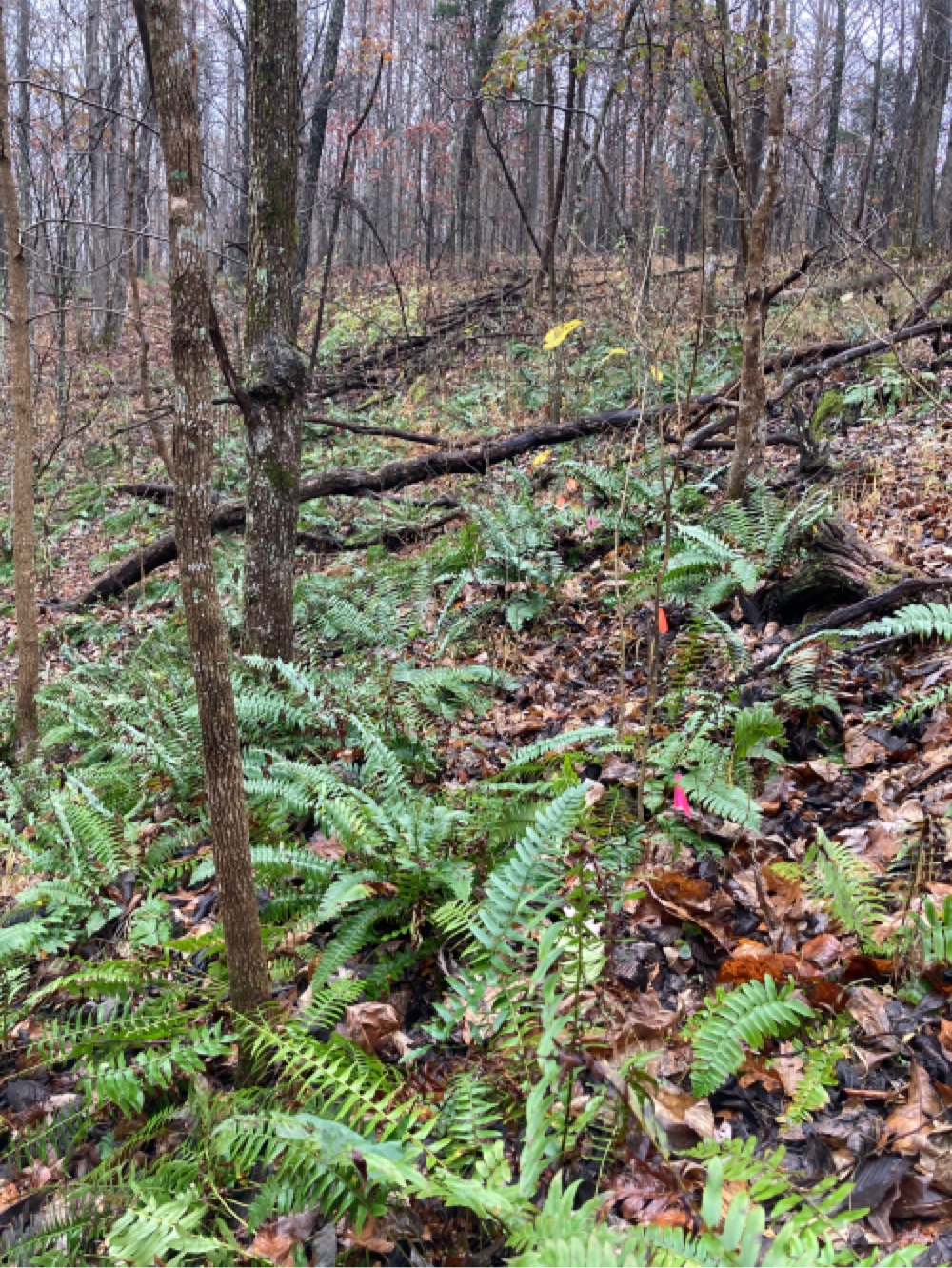
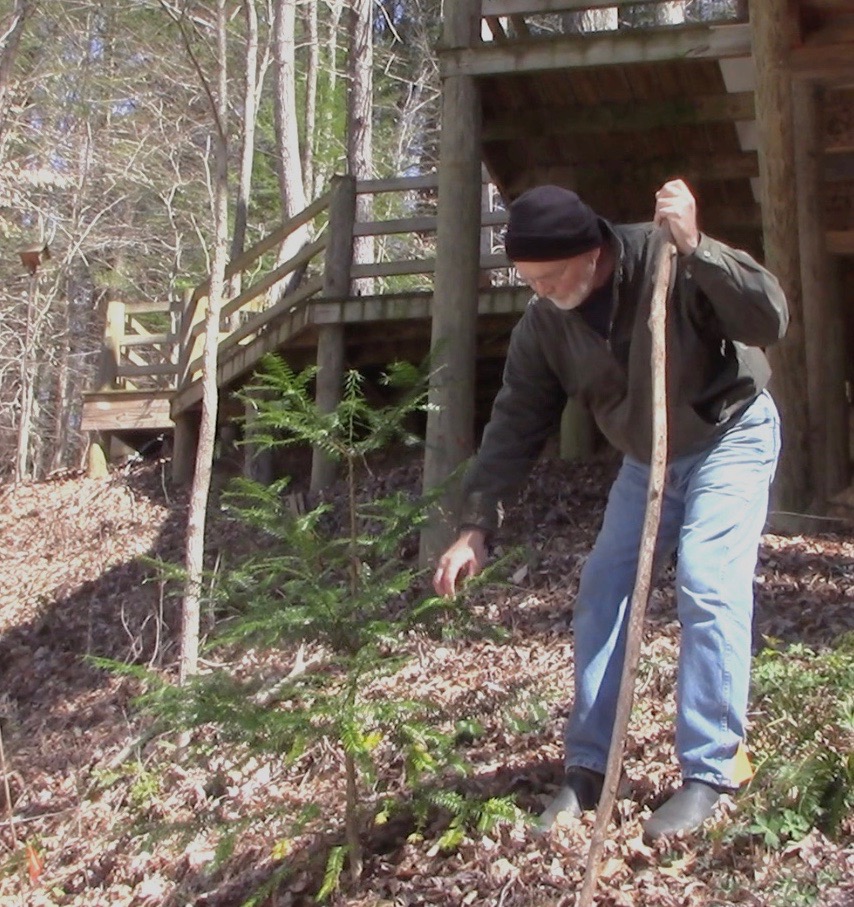
The photo left shows an ideal landscape for torreya planting, based on what Torreya Guardians have learned thus far: (1) Planting on a slope beneath a deciduous canopy, and (2) planting amidst evergreen Christmas ferns, which offer superb camouflage for torreya seedlings as protection against winter-hungry deer.
Visit the new photo-rich webpage of this assisted migration project near BUCHANAN, VIRGINIA.
|
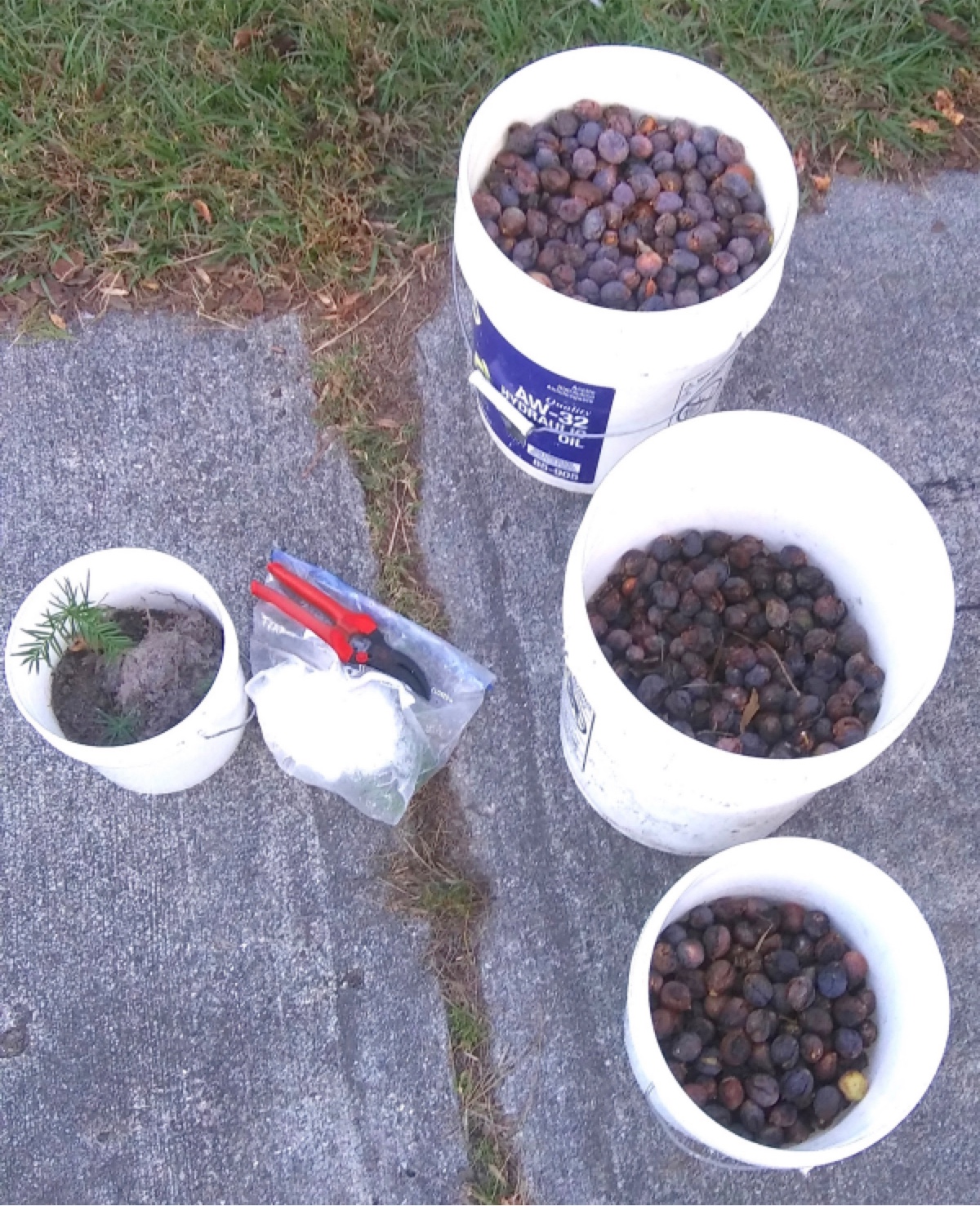
• November 2020 / Joe Facendola & Connie Barlow / Clinton and Mt. Olive NC mature torreyas yield 2,443 SEEDS this year
 |
|
Following introductory phone calls by Connie Barlow to Mrs. Kennedy (in Clinton, NC) and Mrs. Bullard (Mt. Olive NC), North Carolina resident (and Torreya Guardian) Joe Facendola managed to collect seeds (and assist the owners with seedling digging and branch pruning) all in one day: October 31. Both the tall Torreya in Clinton and its pair of mature offspring in Mt. Olive looked very healthy (no signs of canker) and the seeds were abundant and ripe. (Access photos of these sites.)
Joe and Connie then set about distributing seeds via priority mail. Connie had quite a backlog of new recruits because we have had little access to seeds in recent years — yet this website regularly points enthusiasts in our direction.
This year the focus was on mailing large numbers of seeds (usually about 100) to each planter so that the bulk would be "free-planted", a form of "rewilding," immediately within forests. Accordingly, Connie created an easy-to-use PLANTING INSTRUCTIONS CHECKLIST within the otherwise very long "Propagate" page on the Torreya Guardians website.
|
FINAL DESTINATION STATES: North Carolina, Georgia, Tennessee, Indiana, Virginia, New York, Michigan, Wisconsin, and Ohio.
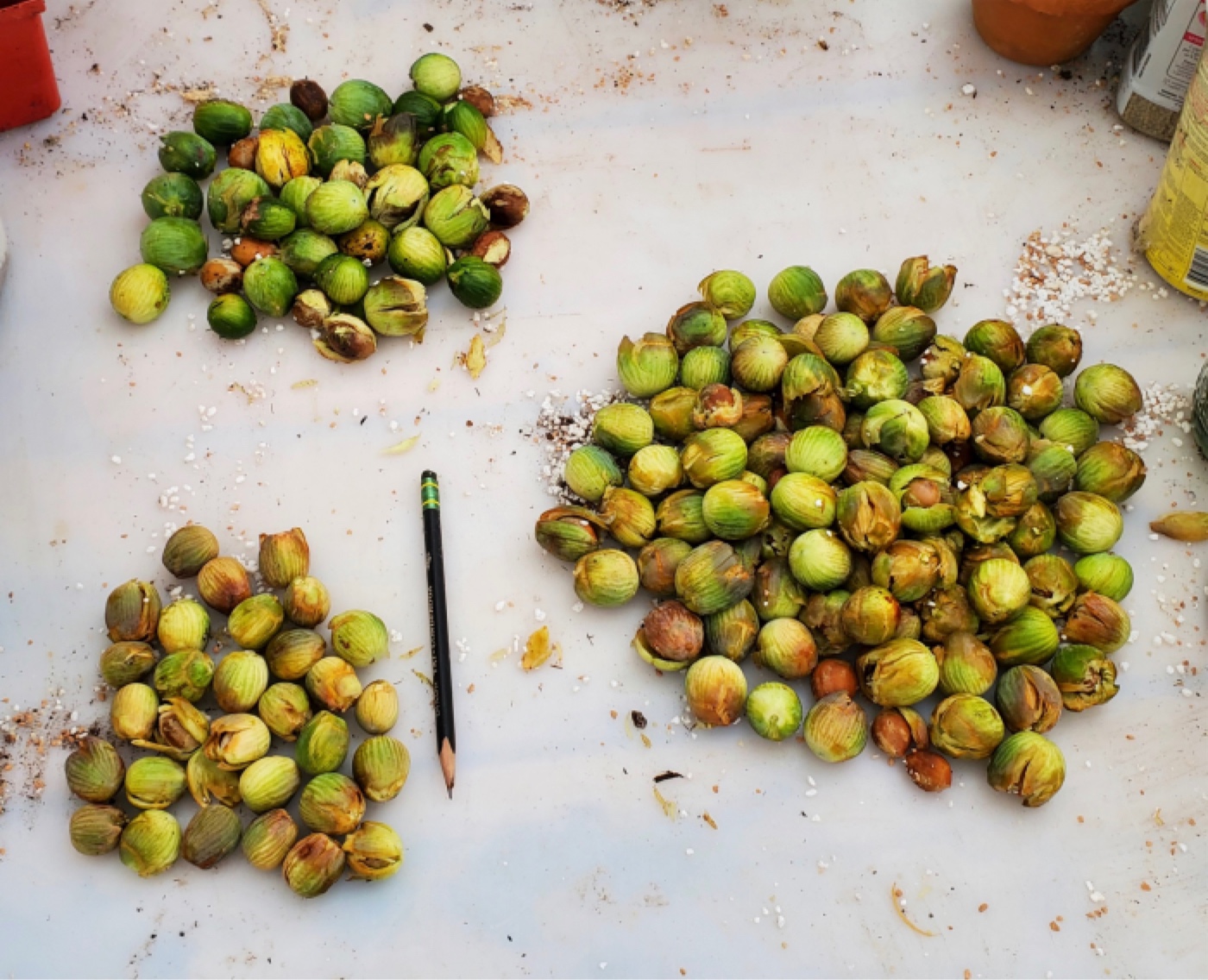
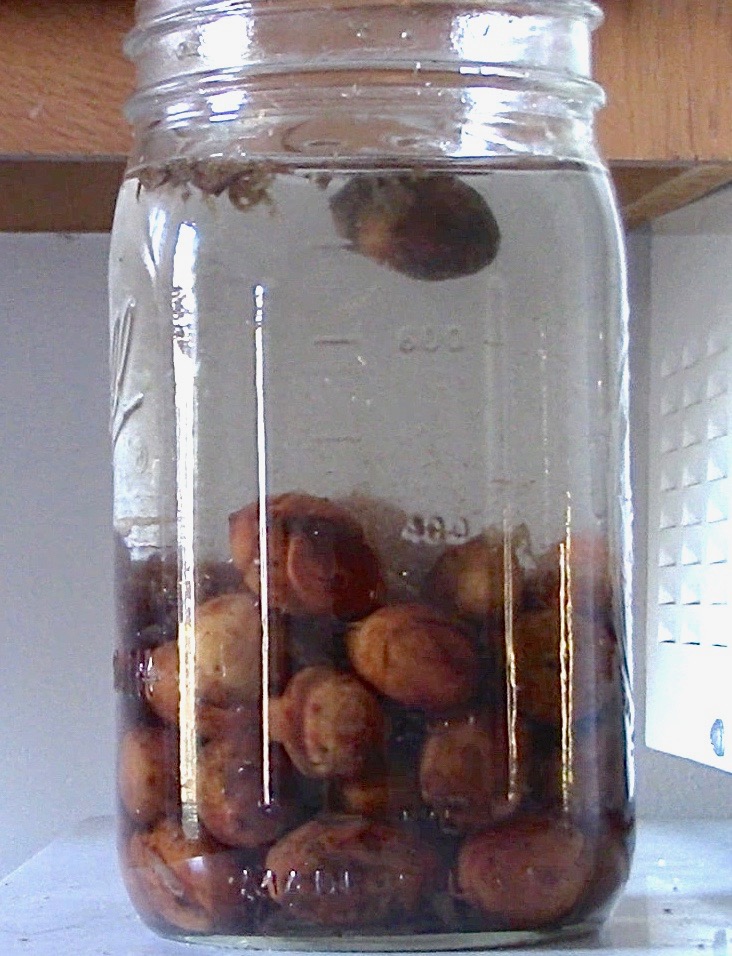
PHOTO ABOVE: Connie randomly sorted out 2 sets of 50 seeds from each of the two NC seed sites and tested them in a jar of water. The average was one "floater" per 50 seeds, with the rest all "sinkers." While Clint Bancroft has noticed no difference in germination success between floaters and sinkers, one still wonders whether harvesting of ripe seeds, followed by immediate removal of fleshy skins and embedding them into moist sphagnum moss, and then immediate mailing might eventually yield one of our most viable seed distribution/planting efforts thus far.
• October 2020 / Connie Barlow / Torreya Guardians excluded from participation in Recovery Plan Update
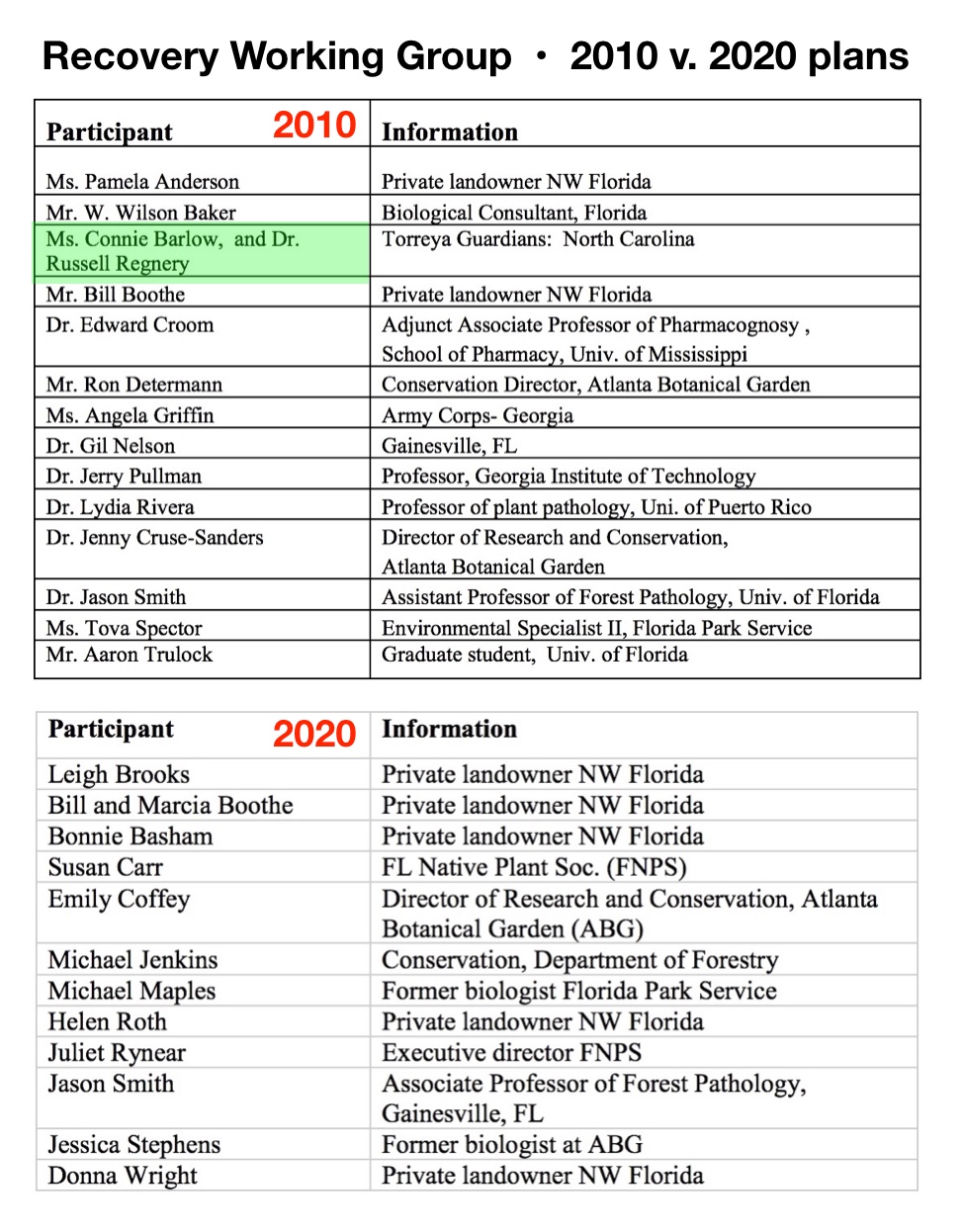
It was a shock this month to stumble on the fact that not only was the 2020 recovery plan update for Florida Torreya finalized and published without our awareness in July 2020, but that the Recovery Working Group met back in April 2019 — and we were not invited. This is in sharp contrast to the invitation we received to contribute our perspective as part of the Recovery Working Group in 2010. (Documentation of our participation in 2010, our written comments, and the comments contributed by well-known scientists we recruited to participate are all filed online here: 2010 Torreya Guardians participation in recovery planning.)
In the image below I have highlighted my name, Connie Barlow, and that of Russell Regnery, listed as Torreya Guardians. Accordingly, although we two Torreya Guardians were the only ones to vote "yes" in 2010 on including actual experimentation in "assisted migration" (AM) northward in the official plan, nevertheless the plan as written recognized our actions in process and offered pre-approval for collaborating institutions to begin planning for AM experimention — if they so chose. Alas, there is no evidence that any of the officially recognized institutions chose to engage in such planning during the past ten years.
 |
|
It is also shocking to notice the degeneration in the official plan itself by comparing the pdf of each available online: 2010 plan and 2020 plan. At the end of both documents, the same staff scientist is credited as "Review conducted by: Dr. Vivian Negron-Ortiz".
My experience is that Dr. Negron-Ortiz is an excellent biologist. Whatever lapses in the usual protocols for endangered species decision-making that found their way into the working group selection, process, and plan writing were therefore unlikely to have originated with her. Notably, there is no way that a scientist of her experience and long familiarity with the goals and actions of Torreya Guardians (as documented on this website) and the diversity of our citizen volunteers would have had her approval to characterize Torreya Guardians as "a religious group based out of northern Georgia" (p. 6 of 2020 plan). Such slighting and slander of well-known citizen stakeholders is a mark of serious degradation in implementation of the Endangered Species Act.
|
Finally I wish to point out two other substantive/legal lapses in the 2020 revised plan. Because it is apparently pointless to submit any comments or queries to the USF&WS endangered species program anymore, I simply post it below for our own participants, the public, and professional managers and researchers working on climate adapatation plans to be aware of. The 2020 plan revision is degenerate in that ...
• Absence of reporting any documentation of SEED PRODUCTION NUMBERS and ultimate destinations in any of the ex situ plantings northward of Atlanta Georgia. Background: In 2018, I (Connie Barlow) became alarmed that because the recalcitrant large seeds of Torreya taxifolia had proven impossible for the botanical gardens to store in viable condition via either dry or deep-freeze of entire seeds (Cruse-Sanders had reported that cryogenesis worked only for extracted and somatically propagated embryos), that the seeds were largely left to harvesting by onsite squirrels. Hence I launched a "FREEDOM OF INFORMATION ACT" official query whose summary line was: "... As founder of the citizen activist group Torreya Guardians, I would like to know documentation of seed production year by year, beginning in 2007. I am aware that the Blairsville site has likely been producing seeds every year since 2007, yet there is no online documentation of quantities and year-by-year reporting of ultimate destinations of the precious seeds. Please provide me (and thereby our group of citizens) this information." Very few documents were sent my way as a result of this FOIA query. Nonetheless, I compiled and linked all FOIA associated documents and communications onto this website.
• No progress in developing a "Preventing Extinction Emergency Plan." Background: After ten years the presence of Torreya taxifolia in its "historic range" is continuing to decline. Nobody disputes this fact. Canopy devastation by Hurricane Michael in October 2018 worsened the slide by (a) suddenly exposing subcanopy saplings to leaf-damaging UV light and (b) reducing ravine capacity to maintain cooler and moister conditions. ESA planning protocol requires attention be given to developing a "Preventing Extinction Emergency Plan." This topic is presented in the 2020 plan on pp. 24-25, but that section should be judged against the more forward-looking 2010 plan (pp. 18-19). Notably, the 2010 plan directed:
A plan should be developed to address guidelines for reintroduction, translocation (and/or managed relocation), and augmentation, a three-step process of planning, implementing and monitoring. Since this species is unlikely to disperse and colonize on its own because current populations are characterized by small individuals that are failing to achieve reproductive maturity, therefore it is a candidate for assistance. Below are preliminary points to be considered:
• Initiate a reintroduction/translocation scheme with disease-free T. taxifolia in environments in which the pathogens are not recognized and/or the habitat has been managed and cleared from the threat that brought the species to endangerment.
• Foster a working partnership between the Torreya Guardians, the Service, and other interested parties to help direct their managed relocation efforts.
• September 2020 / Mike Heim & Connie Barlow / Wisconsin Torreya planter has 2 hour native tree lecture on youtube
 |
|
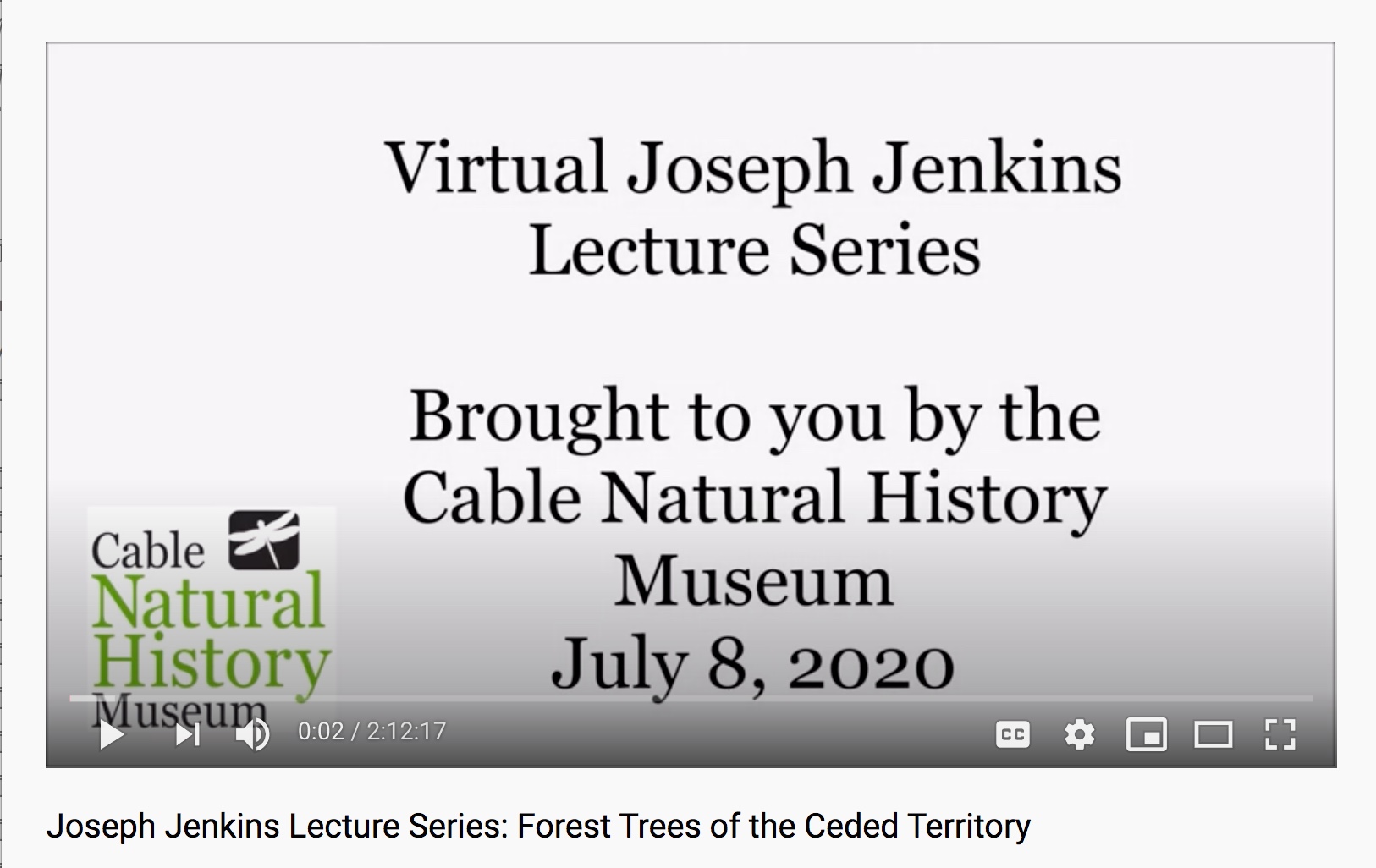
MIKE HEIM presented a 2-hour illustrated talk July 2020, which you can watch on youtube:
"Forest Trees of the Ceded Territory" (northern Wisconsin)
Torreya Guardians founder Connie Barlow reports, "Mike excels in offering solid guidance and images — not only for identifying each species, but also its ecological context, historical uses, and deep-time history."
Use this time-coded topical list for accessing specific tree species during this 2 hour lecture.
|
Connie Barlow continues: "Watching this video, I learned a vital ecological reason why Paul Camire has found in Michigan that RED MAPLE indicates poor habitat for planting Torreya. Instead, one would expect that native trees indicating well-drained rich soils (e.g., beech, sugar maple, basswood) would be good indicators of best potential Torreya habitats in the Great Lakes region."
• August 2020 / Paul Camire & Connie Barlow / Found a 1975 photo of Norlina tree in peak health
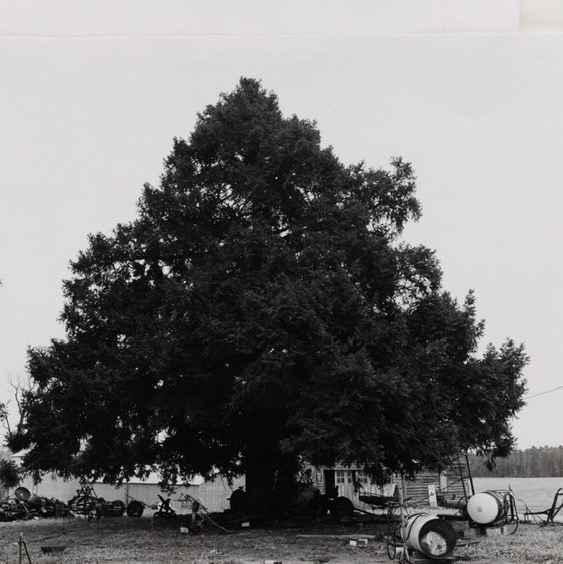
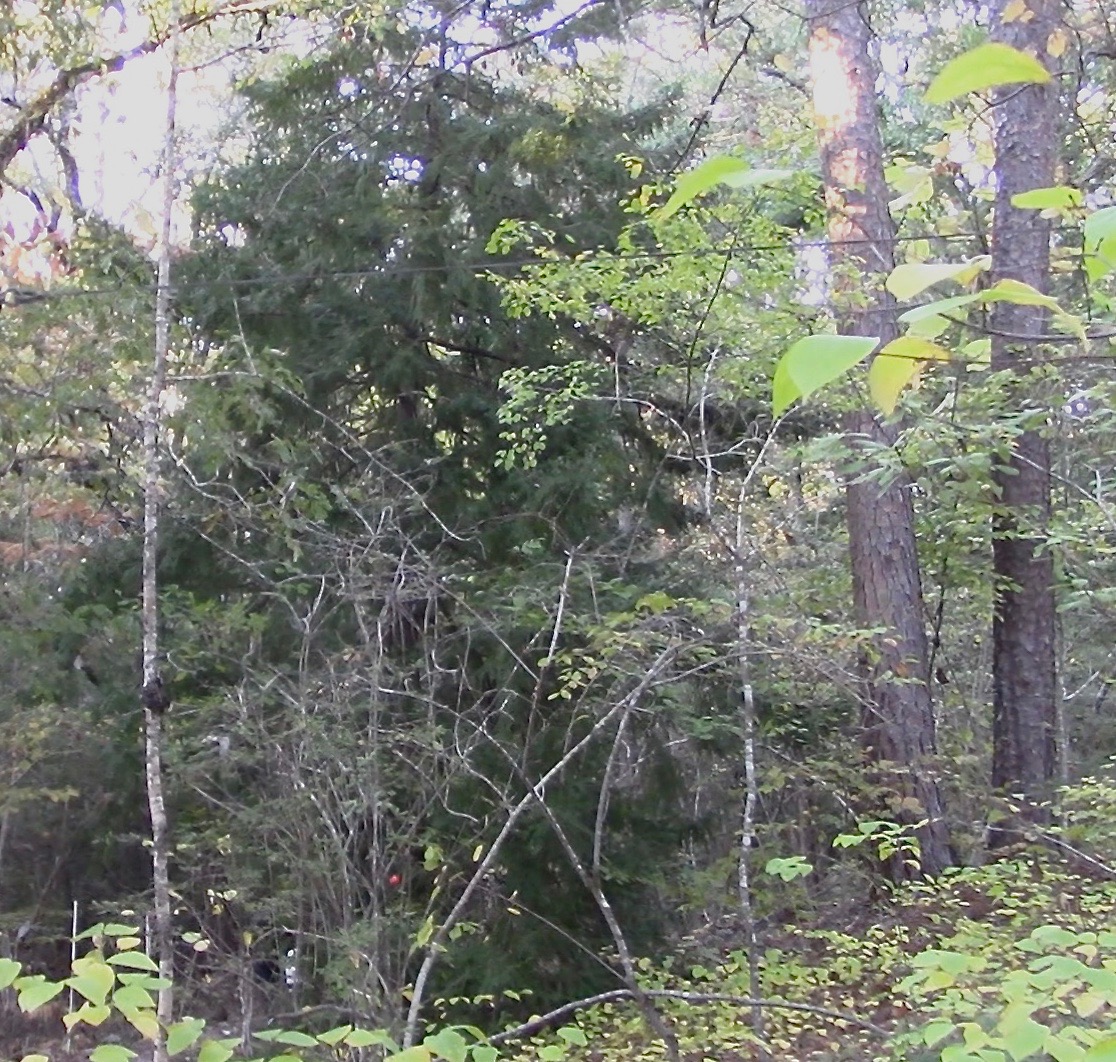
This month our Michigan planter, Paul Camire, turned up a 1975 photo of the then-national-champion Florida Torreya tree: in Norlina NC (photo far left). Connie Barlow added it not only to the webpage we maintain on the Norlina NC Tree but also to a number of other pages that harbor its offspring.
 |
|
|
|
As well, she added this photo (and a photo she took herself, near left, in 2018 of the biggest Florida Torreya at the Caroline Nature Preserve in Louisiana) to the Natural History of Torreya webpage — as a reminder of just how big this species can grow in a century.
|
• August 2020 / Connie Barlow & Bob Miller / Southern Ohio proves excellent for Florida Torreya
|
|
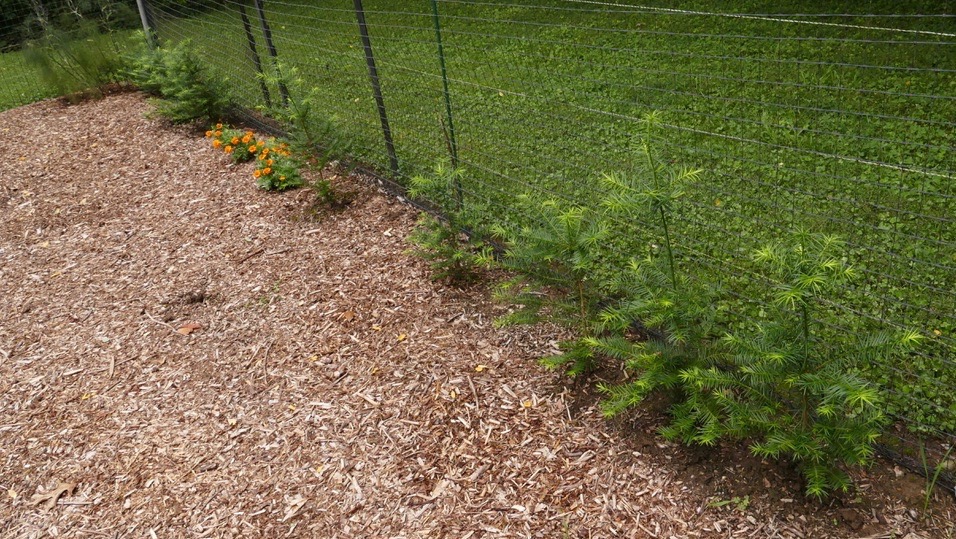
Nearing the end of their 4th year after seed-planting in this fully rodent and deer protected garden edge, these torreyas appear to be happy living in southwestern Ohio. All 22 seedlings that initially germinated along this fence are alive today, although 3 have been out-planted into the forest.
The learning here is not only that southwestern Ohio is already a fine climate for Florida torreya.
The learning is also that protecting against seed predation by rodents and early browsing by deer and rodents is vital for maximizing good results.
|
Access the photo-rich multi-year webpage of Torreya in Loveland in Ohio.
• July 2020 / Connie Barlow / New book presents Torreya Guardians as leaders in assisted migration
|
|
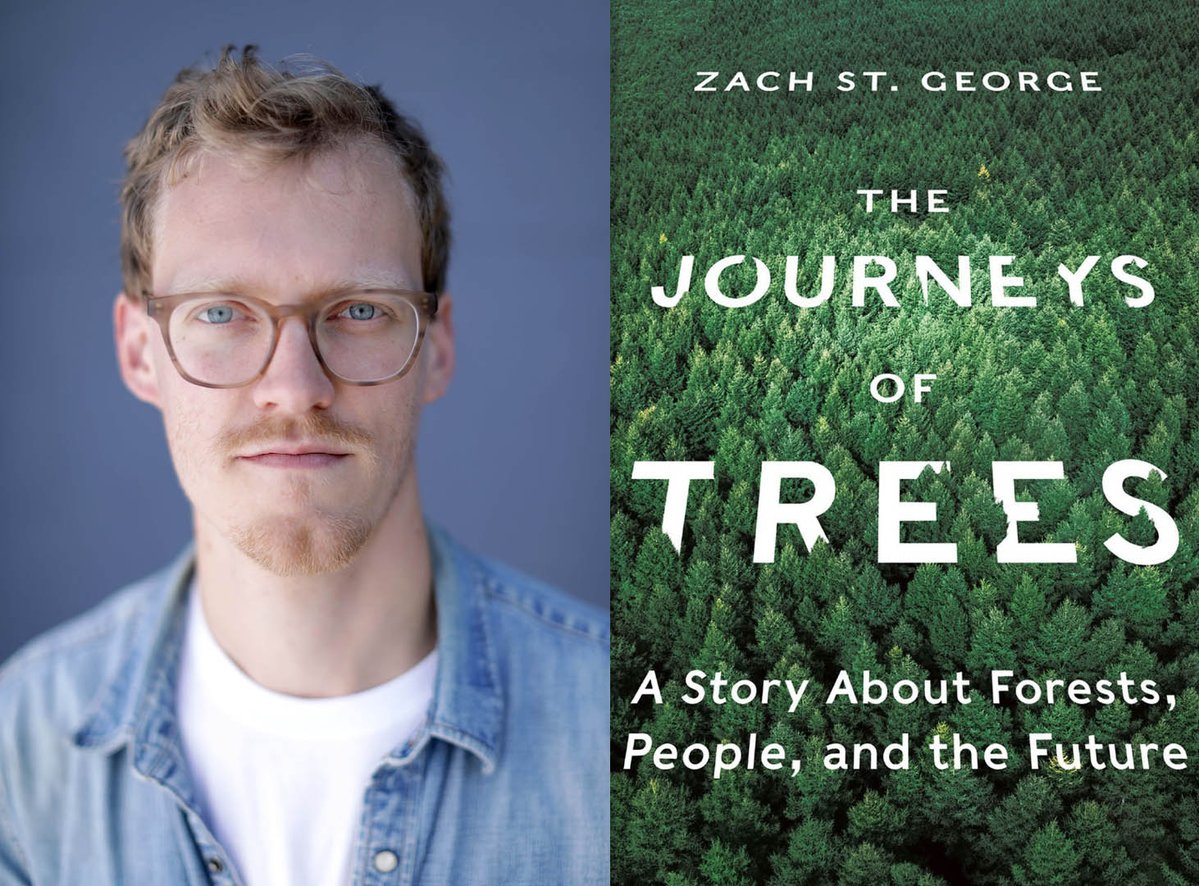
Five years ago, a young science reporter, Zach St. George, began sleuthing about a new and divisive controversy in conservation, forestry, and endangered species circles. Now usually called assisted migration, this challenge to native range as the sole geographic locus for saving endangered species was the foundation for launching Torreya Guardians back in 2004. Because our group is citizen-led and relies entirely on volunteer planters and their experimental discoveries, we could jump out ahead of the established conservation groups, institutions, and academics in our determination to offer this Jurassic-age genus a chance to demonstrate viability far north of the Florida refuge where it waited out the glaciations.
With W.W. Norton as distinguished publisher, this book is a fact-checked, page-turning presentation of a new paradigm in applied ecology for this century of too-rapid climate change.
|
GOODREADS makes the full Introduction and Chapter 1 freely available for reading online, and in much more pleasant to read font resolution than Amazon.
THE WALL STREET JOURNAL published a lengthy and very favorable review of the book, titled 'The Journeys of Trees' Review: Giants in Transit. Note: If you cannot access the full review online, you can read read in here in pdf.
A SHORT ESSAY to learn why Zach chose this project and worked on a shoestring to its fruition, read this short reflective essay he wrote for Powell's Books (in lieu of being able to give a talk in a covid-closed bookstore in Portland OR): "Accepting a Changing World".
THE ESSAY BEGINS: I was working on the third or fourth draft of my book, The Journeys of Trees, when a friend pointed out to me what the book is about. It came as a surprise. I was fairly certain I knew what it was about: the future of forests. Thanks to the combined effects of climate change, globalization, and deforestation, the world's forests are in a state of upheaval unlike any since at least the end of the last ice age. In the book, I abandoned the usual view people take of trees and forests, as reliable and unchanging, nearly geologic in their stillness, and instead cast them as mobile, dynamic collections of creatures — which of course they are, if you take even a moderately long view of things. Slipping out of the usual human scale threw into higher relief what is typical about our time, and what is truly unprecedented. That's what the book is about. But, as my friend pointed out, maybe that's not all the book is about. Maybe, he suggested, it's also about acceptance.
So I went back and looked. Sure enough, it was there, scattered throughout the book. It wasn't even particularly subtle. In the very first chapter, I talked about acceptance with a scientist who studies giant sequoias. As we sat among the ancient trees, high in the mountains of eastern California, he [Nate Stephenson] told me that he'd realized nearly two decades before that climate change would mean that, sooner or later, the ancient trees would die. The place that they currently lived would no longer be suitable for them. He'd fallen into a deep depression. He mentioned a paper by ecologist Richard Hobbs, who wrote that people mourn change in the natural world in a similar way to how they mourn the loss of a loved one. Hobbs had pointed to the stages of grief, famously outlined by Swiss American psychiatrist Elisabeth Kubler-Ross in her 1969 book On Death and Dying: First comes denial, then anger, then bargaining, depression, and — finally — acceptance. The sequoia researcher told me he'd been through all five stages. "I'm through mourning the loss of an ideal," I quoted him saying. "Now it's, 'What are we going to do about it?'"
It was just one of several versions of this story I'd repeated in the book. I heard it from entomologists in Michigan, fighting to save another threatened tree [ash species] — a battle they knew they were likely to lose. I heard it from foresters in Canada, who had accepted that their old ways of operating wouldn't work in the climate of the near future. And I heard it from the book's main character, a woman [Connie Barlow] who appears throughout the book, and who pushes the theme of acceptance to its extreme. She believes in the fast-approaching end of human civilization, and has accepted it. Facing this shrunken future, she takes solace in trying to save a rare, isolated species of tree [Florida Torreya]. My friend was right. The book was indeed about acceptance — about people who have journeyed through grief, confronted the reality of what had been or would be lost, and continued to fight for what remained....
AUGUST UPDATE: The Journeys of Trees is now also available as an audiobook. Unlike many nonfiction science books, St. George's writing style is superb for listening — and except for some strange pronunciations of technical terms (Oligocene, deciduous, arthropod) the narrator excels too.
SEPTEMBER UPDATE: The Journeys of Trees got a great book review in The Inquisitive Biologist. Final para of the review:
"...The flap text on the dust jacket mentions that the book focuses on five trees, but the story defies any rigid or chronological organisation, looping round in circles and delightfully intersecting its own narrative in numerous places. Much as I had hoped, The Journeys of Trees ended up being a fascinating sylvan road trip that sets itself apart from the many books written on trees, not least by its deep-time perspective."
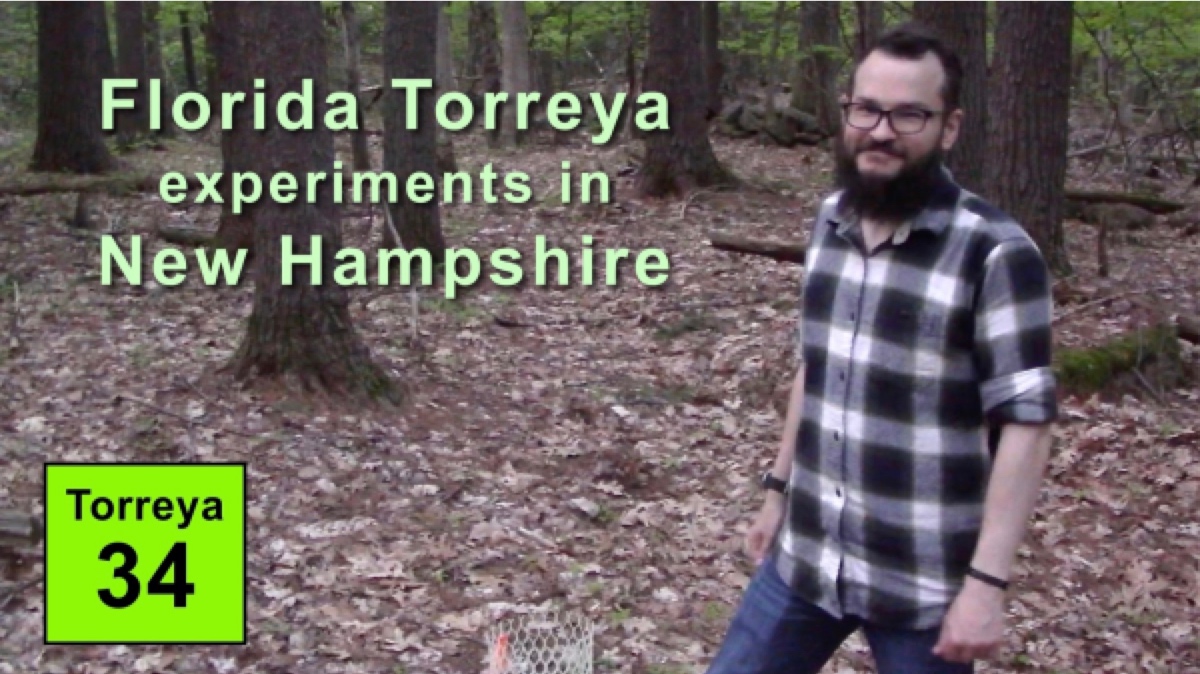
• July 2020 / Connie Barlow & Daein Ballard / Video of Daein Ballard's torreya plantings in New Hampshire
|
|
Mid May 2019 Daein Ballard took me (Connie Barlow) on a tour of his Torreya experiments in southern New Hampshire southeast TN. A year has gone by and I finally edited the raw video into 52 minutes and posted on youtube. Access VIDEO 34.
For this rapidly shifting climate, it is helpful to learn just how far north this slow-to-disperse subcanopy conifer can survive. Fortunately, Ballard has a diversity of woodland habitats on his property, and he planted torreya with an eye to maximizing the habitat types. Even so, he concludes, "Torreya is probably not going to do well here for now, unless you put it in very particular areas."
|
• July 2020 / Clint Bancroft / A 2018 seed from mature Torreya grove in north Louisiana germinates!
|
|
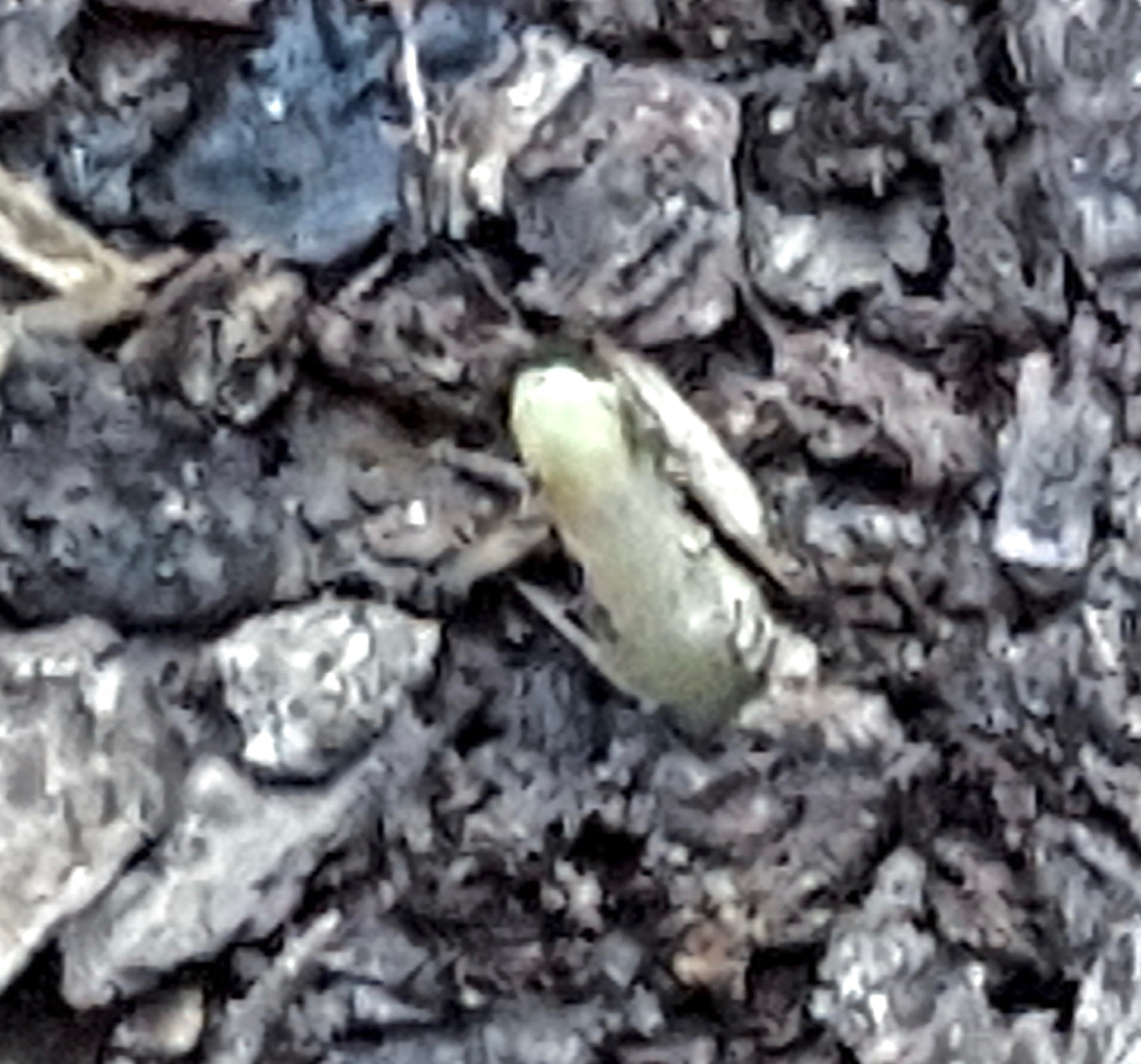
Clint participated in the November 2018 site visit to Briarwood Preserve in northern Louisiana. The preserve donated 3 seeds to Torreya Guardians, which Clint volunteered to germinate and foster.
Photo left is the first germination.
Experience suggests that this nearly 2 years for germination is fairly typical for this large-seeded endangered tree.
As usual, Clint provides very secure protection against rodents, which are both avid seed predators and occasional browsers of new growth.
|
• July 2020 / Clint Bancroft / Severely stressed transplant from November 2019 site visit to Clinton NC recovers!
 |
|
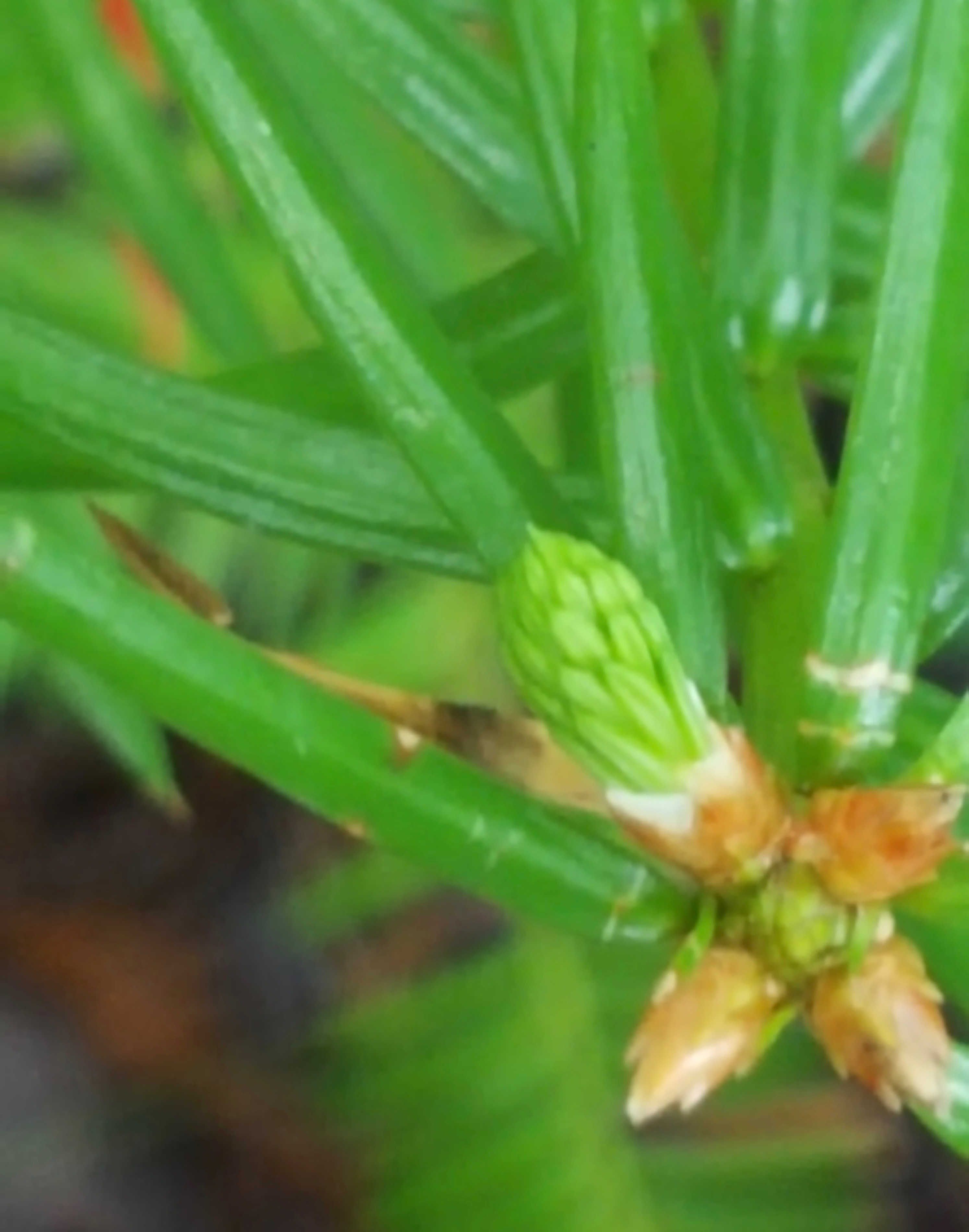
Here is a close-up of a portion of the larger Torreya I had dug from under the evergreen domestic camellia at Mrs. Kennedy's in Clinton, NC (during site visit of November 2019; see Clinton torreya webpage).
I guesstimated the tree to be about 8 years old. The taproot took a severe beating from its extraction, and there was no soil left on any of its roots.
After looking very stressed since I got it into intensive care, and after its losing several small branches since collection, it appears to finally be exercising its option to live. I suppose it sacrificed some small branches to help it muster the energy to recover from its trauma.
EVIDENCE OF RECOVERY: It had apical and lateral buds when collected, but they shrank, got brownish, and did not burst this spring. Just a few days ago one of the laterals has come to life (photo left).
It looks like this tough Torreya is going to make it. I will not even entertain the notion of outplanting it until fall of 2021. |
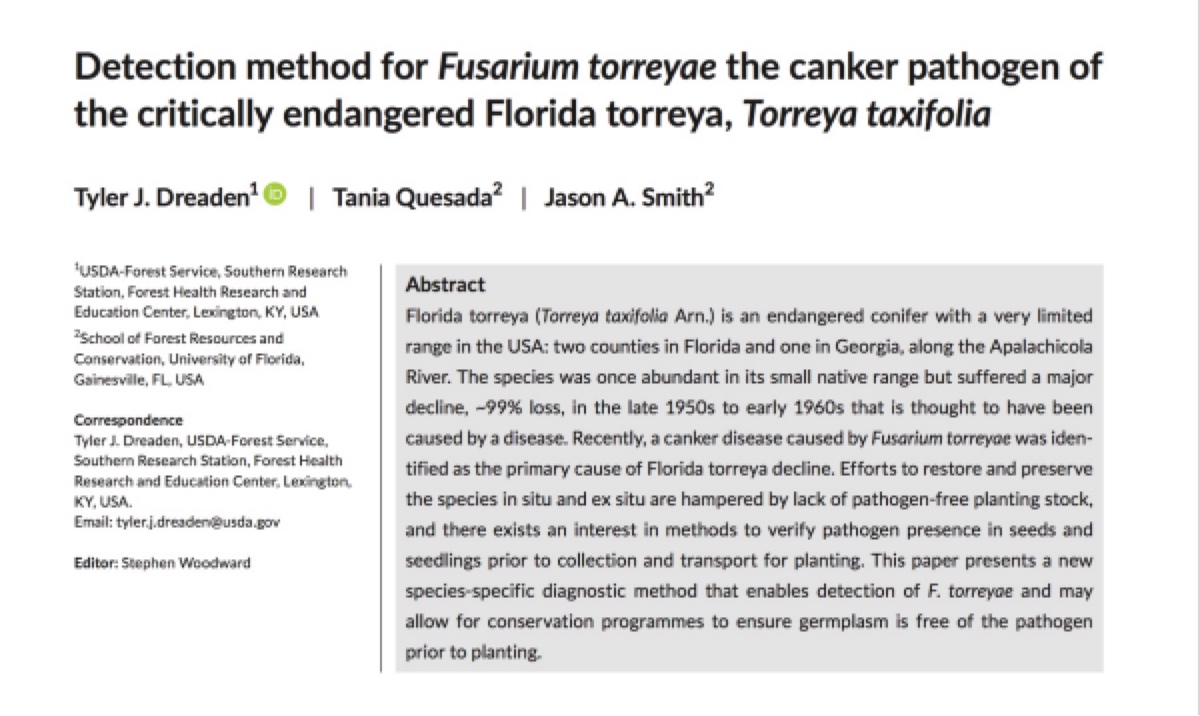
• June 2020 / Connie Barlow / New paper reports lab tool for identifying Fusarium torreyae
NOTE: Thus far, this fusarium has not been examined as to whether it can inflict lethal injury to Torreya and other native trees in an actual Appalachian forest context (rather than a lab in Florida). As I suggest on the endangerment webpage,
(3) Evaluate results and consider next steps:
(3a) If the pathogen is present, but nonlethal, then genetic engineering should not even be considered. Instead, the ideal way to free this endangered tree from its current glide toward extinction is assisted migration (see next section). Note: It is recommended that Prof. Jason Smith be queried on this matter, as it is possible that he has already sampled (and perhaps found) Fusarium torreyae in the Biltmore grove — and with as-yet nonlethal consequences.
(3b) If the pathogen is not present in the two oldest North Carolina groves, the question turns to: What is the farthest northward extent the pathogen has reached — and is it problematic there? Notably, is it on the grounds of Atlanta Botanical Garden or Callaway Gardens (southwest of Atlanta)? And has it established even farther northward in any of the ex situ plantings of Torreya in the northern region of Georgia (the southern-most Appalachian mountains). Overall, is there a sense that northward locations reduce or eliminate the destructive (even lethal) capabilities of Fusarium torreyae?
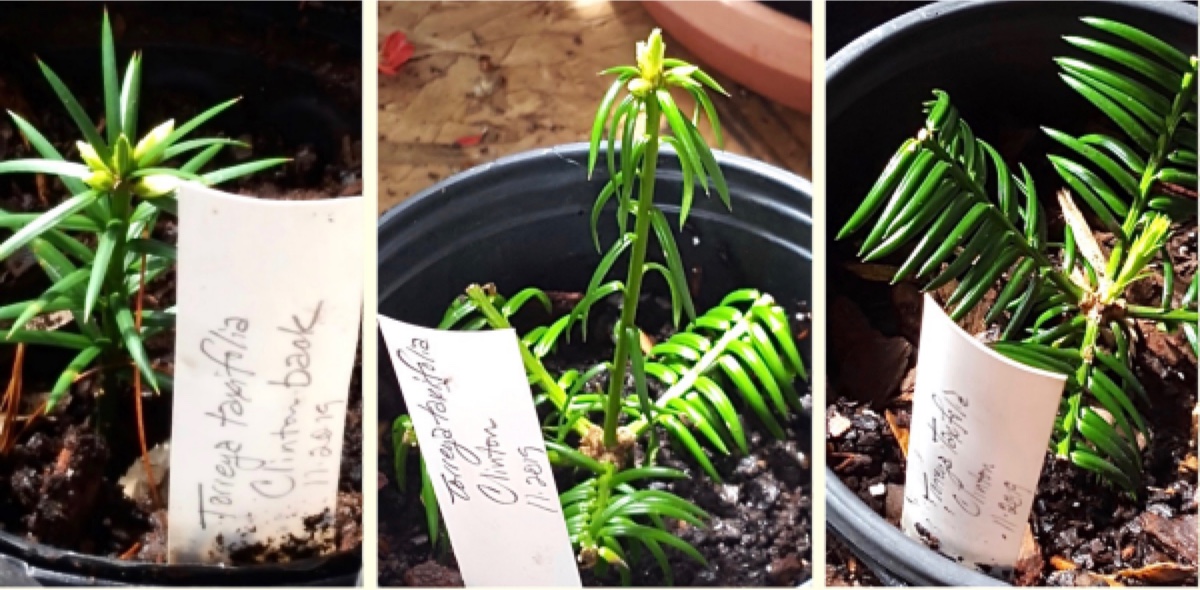
March 2020 / Clint Bancroft / More proof that rooted cuttings from basal cuttings produce tree-form
|
|
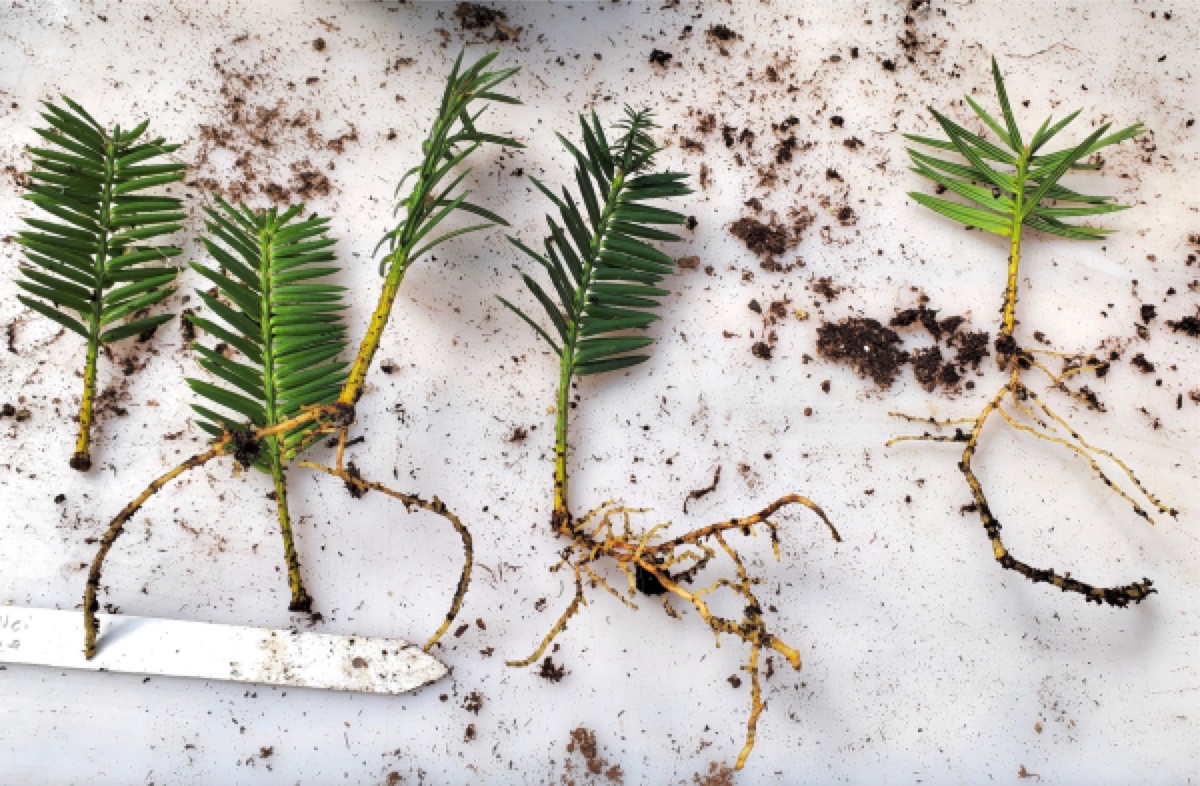
Clint Bancroft of southeastern Tennessee posted 3 new photographs of rooted cuttings of basal stems that were collected in Nov. 2019 at Clinton, NC. Thanks to these experiments, we now can recommend with certainty that using cuttings taken from the apical tips of basals (which sometimes grow in abundance around the base of mature Torreya trees) and then rooting those will definitely yield a growth form of tree rather than shrub. Clint does not yet have results on whether mid-section cut segments of basals also produce a tree-like growth form.
|
March 2020 / two sources / International Scientists Announce First Plant Translocation Conference and Journal section

|
|
• International Plant Translocation Conference" to be held in Rome, Italy (February 2021)
This month botanists and plant ecologists in Italy and elsewhere in Europe announced the first conference to be held on "plant translocation" in which "assisted migration/colonization" in response to current and expected climate change will be one of the topics. (Summary by Connie Barlow)
|
Visit the Committees" tab of the IPTC conference website to access the list of scientists (and their institutions and specialties). There you will see the U.K. plant ecologist, Sarah Dalrymple, who (with forester Richard Winder of Canada) initiated an international PLANT TRANSLOCATION NETWORK several years ago, manifesting as a preliminary webpage with founding membership list. (Torreya Guardian Connie Barlow is on that list and was involved in the early consultations.)
Dalrymple and Winder together launched a proposal in 2019 to the Journal of Ecology to produce/edit a set of up to 10 papers for highlighting as a Special Feature within a 2020 issue of that journal. Their title: "Plant translocations and climate change: Bioassay, surveillance and solution to a global threat?
. Their proposal included a list of authors and paper titles and was accepted February 2020. Read their proposal and you will see that their emphasis on studying existing plant translocations (as in poleward plantings within botanical gardens) can serve as field experiments already underway to (a) assess levels of climate change that plants have already responded to, and (b) obtain on-the-ground confirmation where species "assisted migration" can already be successful. To see how TORREYA GUARDIANS have already been documenting horticultural plantings as indicators of suitable habitats and noninvasivenes, visit our Historic Groves webpage.
February 2020 / Connie Barlow / Applying Torreya Assisted Migration Success to California Conifers
As founder of Torreya Guardians, I have recently expanded my "assisted migration" advocacy for a single climate-endangered tree to apply to "glacial relict" conifers in other regions of the country. California's two species of redwoods (Coast Redwood and Giant Sequoia) are among them. In addition to networking among the redwood researchers, I have undertaken advocacy actions grounded in my experience with assisted migration poleward of Florida Torreya:
|
|
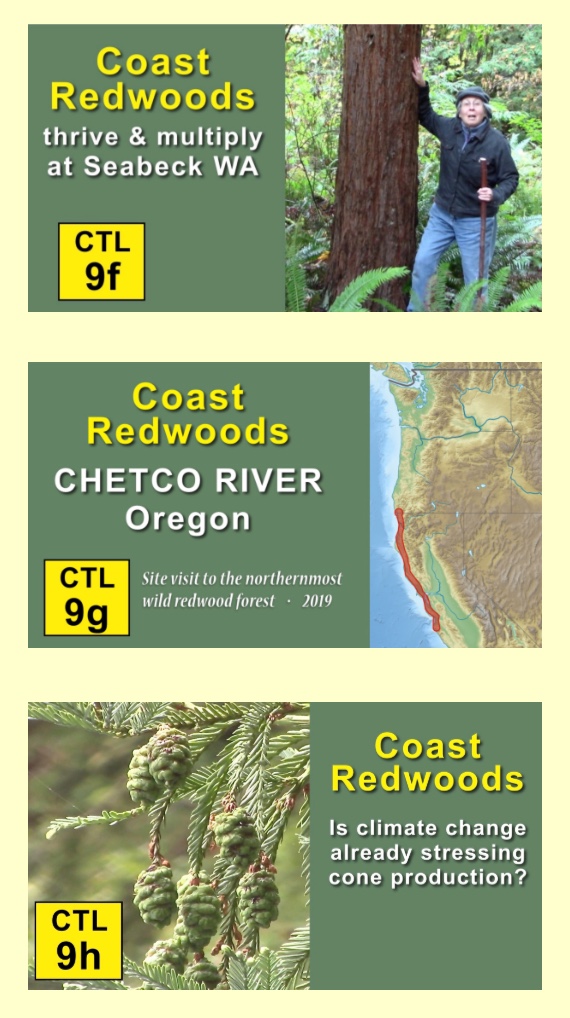
(1) VIDEO DOCUMENTATION OF CALIFORNIA REDWOODS ALREADY THRIVING IN PACIFIC NORTHWEST: In 2019 I posted 3 additional site-visit documentations on youtube (pictured at left), thereby bringing to eight the number of videos on redwoods that I began posting in 2017. Access an annotated list of these redwood videos as part of my larger "Climate, Trees, and Legacy" video series: Assisted Migration Advocacy for California Redwoods
(2) SEATTLE AREA ADVOCACY FOR PLANTING CALIFORNIA TREES AS FORESTRY CLIMATE ADAPTATION: Advocacy for "Planting Trees from Warmer Drier Climates", comment filed by Connie Barlow re public survey of King County 30-Year Forest Plan (Seattle, WA), February 2020.
Barlow's Redwood advocacy is, of course, an individual endeavor and does not implicate any other citizen volunteer involved in the assisted migration of Florida Torreya in this extension of advocacy. Even so, it does suggest that the 15-year history of citizen actions within Torreya Guardians can indeed serve as an exemplar for adaptation responses that could benefit other tree species challenged by climate change. See our extensive webpage on History of Torreya Guardians.
Note: The SEATTLE area already is engaged in forestry climate adaptation by replanting a city-purchased 2012 clearcut with a blend of local genes of native species of Douglas-fir and Western Red Cedar and seeds sourced from native forests in SW Oregon. See: Why We're Planting Oregon Trees in Washington; more detail here.
|
January 2020 / news clip / Shock at Giant Sequoia deaths may help assisted migration for Torreya
• "This is not how sequoias die; it's supposed to stand for another 500 years"
|
|
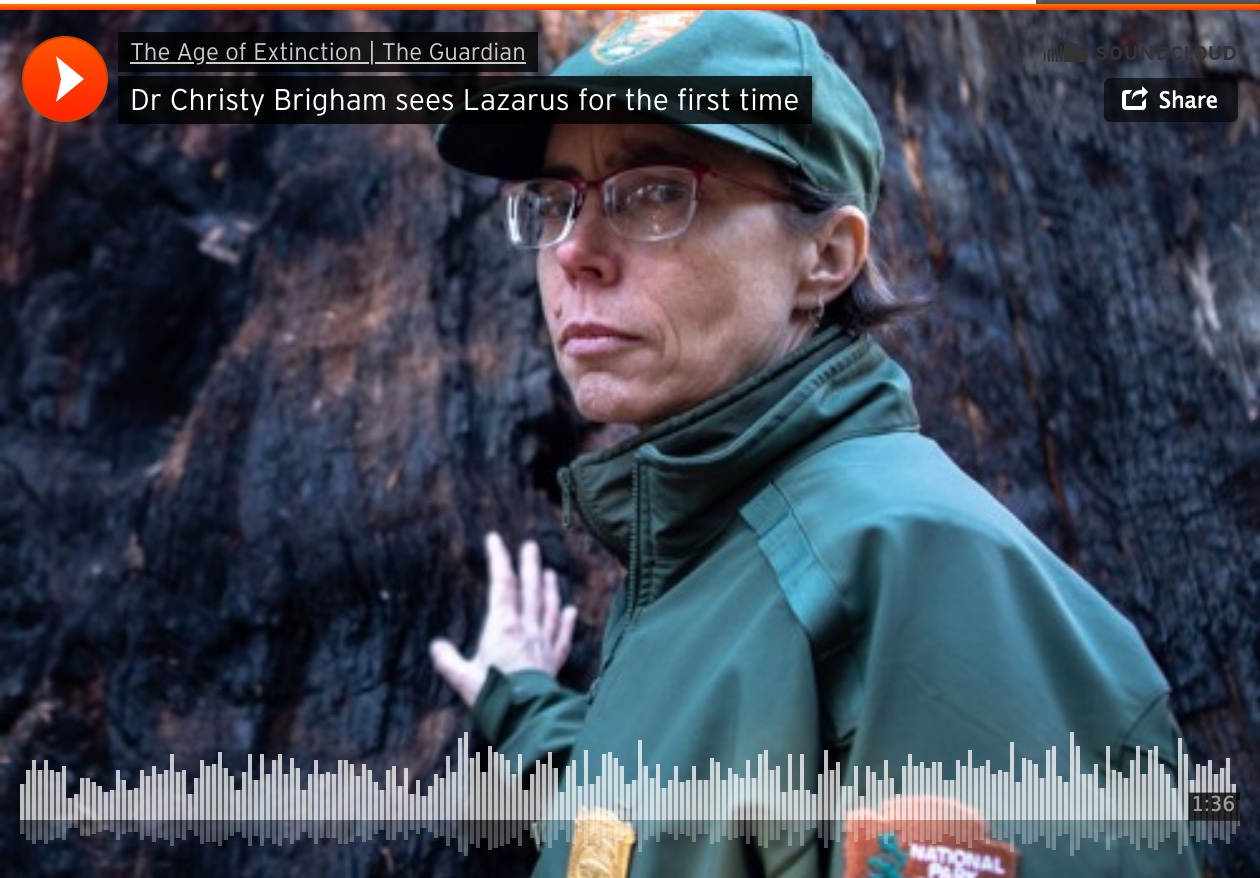
SUMMARY by Connie Barlow: This lengthy, illustrated article in the January 18 online issue of The Guardian is a tear-jerker. I already knew this past fall of the shocking losses of Giant Sequoias in the Sierras, as I communicated with one of the coauthors of the in-press paper — because I had come upon a newly fallen branch of a Coast Redwood that also showed bark beetle tunnels, despite the "knowledge" that bark beetles cannot attack redwoods. What I see now is that, yes, bark beetles cannot penetrate the thick trunk bark, but the bark on even the most massive branches (of a Coast Redwood) is no thicker than that of a yew. So the beetles kill redwoods slowly, out of sight in the high canopy, branch by branch. In contrast, pines and firs and spruce wiped out in the western USA are killed by bark beetles whose tunneling and fungal follow-up girdle the main trunk. The damage is readily apparent even at ground level.
|
PHOTO ABOVE: Dr. Christy Brigham, who is responsible for the welfare of the ecosystems in Sequoia and Kings Canyon national parks, stands in front of a suddenly dead Giant Sequoia.
IMPORTANCE FOR TORREYA: Crucially, because the scientists in charge are shocked by the deaths and because Giant Sequoia is a beloved tree that happens to be the most massive tree species in the world, this occurrence may finally prod the establishment to realize that our own climate-endangered Torreya deserves official approval of poleward assisted migration.
January 2020 / multiple sources / Wollemia survives the Australian fires, thanks to humans
|
|
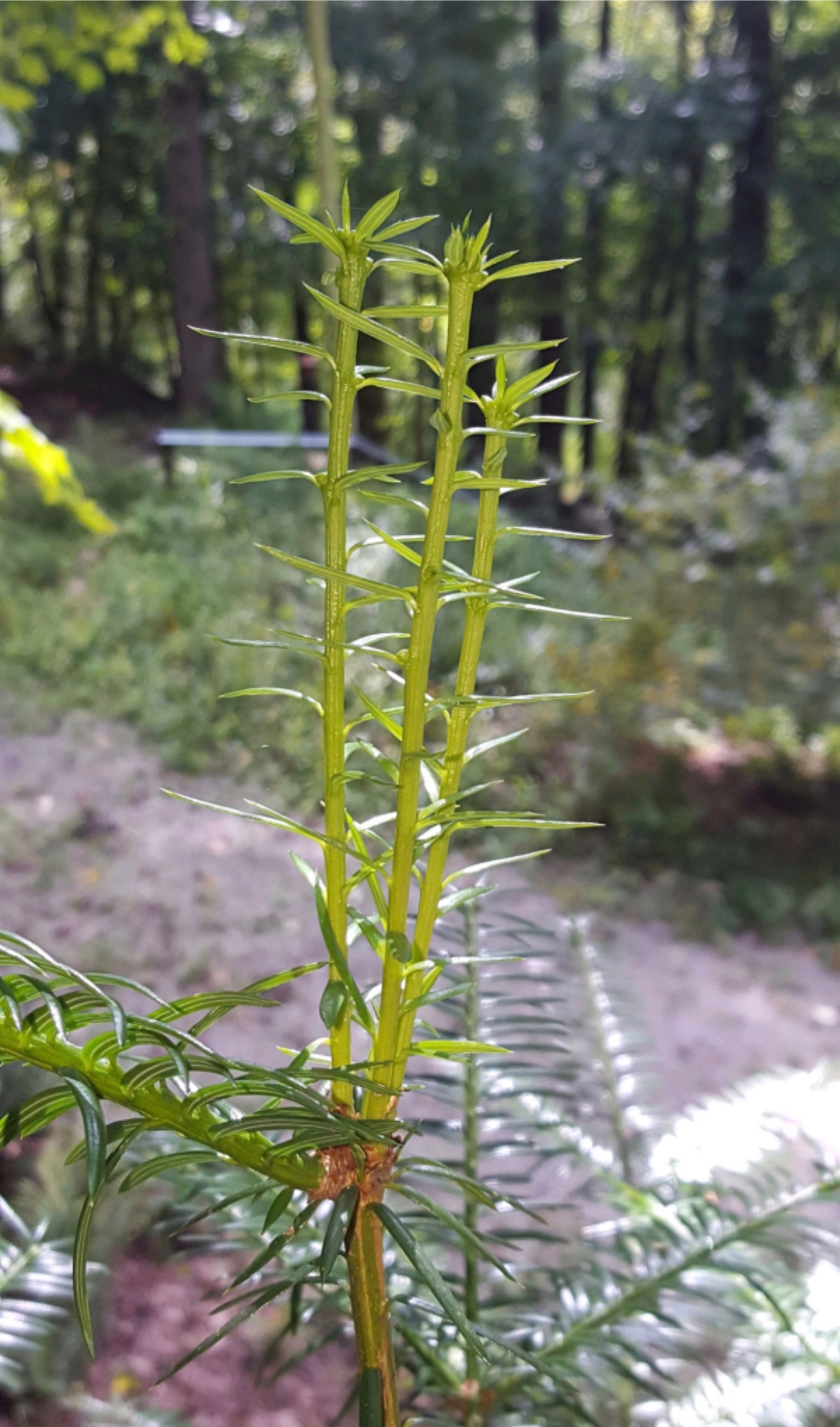
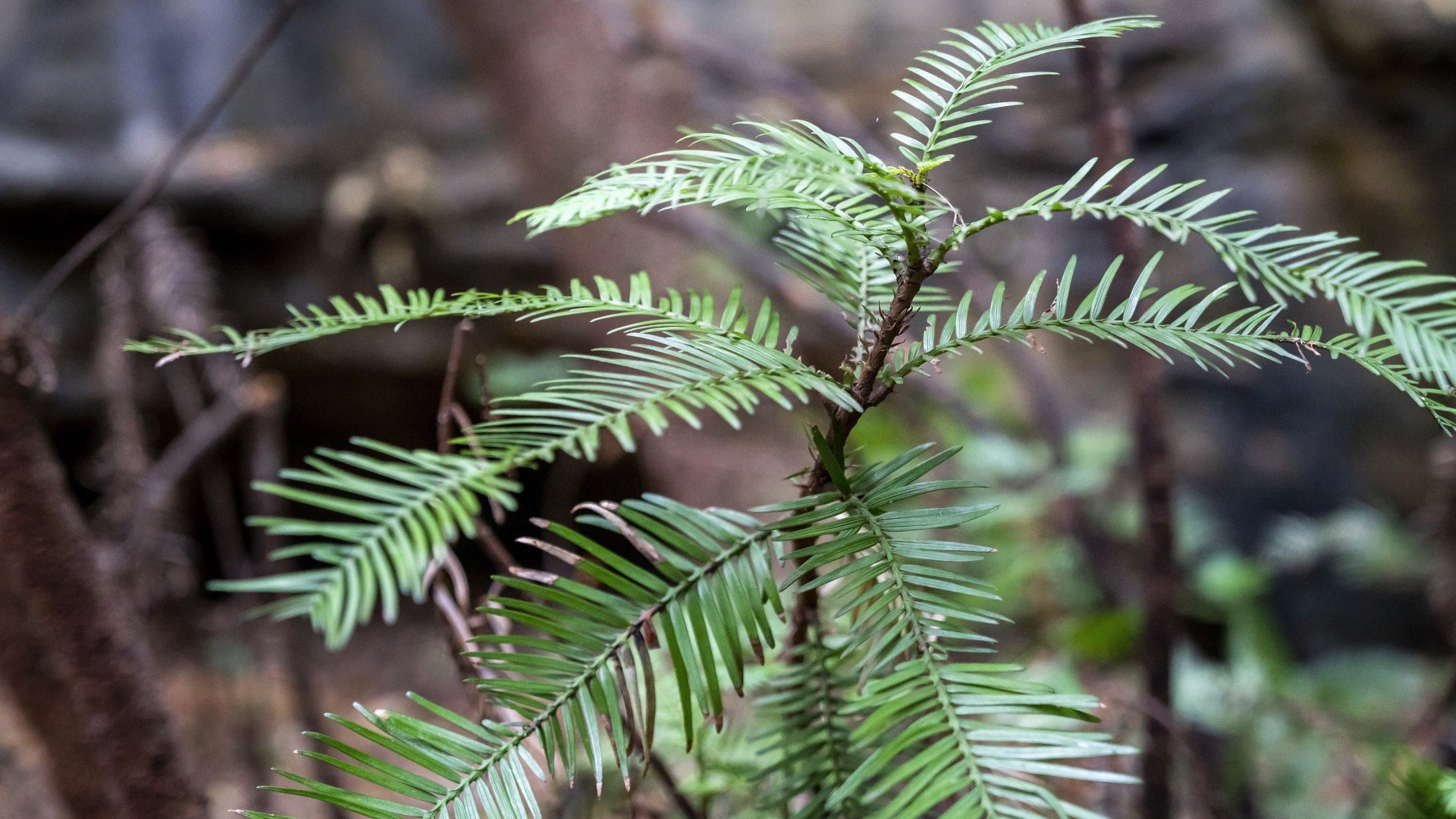
PHOTO LEFT: No, that is not a seedling Torreya. It is Australia's endangered Wollemia nobilis, of the Araucariaceae family of conifers (Torreya is of the Taxaceae family). When, in 1995, it was discovered in a single deep gorge within Wollemia National Park, Wollemia was judged by some to knock Florida torreya out of its presumed status as the most globally endangered conifer tree.
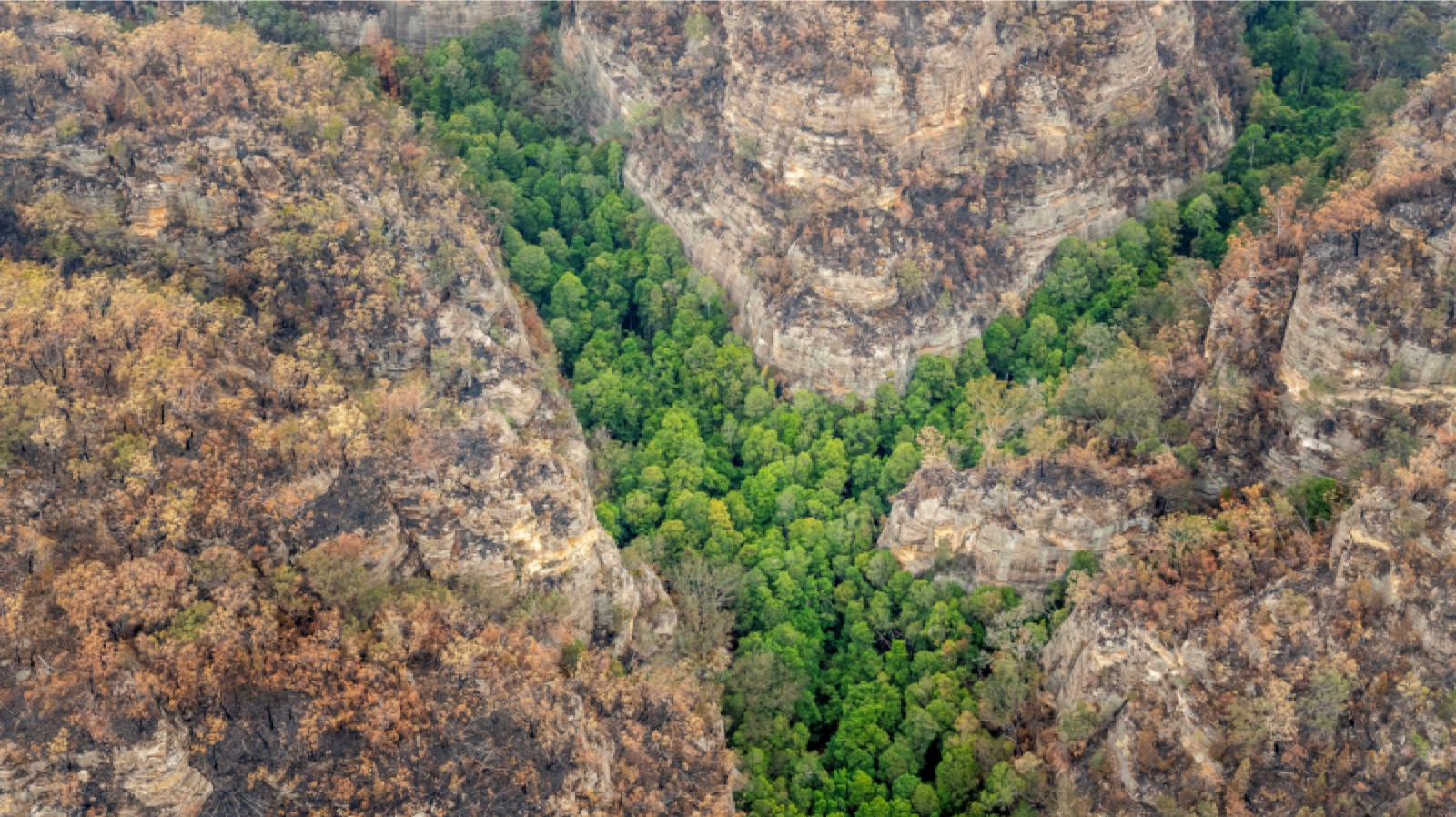
PHOTO LEFT BOTTOM: Several Torreya Guardians have been corresponding about the tremendous success of the fire-fighting effort that saved the Wollemia from likely extinction in the wild this month. Not all the greenery in the photo is Wollemia, but all of the brown is where the fire burned — and would have burned into the depth of this gorge, were it not for make-shift irrigation, spraying, and chemical retardant.
• Torreya Guardian Connie Barlow says, "What is remarkable is that no mention is made in media reports of the possibility of assisting the migration of this ancient genus to more suitable climates. Clearly it is a "left-behind" species, whose final redoubt is the coolest, wettest depth of a canyon system."
|
January 2020 / multiple sources / Photos of mature Torreya at Kalmia Gardens SC
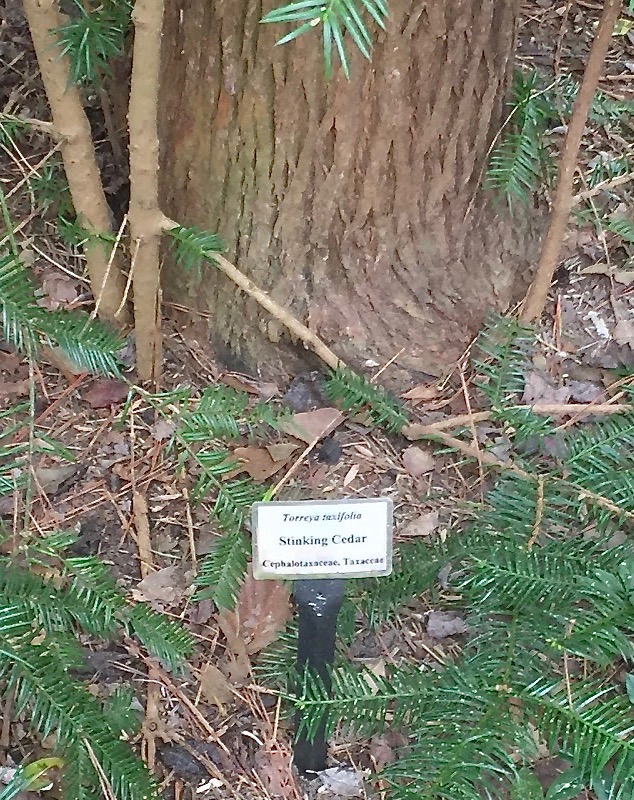
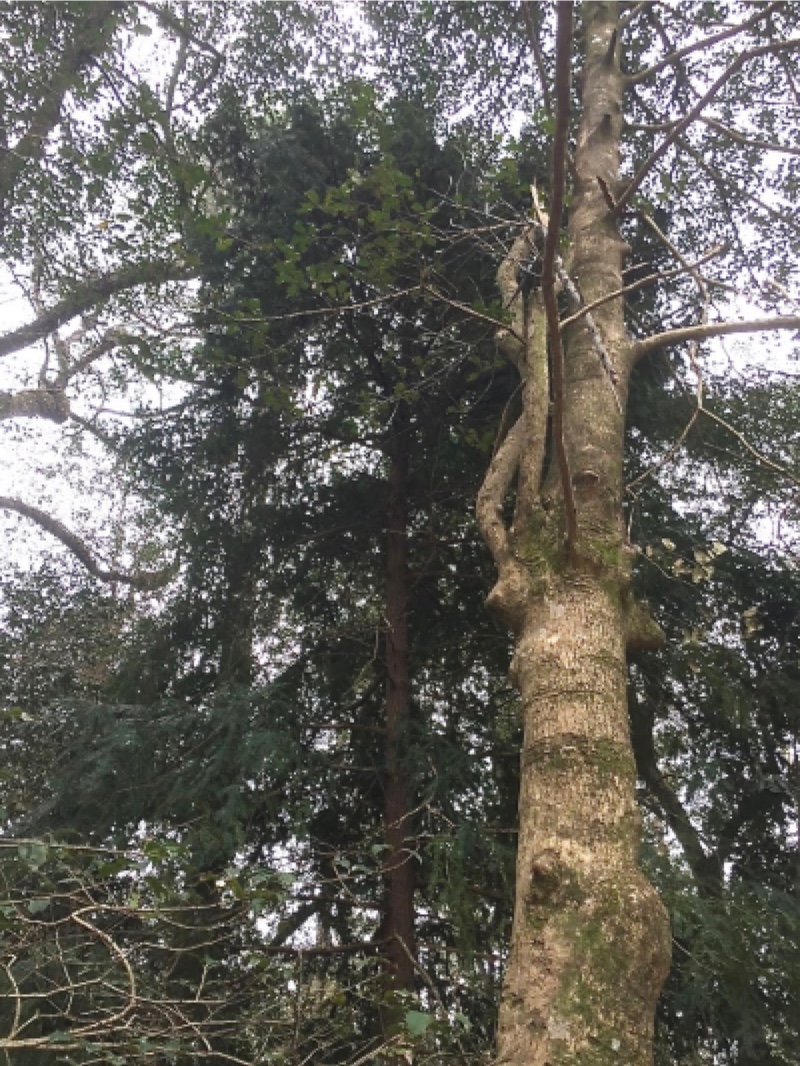
Beginning in 2018, Paul Camire and Connie Barlow attempted to fully document (with photos, where possible) all mature plantings of Florida Torreya, especially in states northward of Florida. As new information comes our way, Paul keeps updating the lengthy pdf, titled Ex-situ specimens of Torreya taxifolia.
 |
|
 |
|
Where photos and important information on long-term survival and reproductive results are available, Connie adds the new information to the Historic Groves webpage.
The PHOTOS here pertain to the newest entry on the Historic Groves webpage, pertaining to Kalmia Gardens in eastern South Carolina.
|
December 2019 / Clint Bancroft (TN) / Discovery of Torreyas free-planted by a mystery rodent
 |
|
 |
|
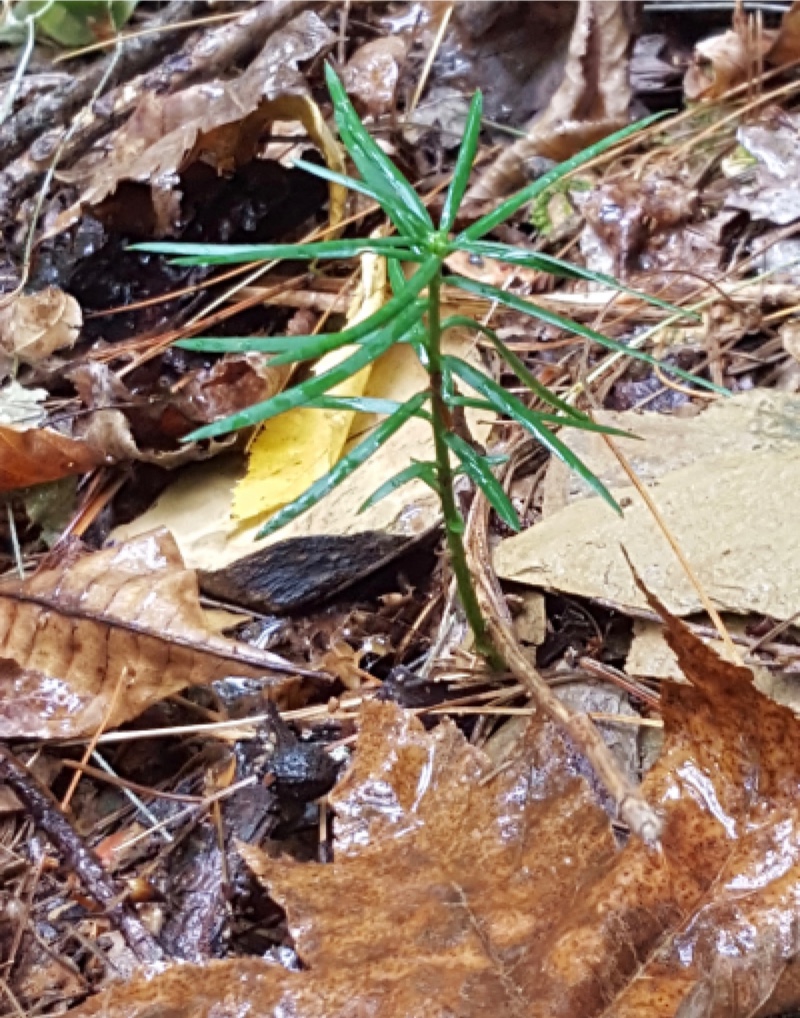
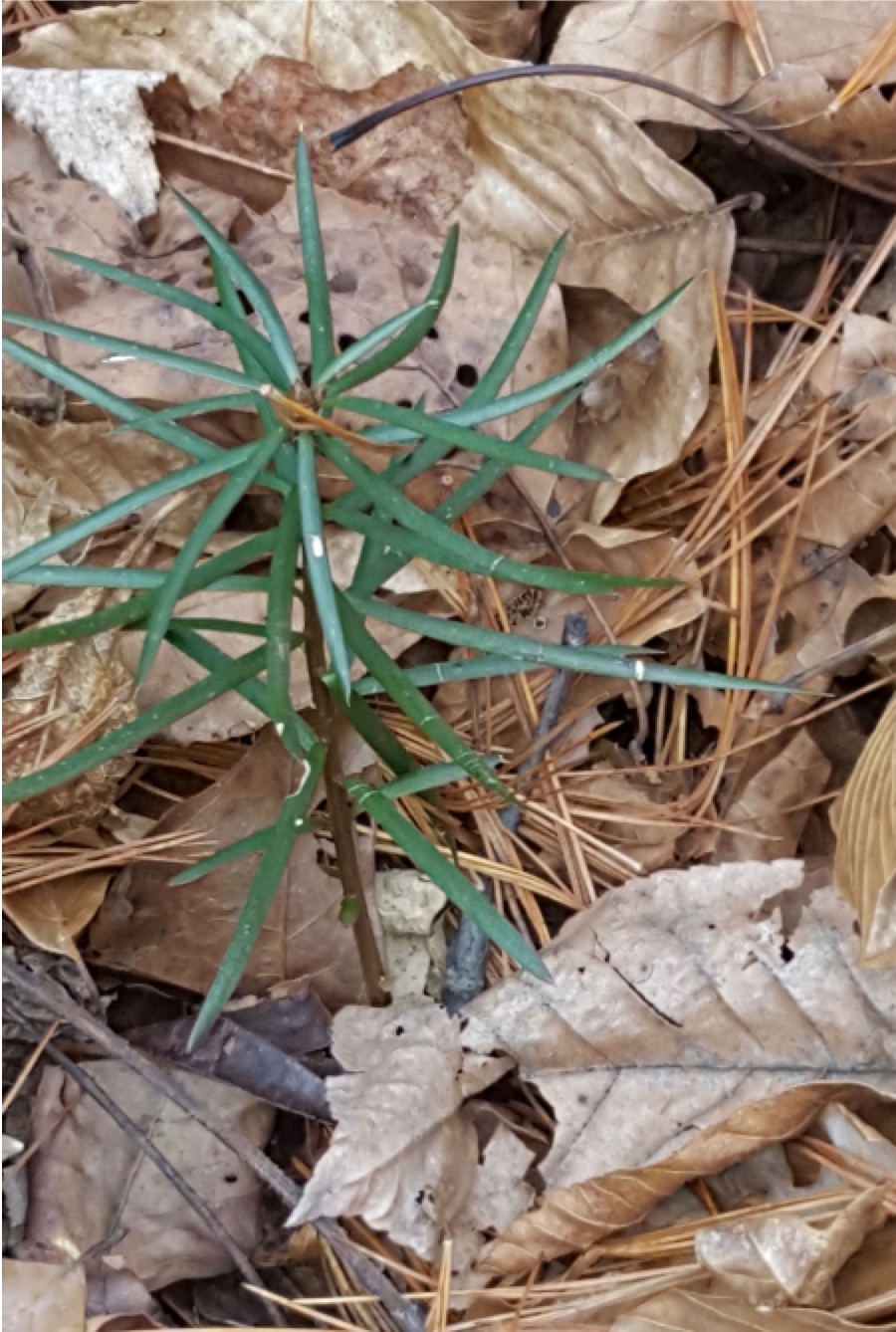
PHOTO LEFT, OCTOBER 12: "I was carrying water to a dwarf mountain laurel I had planted. I saw with amazement this new seedling. I have free-planted only a single seed and that was 3+ years ago by the creek."
PHOTO MIDDLE, DECEMBER 29: "Behold a SECOND strange and wondrous mystery: a second germination I did not plant. This one is about 12 feet from the first. Both are easily 200 feet from my propagation area, which is the only place seeds could have come from...."
|
"... These have to be Medford OR seeds I had planted in an outdoor propagation pot February 2017. The pot was wire-mesh covered and should've been safe from squirrels. However something dislodged the wire mesh cover and squirrels got into the pot. All but one of the seeds were pillaged from that pot. If so, this means it has taken them three summers to germinate." FULL REPORT
December 2019 / Chris Anderson (TN) and Fred Bess (OH) / Photos of torreya for holiday cheer
Report Summary by Connie Barlow: December is not a usual time for torreya activity, but two planters sent in photos for posting this month.
PHOTO BELOW LEFT: A beautiful, herbivory-free torreya free-planted from seed by Chris Anderson directly into his forested property, east side of Cumberland Plateau, TN.
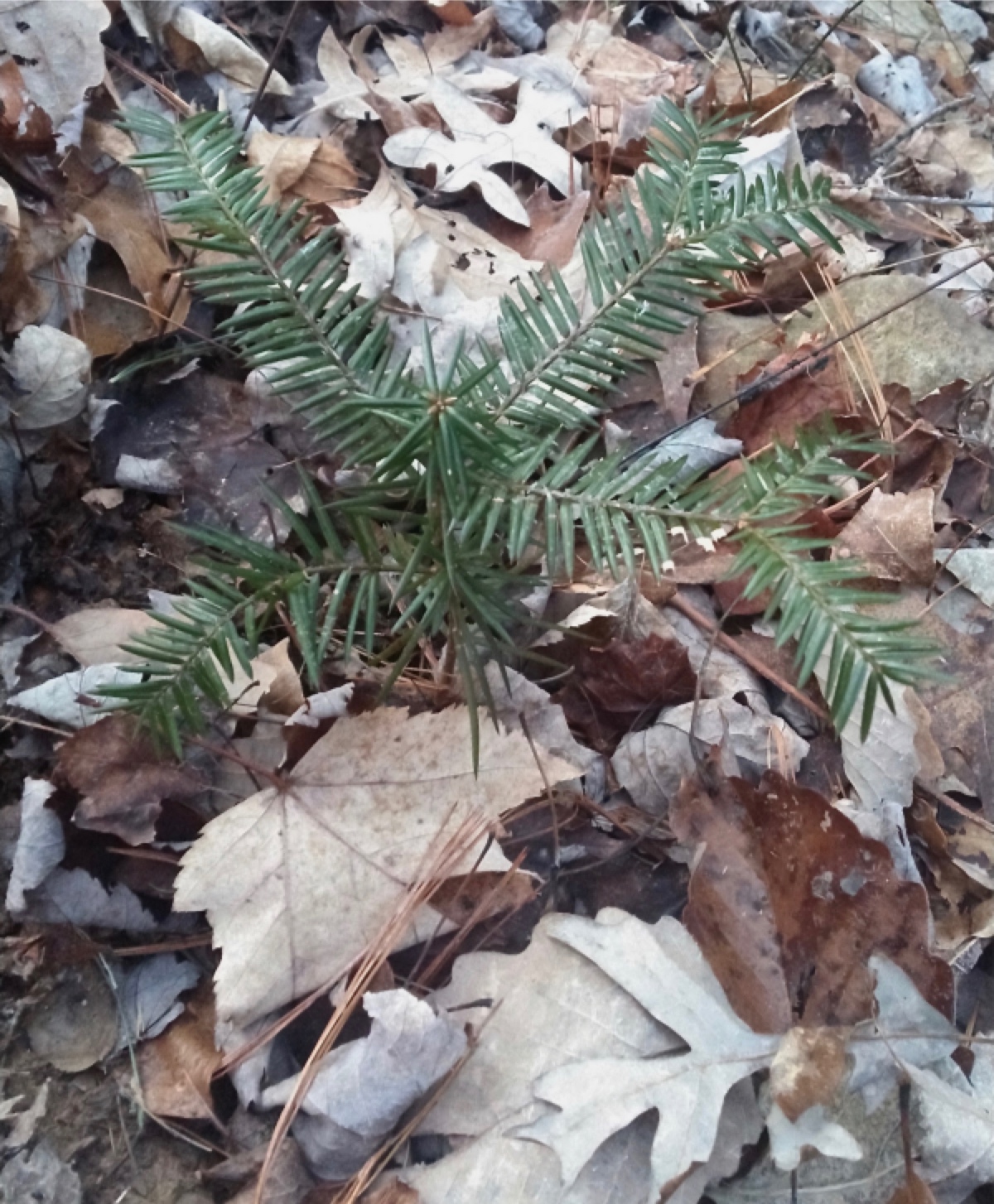 |
|
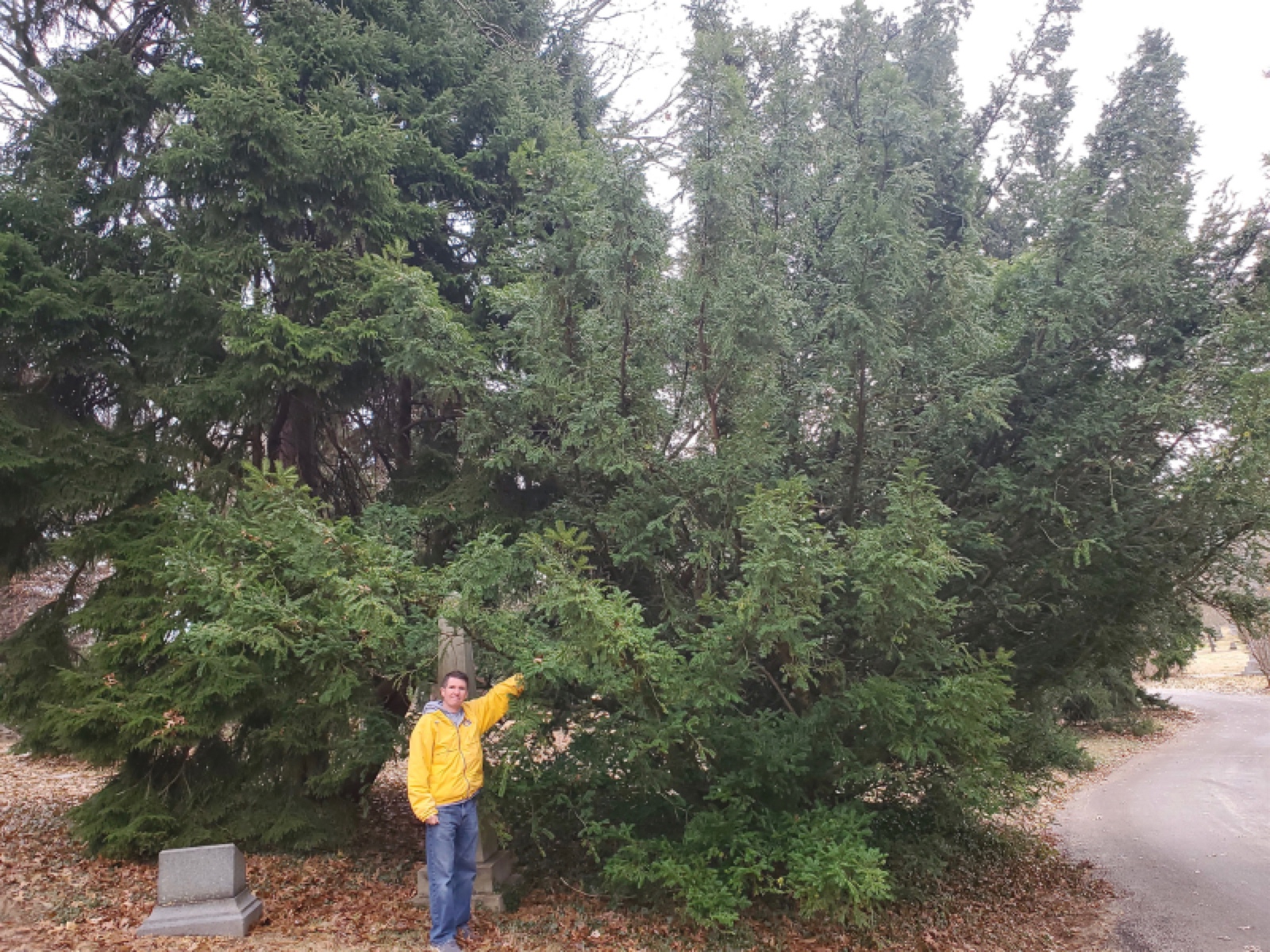 |
|
PHOTO NEAR LEFT: Fred Bess (torreya grower in Cleveland, who is our northern-most seed producer) revisited the lone Florida Torreya in a cemetery near Cincinnati. The neighboring conifers make it difficult to assess the height in this photo, but as Fred reports, "The Cinci tree is still looking good as ever."
|
November 2019 / Mike Heim / Two Florida Torreyas winter in Wisconsin
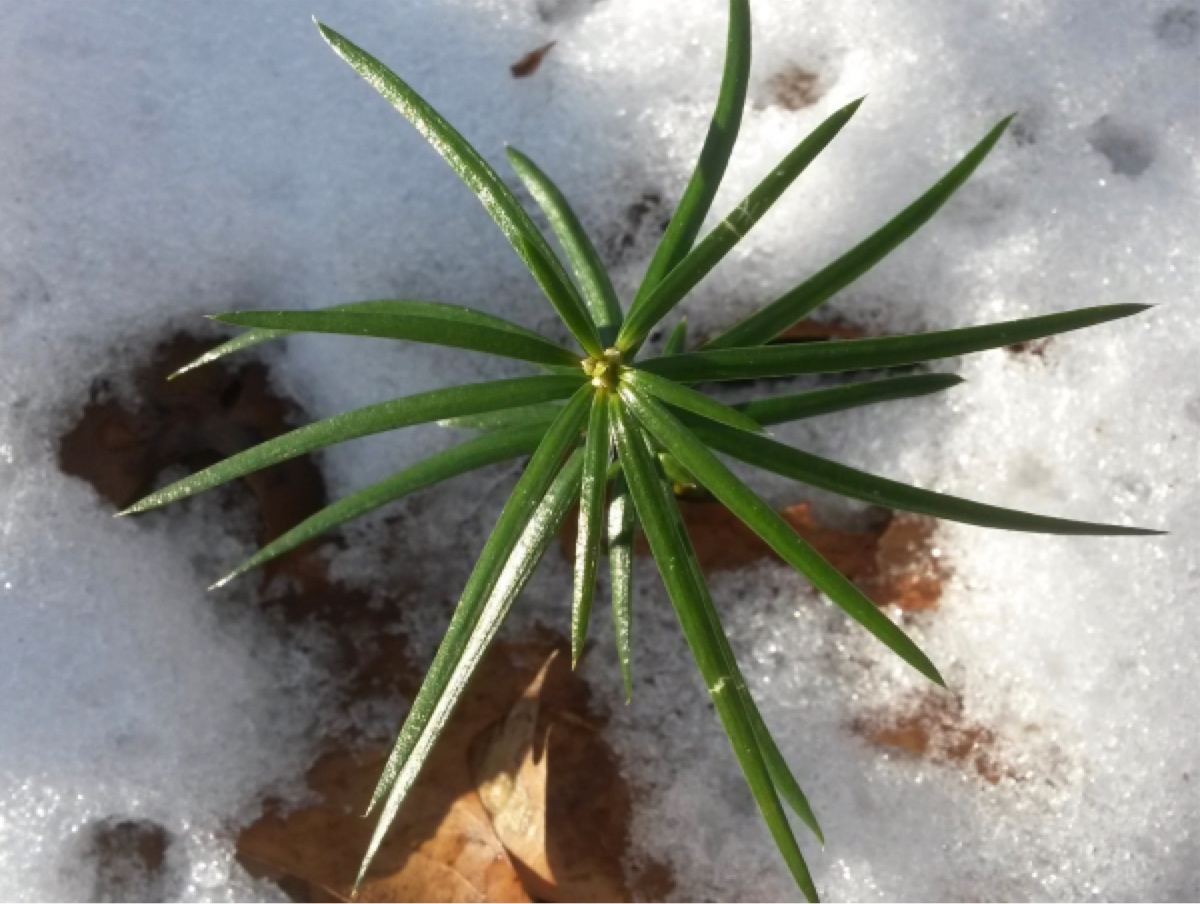 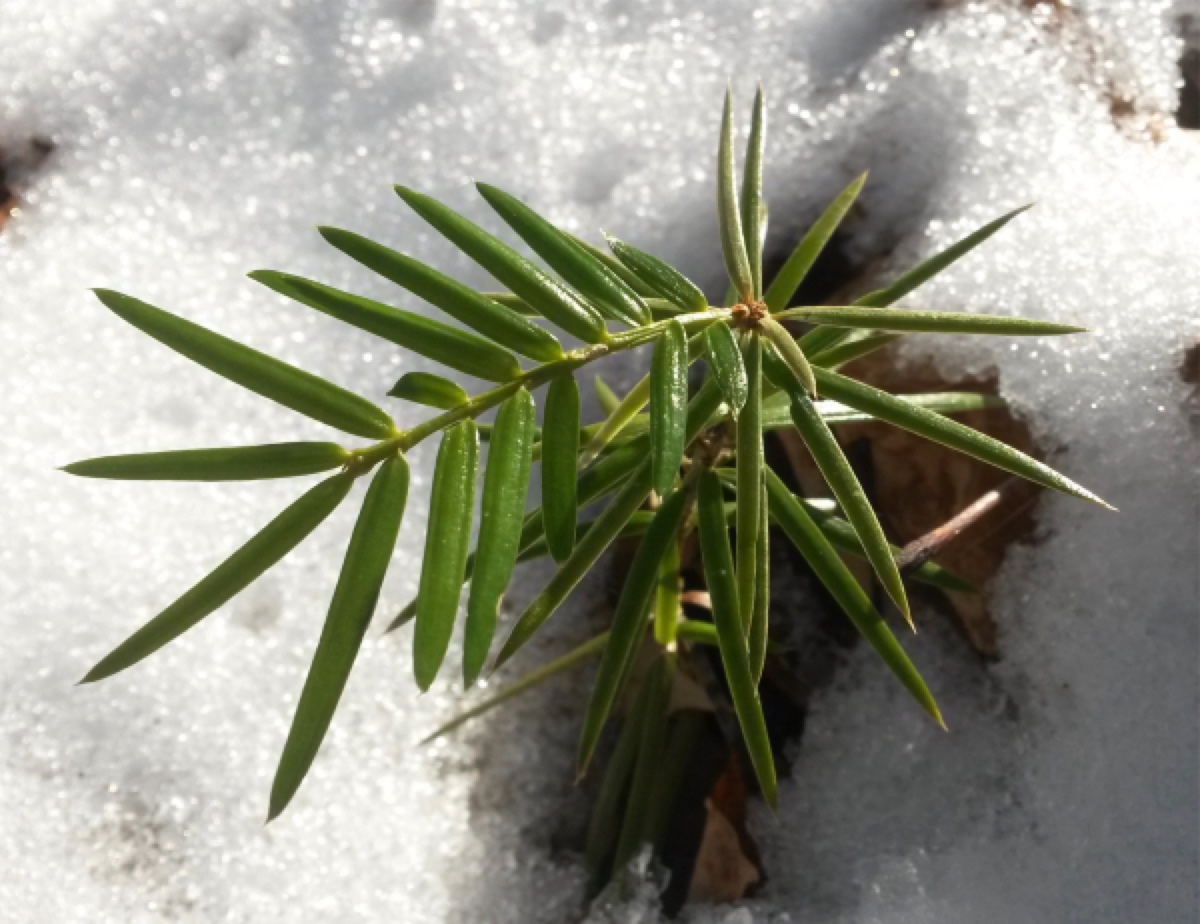
|
|
Mike Heim writes, "Thought you might like an update on the Florida torreyas way up here in northern Wisconsin. It's all good news."
PHOTO TOP (Nov 24): This past summer one of the seeds germinated that I planted in situ two years ago in the woods. I find it interesting that the only one to germinate so far did so next to a wild ginger (Asarum shuttleworthii) division that I transplanted from the western North Carolina mountains a couple of years earlier. Just speculating, but perhaps something in that soil triggered germination, whether it be soil fungi/microbes or exudates from the ginger roots. Only time will tell if there's any merit to this idea, when and if the others germinate.
PHOTO BOTTOM (Nov. 24): This one is from the native Georgia population that has been growing here without injury for several years. Last winter it survived under only a couple of inches of snow at -36F. This fall both of these plants were exposed to -6F on November 12th, which is exceptionally early for such cold. There was no snow whatsoever. As you can see, the torreyas were not fazed by this.
The full report (with reports and photos from previous years) are on the Hayward, Wisconsin Torreya webpage.
|
November 2019 / Joe Facendola, Clint Bancroft, Nelson Stover / 200+ seeds and 10 seedlings collected at Clinton NC Torreya tree
Report Summary by Connie Barlow, using emails submitted by the three collectors.
 |
|
 |
|
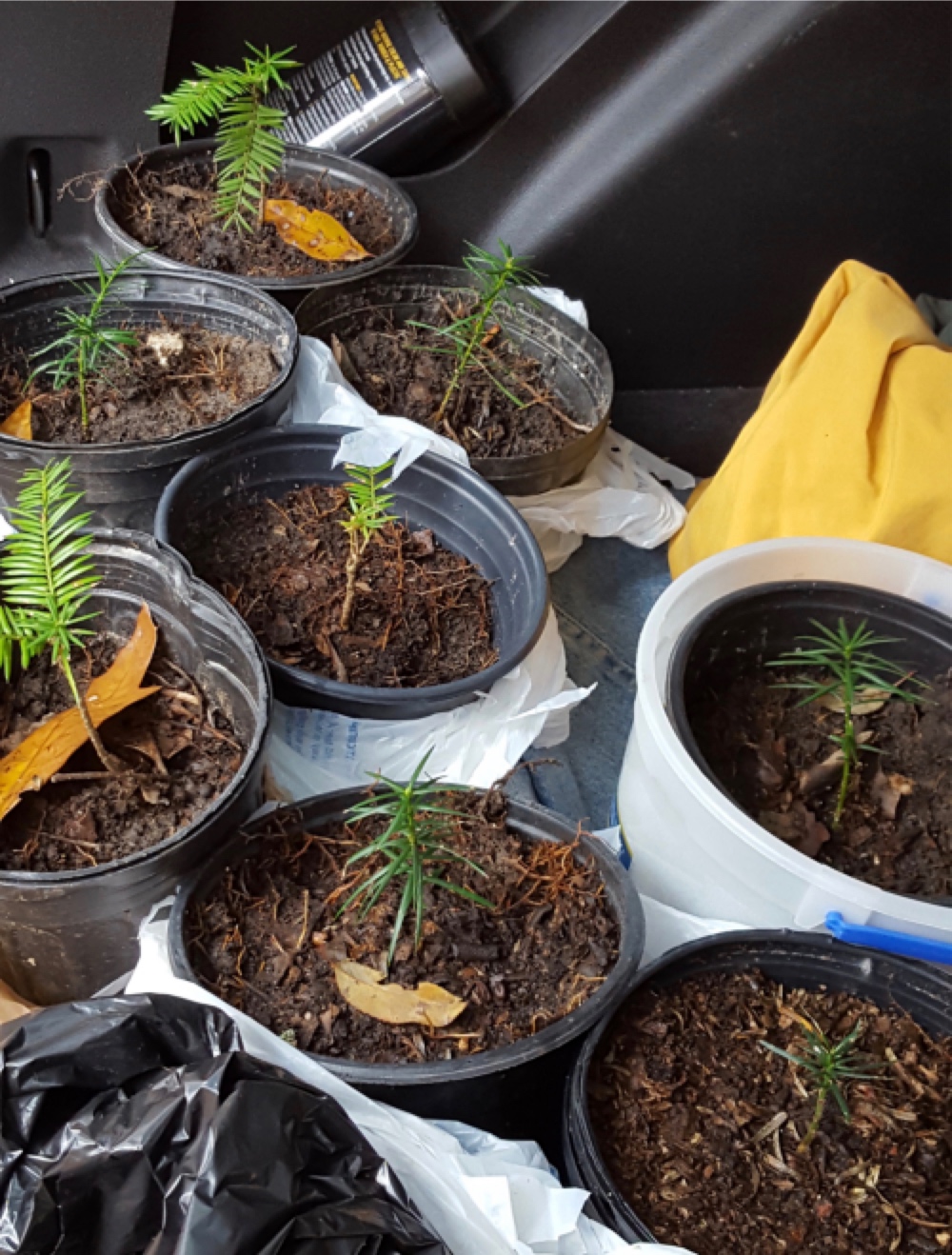
The single old horticultural planting remaining in Clinton NC seems to still be bearing close to 500 seeds annually. Joe Facendola visited the site first, collecting 208 seeds that had already fallen to the ground. Clint Bancroft and Nelson Stover made a joint expedition there 10 days later. Few seeds remained at that time (squirrels noticeably harvest them, removing the fallen seeds and leaving the hulls right where they found them).
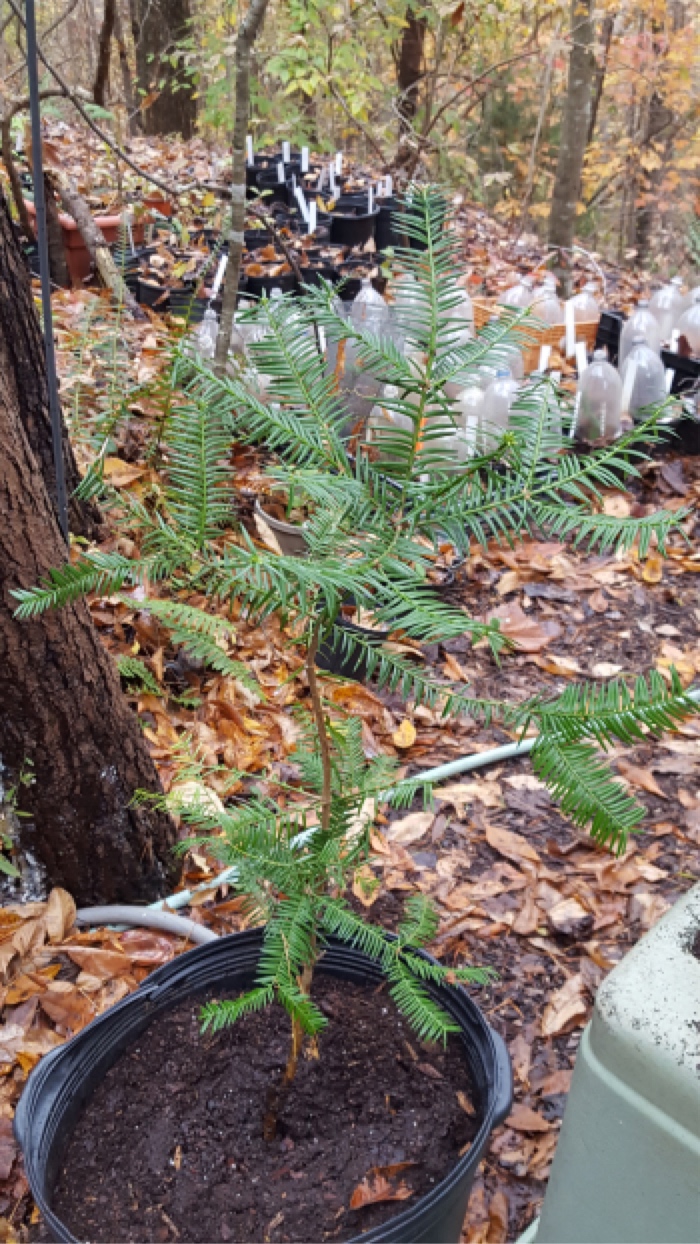
Fortunately, the owner (Mrs. Kennedy) encouraged the duo to dig up (and thus rescue from the lawnmower) any seedlings that they found. So Clint dug up 10 first-year seedlings and also a much larger one that had escaped mowing by having been buried by a squirrel right next to the trunk of a Camellia. He also collected some cuttings for rooting. Nelson photographed the saplings in the backyard — too big to dig up.
Direct link to the 2019 UPDATE on the CLINTON NC torreya webpage.
|
November 2019 / Connie Barlow / AUDIO PODCAST on Torreya portrays Fusarium torreyae as present in all tissues — but harmless until [environmentally] triggered
An hour-long AUDIO featuring Florida Torreya was posted 3 November 2019 in the podcast series titled "In Defense of Plants." The episode was hosted by Matt Candeais and titled "The Fall of the Torreya and What Is Being Done To Save It". The interviewee was Jennifer Ceska, who co-founded the Georgia Plant Conservation Alliance from her base as conservation coordinator of the State Botanical Garden in Athens, Georgia.
This interview offers significant new information on how the Fusarium torreyae is being interpreted. Because is is found "in all tissues" but is usually not pathogenically expressing, this evidence supports arguments in favor of northward assisted migration (to escape environmental triggers that are pathogenic in too-warm climates, including the tree's native range). However, neither Ceska nor the podcast host ever mentions that Florida Torreya is a well-known glacial relict. Absent that understanding, the environmental trigger of disease expression seems to remain a mystery. Indeed, absent a paleoecological understanding that Torreya was already suffering from interglacial warming within its peak glacial reserve when seed-production stopped 60 or 70 years ago, Ceska now fears that her institution's ex situ plantings in north Georgia may actually be threatening nearby native conifers with the disease — and thus may warrant removal and burning (!). Overall, the institutional interpretation of how best to manage Florida Torreya is the exact opposite of what is supported by the strong and growing compilation of evidence gathered over 15 years by Torreya Guardians. The case we make in favor of northward assisted migration is now very strong, as evidenced on our Historic Groves webpage and the lengthy causes of endangerment webpage.
|
|
KEY QUOTATIONS BY JENNIFER CESKA (in pdf) with audio timecodes:
28:31 JC: [Recent debates about whether "commercialization of endangered plants" was helpful for the plants] ... Torreya was the godchild; you could grow an endangered tree in your garden and it's a beautiful horticulture tree ... that document never saw the light because we learned from Jason Smith at the University of Florida [what the pathogen was]
30:03 JC: ... We thought we were taking the torreya away from the disease; we thought this was in the soil. We thought it could be introduced or always been there. Well, no. It's in the torreya; it is part of torreya. He named it; it's a fusarium named for torreya. It's in all of its tissues; it's passed from mother to child. And if the tree is healthy, everything's fine; they live together. But if the tree is weak in some way horticulturally, then this fusarium can express and it can spread. And in the lab Jason Smith has learned, he's done inoculations in the lab, that it can jump in the lab to different plant families. |
ACCESS THE COMPLETE TIMECODED EXCERPTS OF J. CESKA'S STATEMENTS, as selected and transcribed by Connie Barlow in pdf. Connie selected excerpts that (a) convey what the official institutional implementers of the Torreya recovery plan have learned about how best to nurture this endangered species in northward ex situ plantings, (b) convey the lack of attention to Torreya's undisputed glacial-relict status as the most scientifically reliable explanation for what triggers the embedded fusarium to become pathogenic, and (c) reveal the degree to which a non-peer-reviewed master's thesis (lab based only, with no testing of the pathogen's ability to survive winter freezes and other ecological limiting factors) is being used to consider destroying ex situ torreya collections — on the off-chance that Fusarium torreyae might be able to infect other native conifers of Georgia and points north. Key excerpts on the latter:
31:44 JC: We've gone back to our partners [like in Gainesville GA] ... and I said, 'You know that collection you planted 18 years ago as a partner and we were so grateful that you planted that grove of torreya, and it is in a cultivated area, but it is next to your woods: you need to know. And so now their board is. They still have them. But they had to go have a conversation about that. And if they decided that they needed to remove those trees, I would have respected that and understood. Because they have a responsibility to the natural areas that they are restoring and protecting as well.
32:21 JC: So, yes, the story changed. And, thank goodness that we did track them everywhere that we planted ... that we know whose who and where, that we know the health of those trees, and if we do see a problem we would remove and burn that material.
For the long history of acceptance of Florida torreya as a glacial relict, consult the excerpts on torreya as glacial relict posted from the 1984 ESA listing, the 1986 original recovery plan, and the 2010 federal plan update.
October 2019 / Connie Barlow / NEW VIDEO by Tallahassee Public TV station on Hurricane Michael Damage
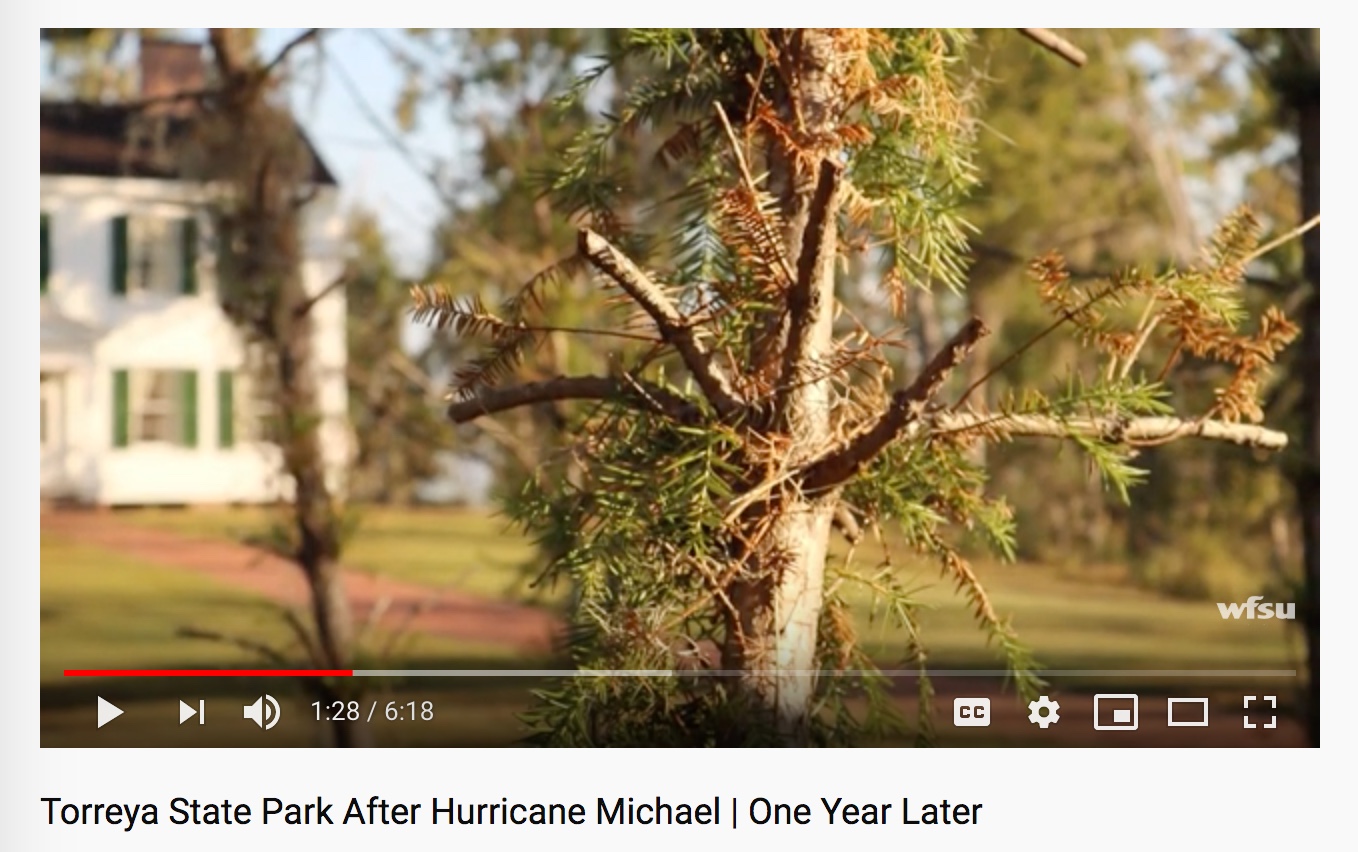
Six-minute video titled Torreya State Park After Hurricane Michael: One Year Later was produced by WFSU, the public TV station affiliated with Florida State University in Tallahassee. The video begins with a look at the two unlikely survivors of the hurricane where the entrance road ends in a parking lot. Both Gregory House and a planted little grove of torreya trees at the lawn edge survived, the tall trees fallen all around them.
|
|
For viewers and readers familiar with the paleoecological foundation undergirding the drive for "assisted migration" poleward of the glacial relict Torreya tree, the video offers a few hints of the steephead ravine ecosystem similarities in the park to habitats now found in the southern Appalachians. The actions of Torreya Guardians are of course not mentioned. But the accompanying essay does say this:
"In the 1950s, a fungal blight wiped out a population of about 600,000 Torreya taxifolia in the region. The Florida Park Service, Nature Conservancy, and the Atlanta Botanical Garden have been working to revive the Florida torreya, a species whose future may lie in its likely ancestral home of North Carolina, where planted trees have thrived disease free."
|
October 2019 / Connie Barlow / TESING HYPOTHESIS THAT VERTICAL BRANCHLET TIPS MIGHT BE BEST
Recent rooting of cut basal tips confirms that vertically oriented basals can turn into actual trees, rather than multi-stemmed shrubs (which is the fate of tips cut and rooted from lateral branches. But if a tree produces some radial-structure, vertically oriented branchlet tips, might cutting these produce real tree structures?
|
|
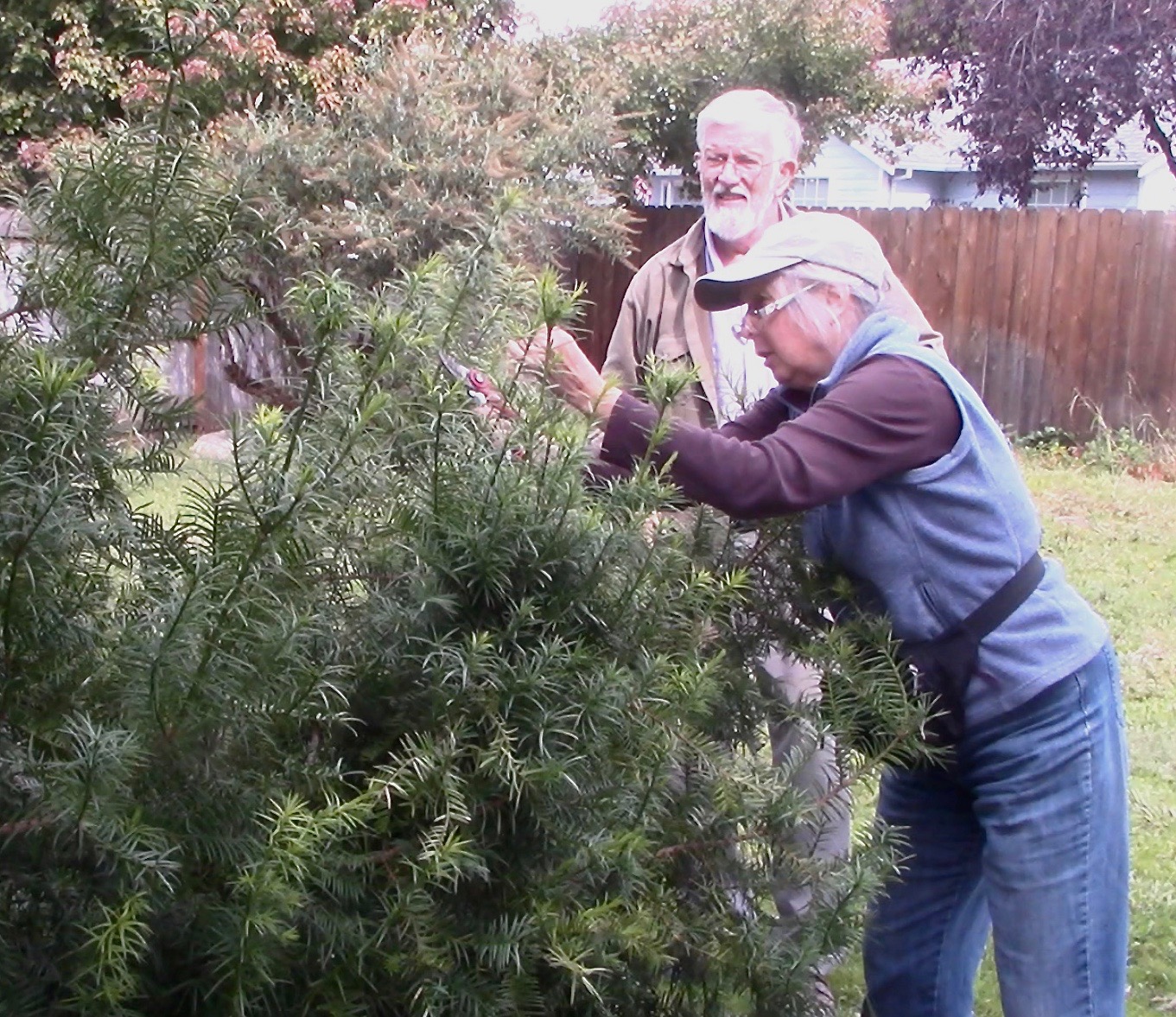
October 3, 2019, CONNIE BARLOW clips the most vertically oriented branch tips she can find on the two seed-grown trees FRANK CALLAHAN (standing behind) had planted at his mother's home in Medford, OREGON.
Connie notes that the most vertically oriented branchlet tips she could find were not quite as leader-like in structure as the ones she had clipped from the shrubby, rooted-branchlet "trees" at Hawthorne Park earlier that day. Visit the Oregon Torreya webpage on this website to access photos of the vertically oriented branchlets on the other set of trees in Medford.
As to BASALS, Connie was at first surprised that there were no really good-looking basal sprouts at the base of either of the two trees (See photos). But then she realized that because both were planted in full sun, the low shrubby branches precluded basals from contributing any sunlight-derived photosynthates, so the trees probably wouldn't bother creating good basals unless they felt stressed and possibly facing death.
|
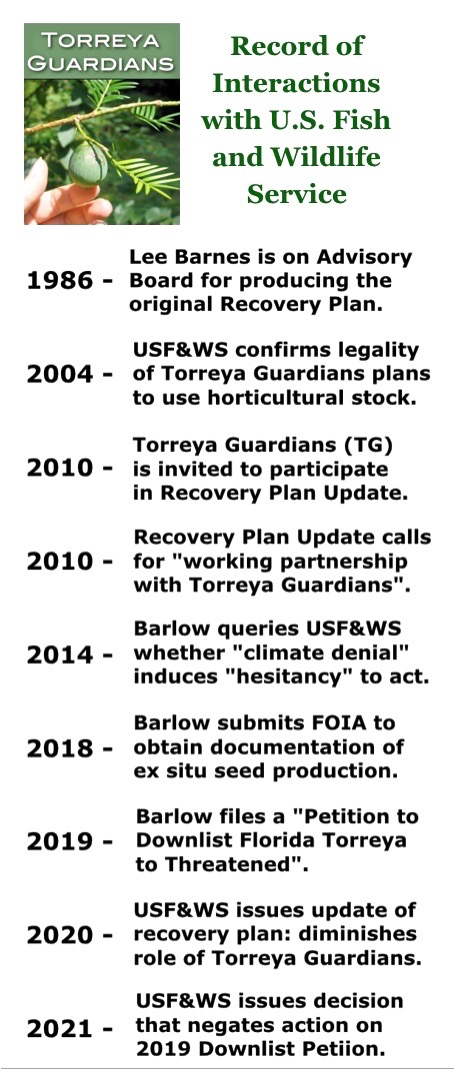
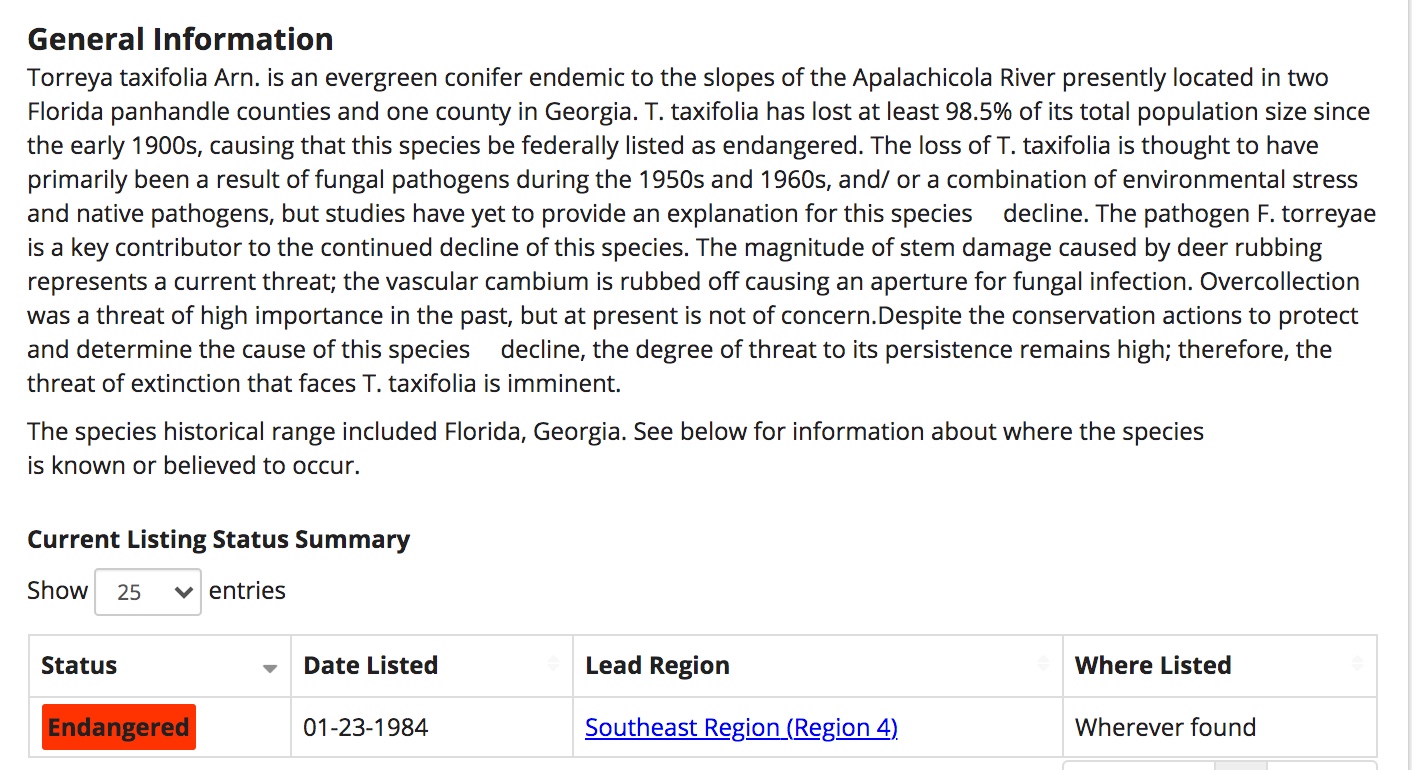
OCTOBER 2019 / Connie Barlow / F&WS acknowledges receipt of "Petition to Downlist"
I received via mail an official 3-page letter dated 23 October 2019, signed by Leopoldo Miranda, Director of the Southeast Region of the U.S. Fish and Wildlife Service. I scanned the letter and have posted it on this website as a 3-page PDF. From what I can discern, no decision has yet been made on whether the 26-page formal "petition to downlist Torreya to threatened"
that I submitted last month (September) offers the agency any new information worth considering. However, it appears that the earlier 21-page report I submitted to DOI August 2019 (see below) did not offer any new information worth considering. My sense is that because LAST YEAR (6 August 2018) the service announced initiation of an official "5-year Status Review", consideration of my current petition to downlist will be subsumed within that process already underway, and thus no additional decision as to whether my petition merits substantive attention need be given. Overall, we can all expect an opportunity to COMMENT ON THE PENDING 5-YEAR STATUS REVIEW — whenever that is offered for public review in the future. In the meanwhile, the official letter itself reveals some important insights into the current official thinking of the Fish & Wildlife Service, notably these EXCERPTS (bold as emphasis added by Barlow):
• "... The Endangered Species Act (ESA) compels us to return all listed species to being viable and self-sustaining in their ecosystems. We recognize the critical role of stakeholders and how important their participation is to help achieve this goal. Recovery is not a fast process. It takes decades in some cases to see progress or to reverse long-standing threats...."
BARLOW'S INTERPRETATION - Official policy is thus more encompassing than some past communications to Barlow that actions underway were limited to "preventing extinction" and undertaking "genetic safeguarding." (Full recovery was not mentioned as a goal of the ongoing official actions.)
• "... Florida torreya is a critically endangered tree endemic to habitats along the Apalachicola River in Florida and extreme southwest Georgia. Populations once had about 650,000 individuals but crashed in the 1950s due to a fungal pathogen (Fusarium torreyae). Now we have 750 individuals (i.e., re-sprouts from stumps) that fail to reach maturity in the wild. In addition, these re-sprouts from stumps display different degrees of decline such as root necrosis and stem cankers...."
BARLOW'S INTERPRETATION - This is the first time I have seen the newly isolated and named Fusarium torreyae definitively presented as having been the cause of the 1950s population crash (as well as being now the apparently most debilitating cause of ongoing stem dieback, among the multiple disease agents long specified as afflicting Florida Torreya in its peak glacial refuge). To my mind this suggests that, despite more than half a century of disease presence, and despite presumably lax antiseptic practices by official institutions in moving plant materials from the disease-ridden historic range and/or cleansing boots worn in the collecting area (as well as botanic gardens and citizen practices in moving plant materials around well outside of its historic range), there have been no documented lethal consequences of Fusarium torreyae in the Appalachian mountain region and points north. This is highly suggestive that helping this glacial relict species finally be able to "migrate" hundreds of miles north of its peak-glacial historic range is both a practical and a proven method for restoring this species to health.
• "... The Torreya Guardians' work conducted under the concept of assisted migration has been acknowledged by the Service in the 2010 5-year review, and will be noted also in the 5-year review currently underway...."
• "... The Service does not have an official policy on assisted migration of threatened or endangered animals or plants, and assesses the needs of species on a case-by-case basis...."
• "... we urge considerable caution in your efforts to translocate the Florida Torreya outside its native range. We remain concerned that transporting Florida Torreya seedlings, cuttings and seeds outside its native range may carry the fungal pathogen to new areas.... Therefore, we suggest all potential Florida Torreya outplantings undergo health screenings, and the results documented."
• "... This species needs help from passionate partners such as yourself and the Torreya Guardians, and I encourage further efforts to secure the Torreya within its native range.... If you have any questions regarding the ongoing 5-year review process, or wish to discuss opportunities to engage with the Service in securing the Florida Torreya within its native range please contact Dr. Sean Blomquist, Acting Field Supervisor, Panama City, Florida Ecological Services Office ..."
BARLOW'S INTERPRETATION - It appears that although "the Service
does not have an official policy on assisted migration", the closing of this email response strongly implies that with respect to this particular species a decision is already in place to continue the sole focus on recovery taking place "within the historic range." If even this undisputed "glacial relict" (by definition, having been unable to migrate poleward after the ice retreated) is not given an opportunity to excel in a more suitable climate today and into the future, how then could any other listed species be given assistance in migrating to cooler realms in the coming decades of climate disruptions already underway?
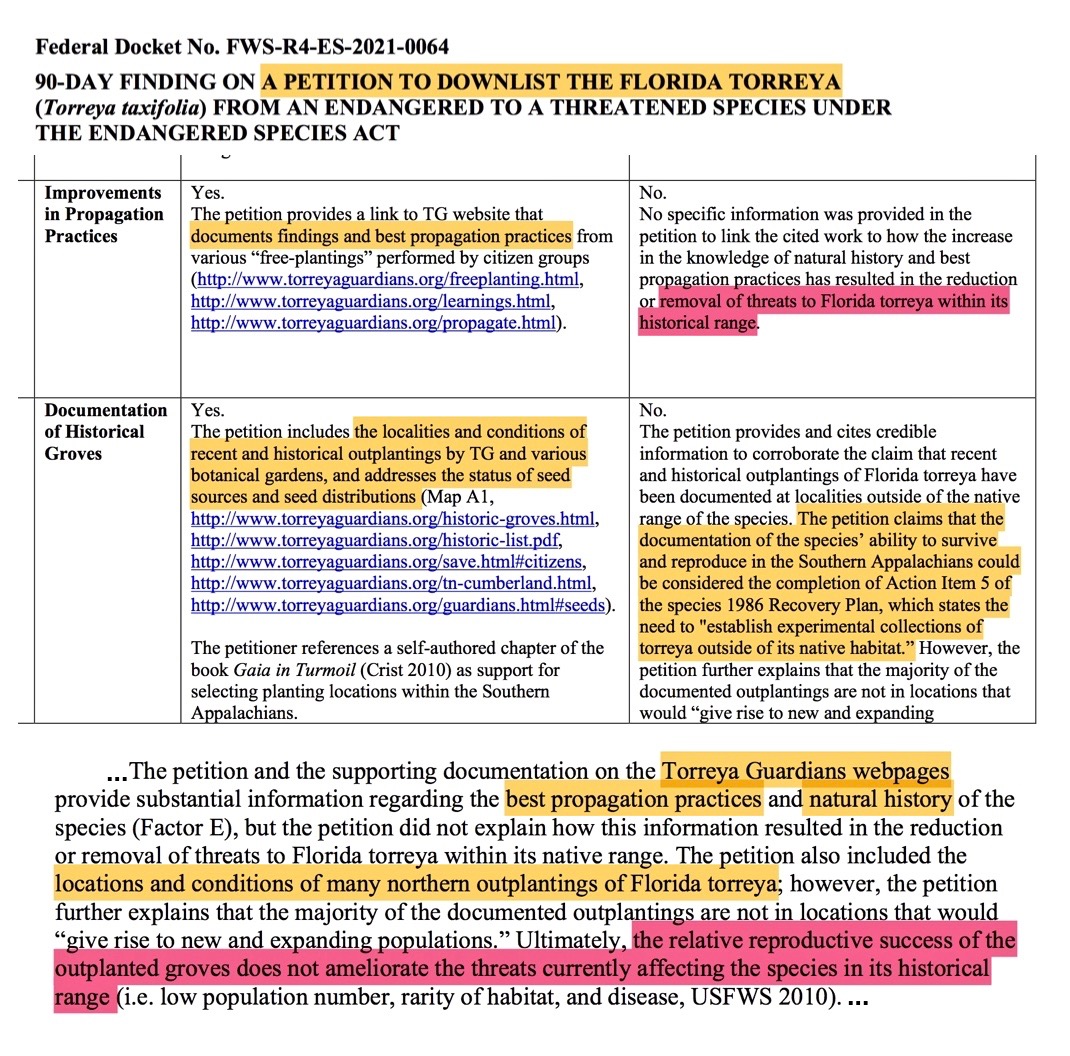
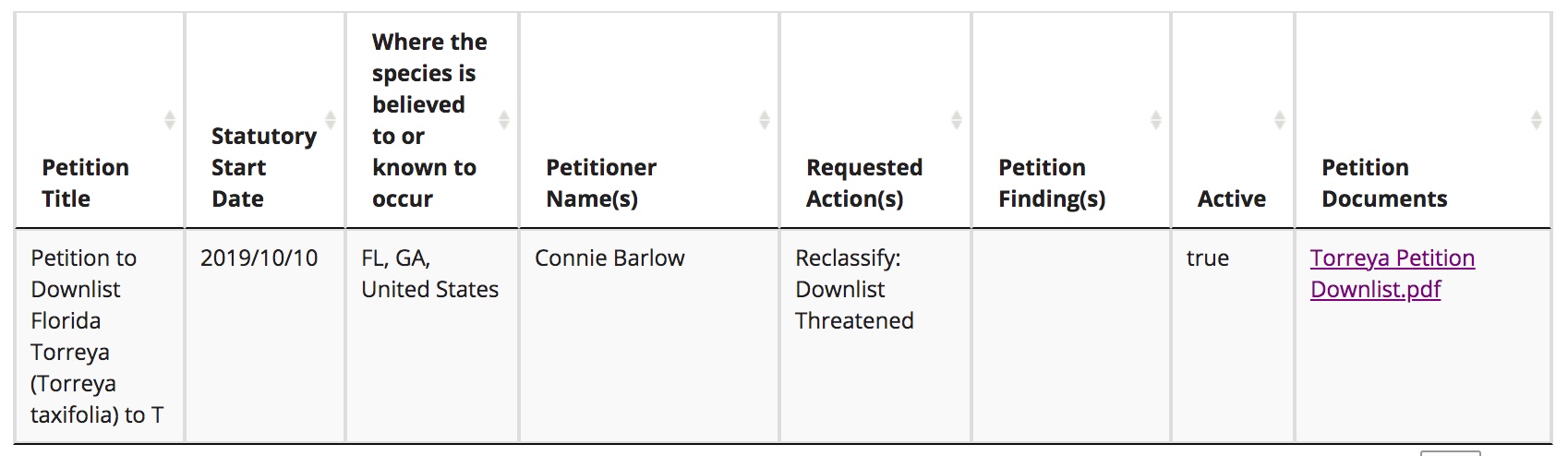
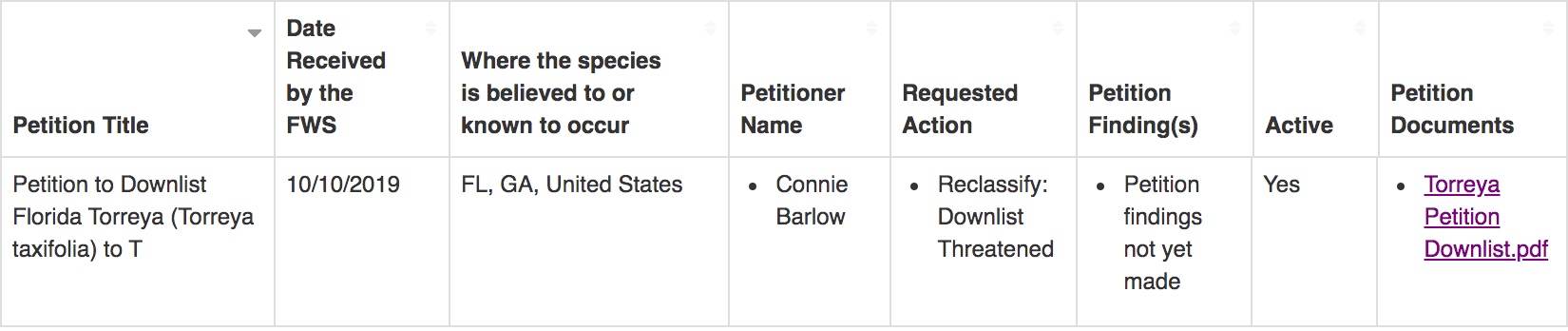
UPDATE: USF&WS added this petition to its official Florida Torreya webpage, as shown below:
September 2019 / Connie Barlow / PETITION TO DOWNLIST Florida Torreya submitted
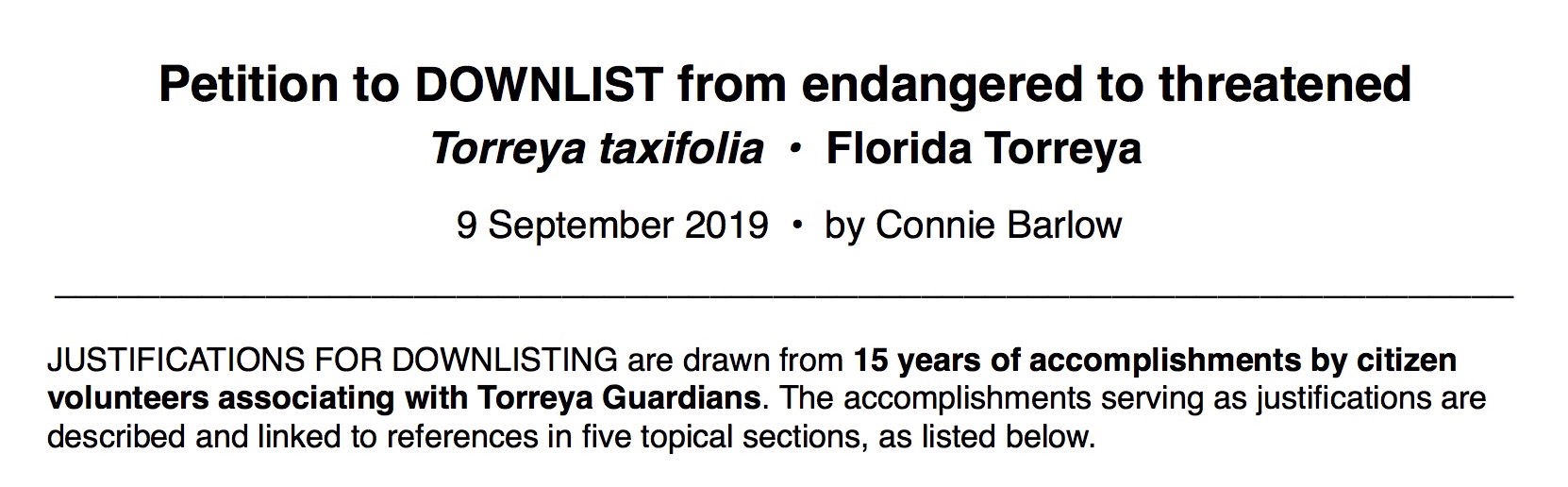
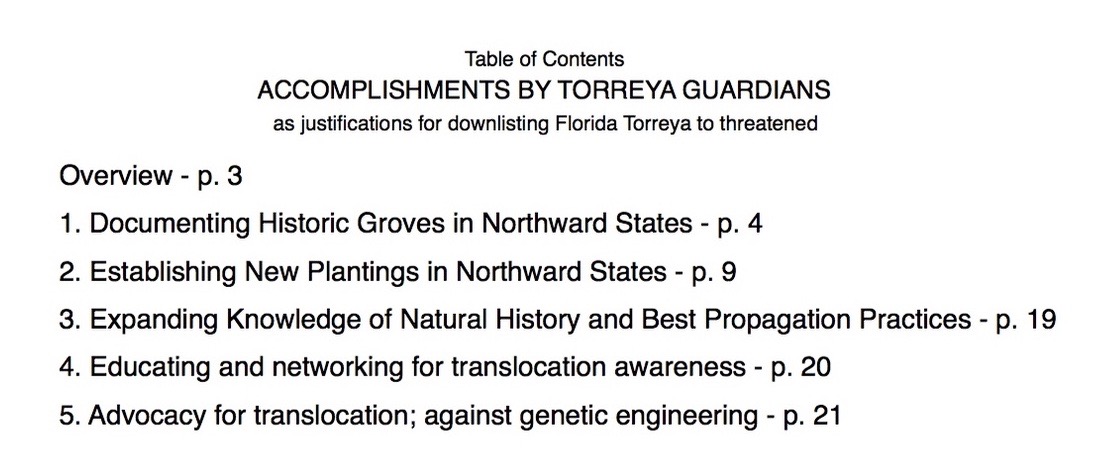
September 9 I (Connie Barlow), as an individual and citizen, submitted a 26-page formal petition to downlist Florida Torreya from "endangered" to "threatened" status — based entirely on the actions accomplished by various citizen volunteers with Torreya Guardians over our 15 year history.
In accordance with F&WS policy, I submitted a copy to both of the states (FL and GA) in which the historically native range occurs. The Georgia recipient redirected my petition to Timothy Merritt, Chief, Branch of Conservation and Classification for Endangered Species of the Southeast Region of F&WS. [October 9 Barlow submitted this petition to the Department of Interior, per regulations.]
|
|
In my Sept 9 cover letter to Mr. Merritt, I wrote: "The timing of this petition was inspired by the new ESA regulation clarifying "threatened" status as distinct from "endangered." In this particular case, downlisting to threatened could substantially help an endangered plant move toward full recovery, by making it possible for we citizens to play an even greater role than we have been playing in past years." Access documents:
• Petition to Downlist (26 pages pdf)
• Cover letter to Mr. Merritt (2 pages pdf)>
• Cover letter to Mr. Bernhardt (2 pages pdf)
|
USF&WS added this petition to its official Florida Torreya webpage, as shown in this image below:
Sept 2019 Barlow also filed a 2-page, "Formal request to document Torreya seed production ex situ 2018 and 2019", available here in PDF.
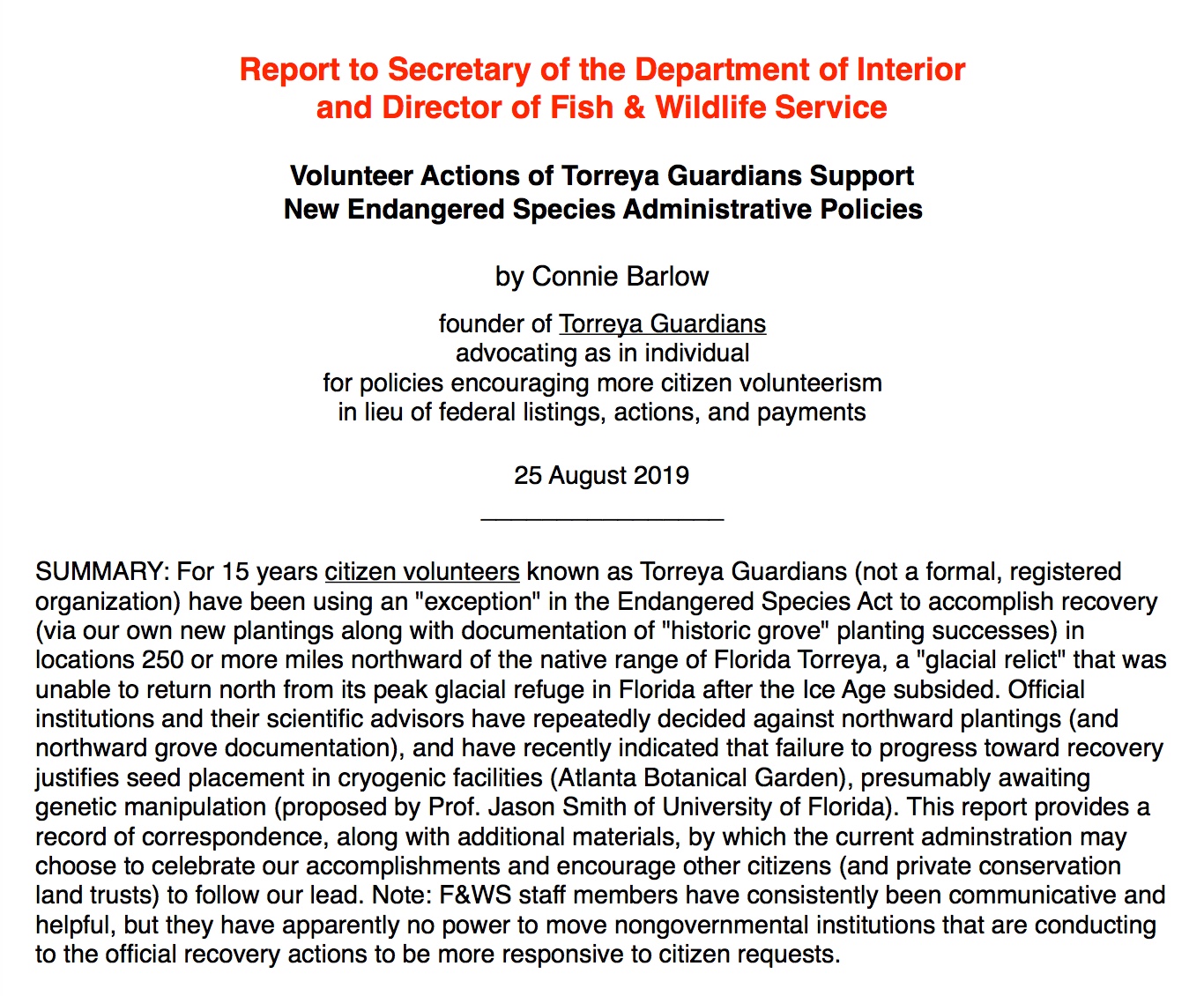
August 2019 / Connie Barlow / Report to DOI: Volunteer Actions of Torreya Guardians Support New Endangered Species Administrative Policies
August 25 I (Connie Barlow), as an individual and citizen, submitted a 21-page "Report to Secretary of the Department of Interior and Director of Fish & Wildlife Service: Volunteer Actions of Torreya Guardians Support New Endangered Species Administrative Policies"
.
|
|
TABLE OF CONTENTS:
1. Suggestions for Florida Torreya Plan Update: Part A - Translocations (p. 2)
2. Suggestions for Florida Torreya Plan Update: Part B - Actions for DOWNLISTING (p. 4)
3. Details for updating key sections of the 2010 Recovery Plan for Florida Torreya (p.6)
4. Details for reinstating sections of the 1986 Recovery Plan for Florida Torreya
5. Torreya Guardians Citizen Actions Empower Joshua Tree Citizen Advocates (to undertake conservation actions without endangerment listing)
|
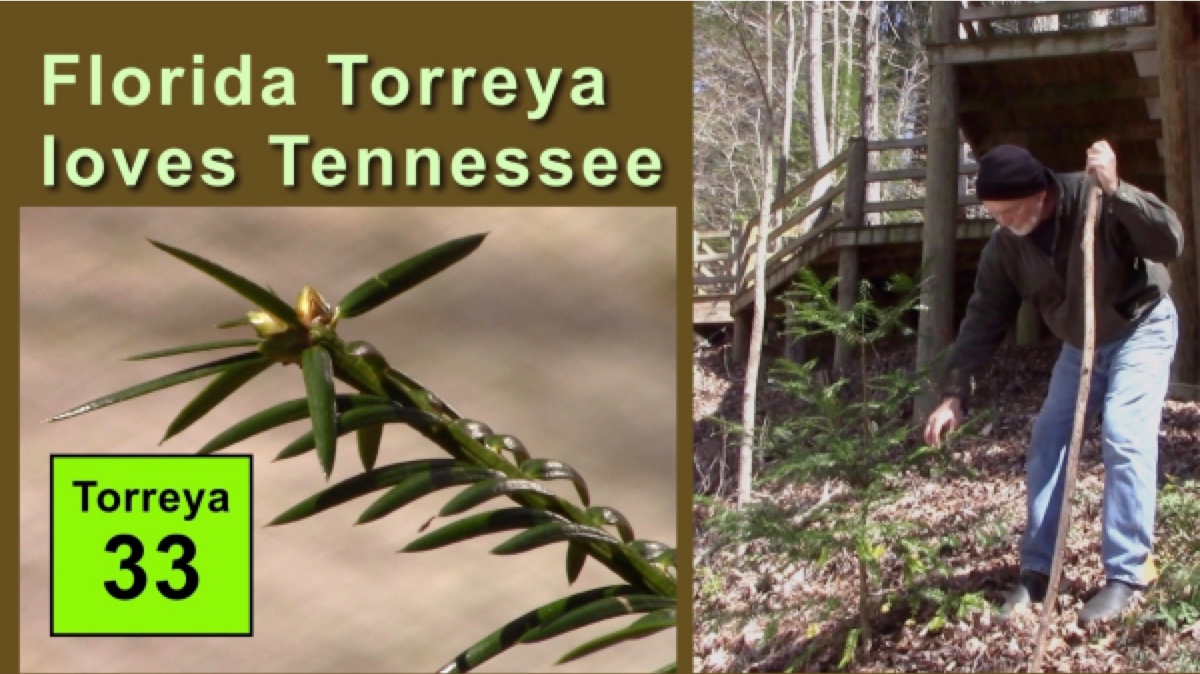
August 2019 / Connie Barlow and Clint Bancroft / NEW VIDEO: "Florida Torreya loves Tennessee"
|
|
Mid March 2019 Clint Bancroft took me (Connie Barlow) on a tour of his rewilded Torreya plantings in Ocoee Watershed southeast TN. I just posted the new video, to which I added sections of the March 2015 video for showing how much growth the original plantings achieved in four years. This new VIDEO 33 (50 minutes) offers two key findings, beyond the obvious excellent, disease-free growth.
(1) No herbivory; the plants are in perfect condition.
(2) With the help of Jack Johnston, Clint has established a "Torreya Bowl", intended for seed production in a wild setting. Maximizing genetic diversity there is a priority.
|
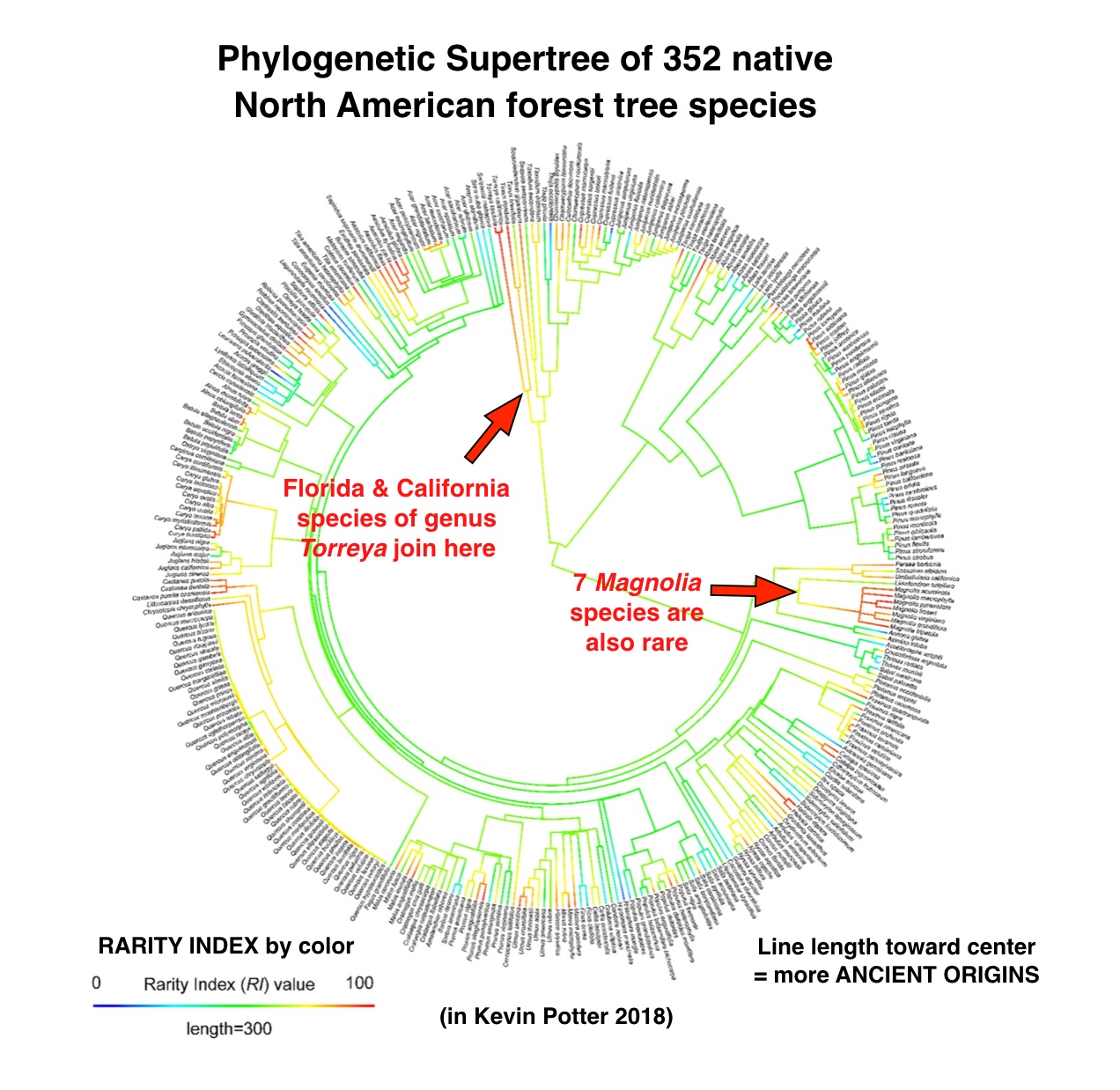
August 2019 / Connie Barlow / Genus Torreya is both rare and ancient
| |
Kevin M. Potter, Dept. Forestry and Environmental Resources of North Carolina State University, published a paper in the May 2018 online issue of the journal Biological Conservation:
"Do United States protected areas effectively conserve forest tree rarity and evolutionary distinctiveness?"
Connie Barlow added red type and arrows to the original figure, left.
Notice that the sister species in Florida and California of genus Torreya are among the rarest of 352 tree species native to North America.
These two Torreya species also are among the most ancient tree lineages.
Together, rarity and age of origin call out for the highest levels of conservation attention.
|
August 2019 / Connie Barlow / Seed-producing Torreya in Louisiana survives tornado
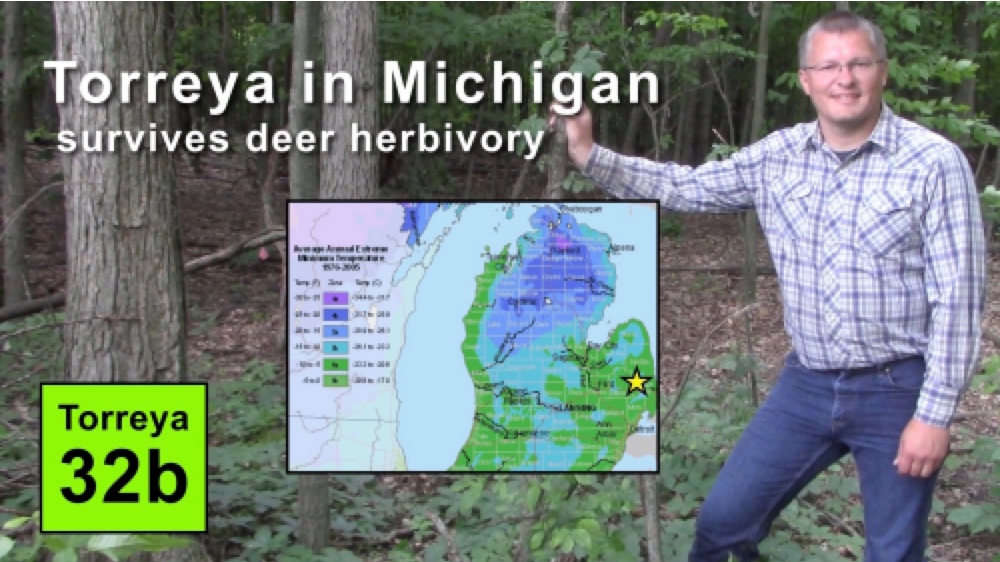
July 2019 / Paul Camire and Connie Barlow / Two-part VIDEO filmed s. Michigan June 2019 and September 2018
Two-part video of Paul Camire's Torreya in-forest plantings of potted seedlings and also seeds from the 2016 fall harvest in Medford Oregon.
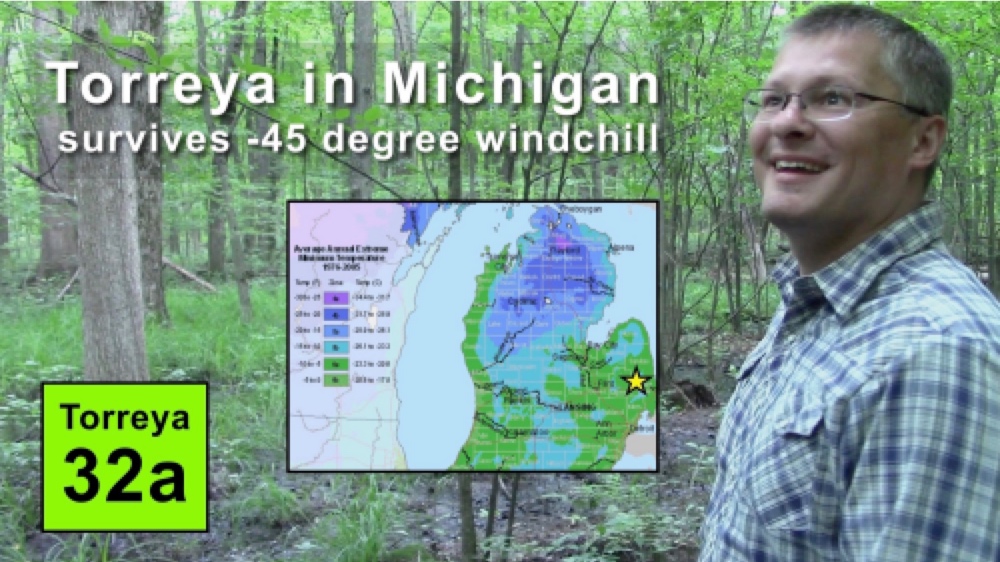
30-minute video |
|
 28-minute video
 |
|
Florida Torreya has been documented surviving (with little or no damage) subzero temperatures before in other states. But this is the coldest: -45 degrees F windchill during Winter 2019. Yet the exposed Torreya branches showed no damage! The biggest problem is deer herbivory: they even push over wire cages.
|
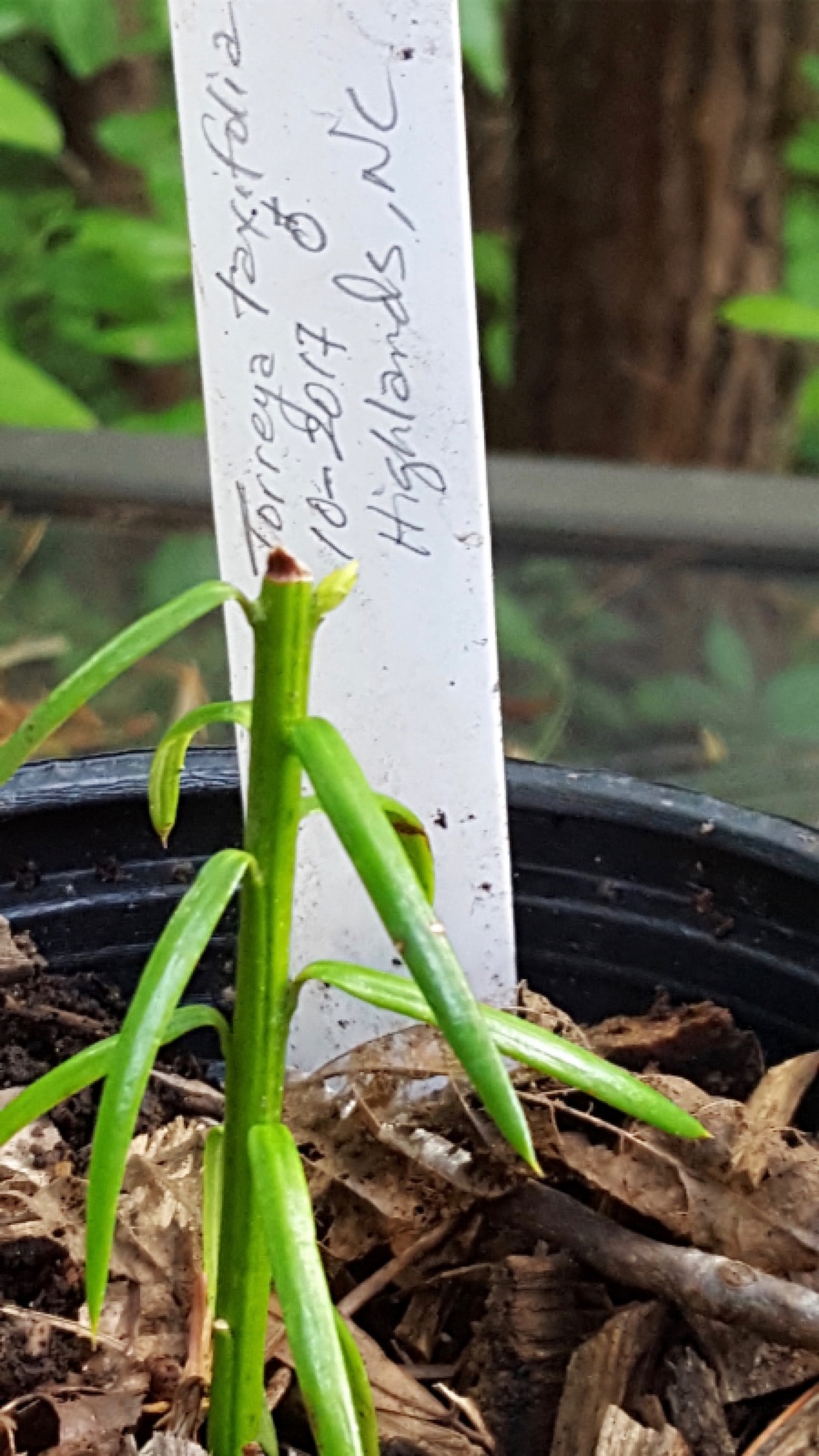
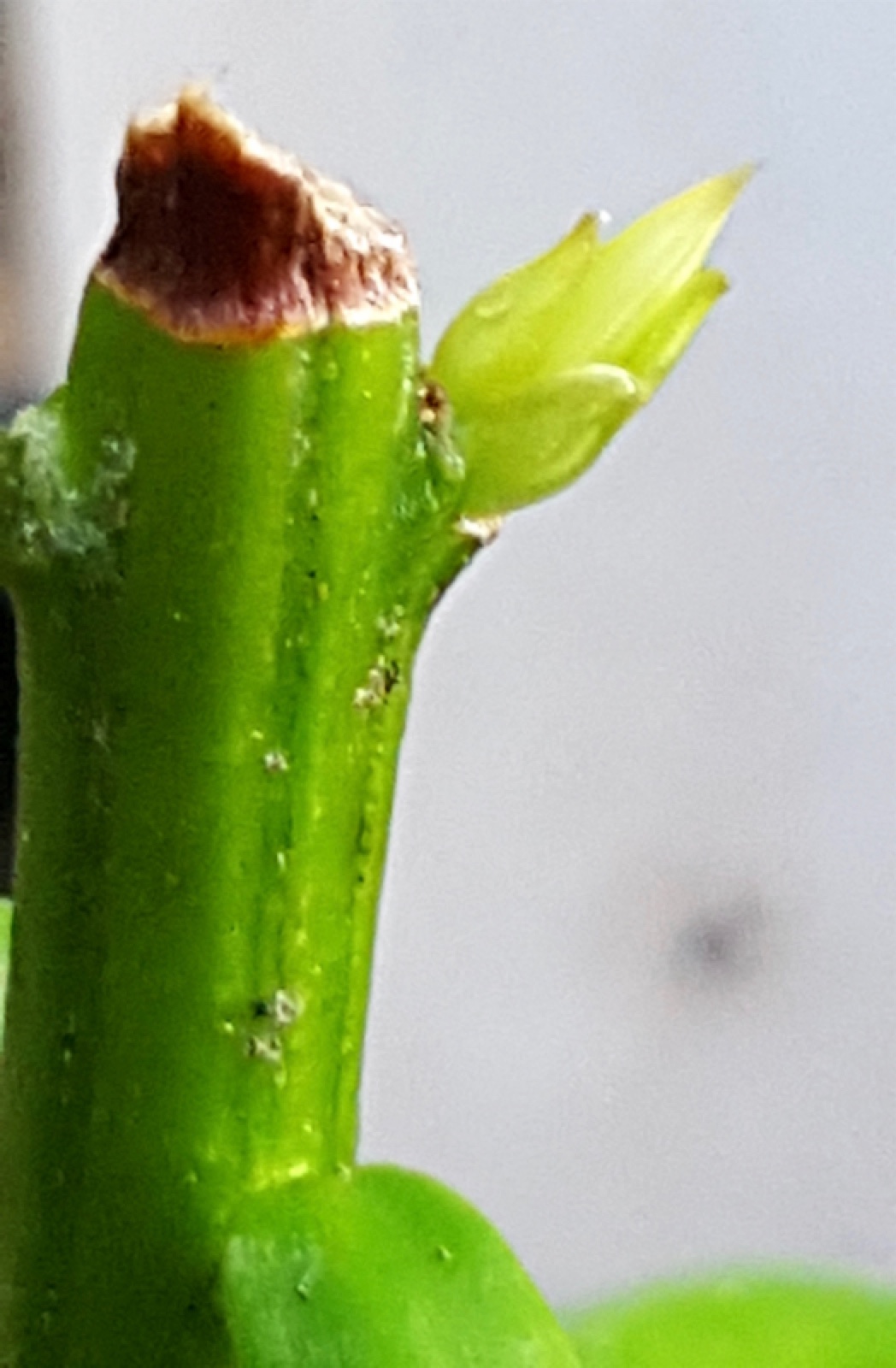
July 2019 / Clint Bancroft / Precious apical cutting of a Highlands NC basal recovers from herbivory
CLINT BANCROFT writes:
Regarding my accidental experiment in which a rooted apical cutting had put up a new 6 inch vertical and then all but a few inches of the whole pant was eaten. In just 2 months or so, the eaten-down stump is putting up what appears to be a new vertical leader.
 |
 |
|
Note by Connie Barlow: I am reading about Coast Redwood basal growth and propagation now. Genus Sequoia and Torreya, ancient members of Cupressaceae Family, have probably survived this long thanks to their ability to produce new stems from basal growth if the original stem fails (or is logged). The term for what we see in photo left is an axillary bud doing what it evolved to do — produce a new vertical leader. Apparently all single leaves produced on the vertical main stem each carry on their upper side a suppressed axillary bud. For redwoods, each of those buds can become either a vertical leader or a root, depending on whether it senses air or soil when hormones direct it to wake up. Apparently Torreya can do the same, so we can actually obtain more than one vertical clone from each basal sprout we cut from.
|
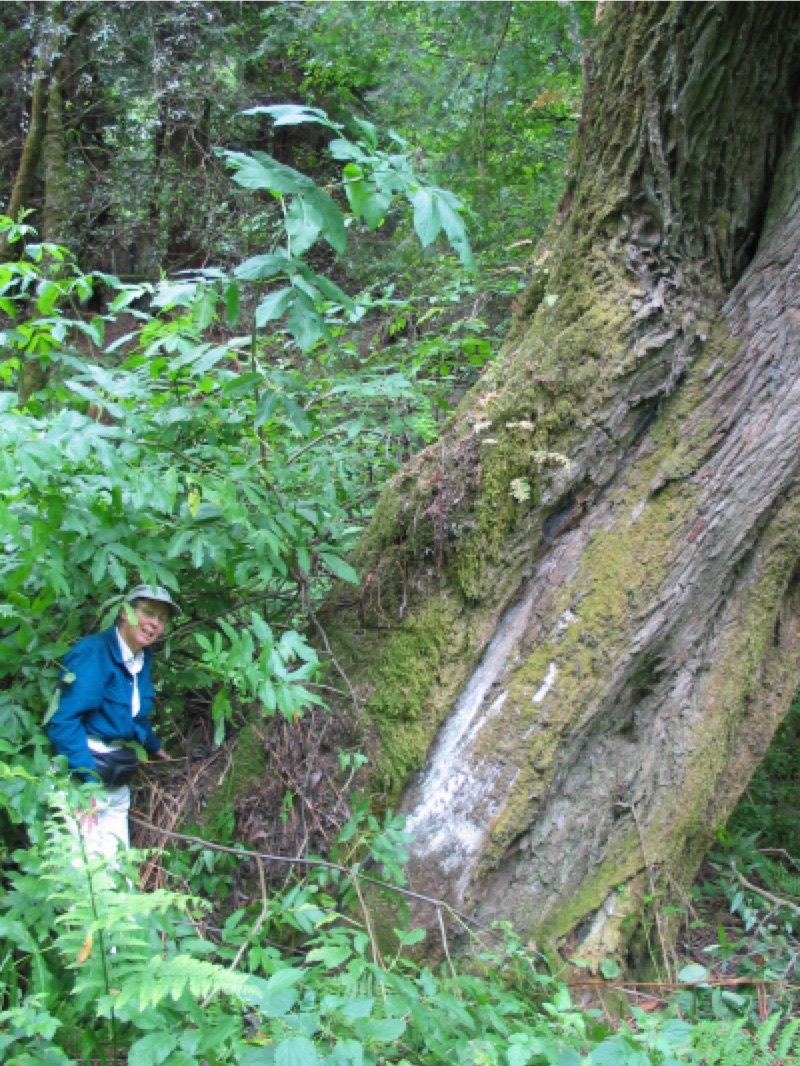
July 2019 / Connie Barlow / Photo of new champion California Torreya shows what Florida might achieve in North Carolina mountains
 |
|
 |
|
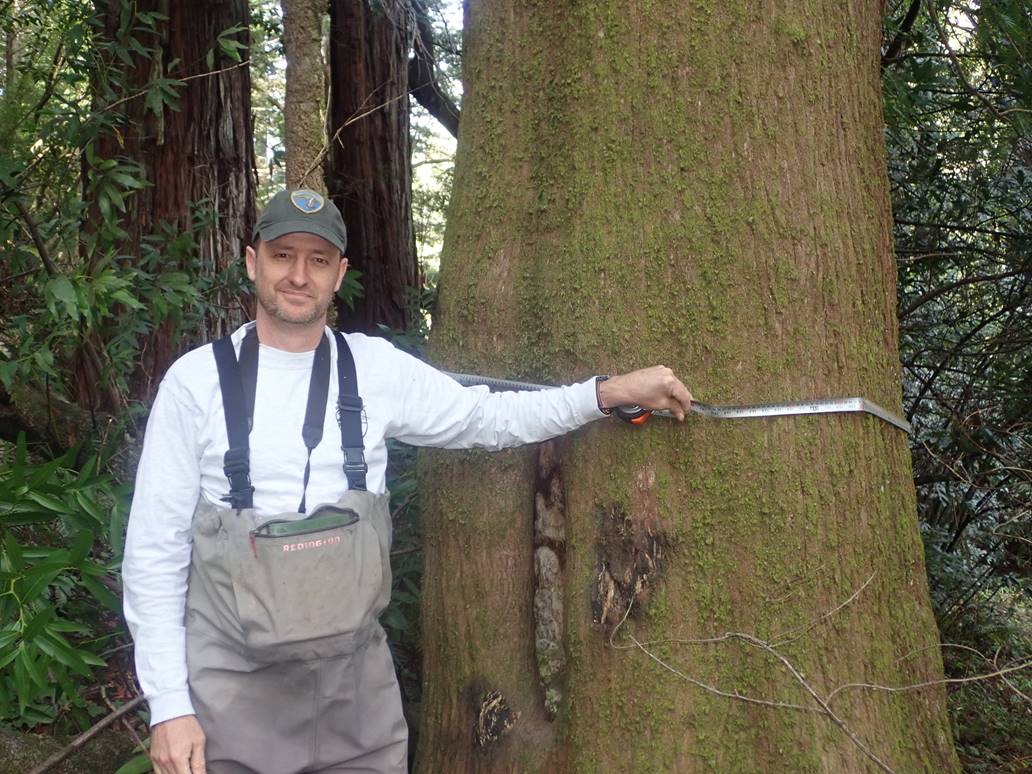
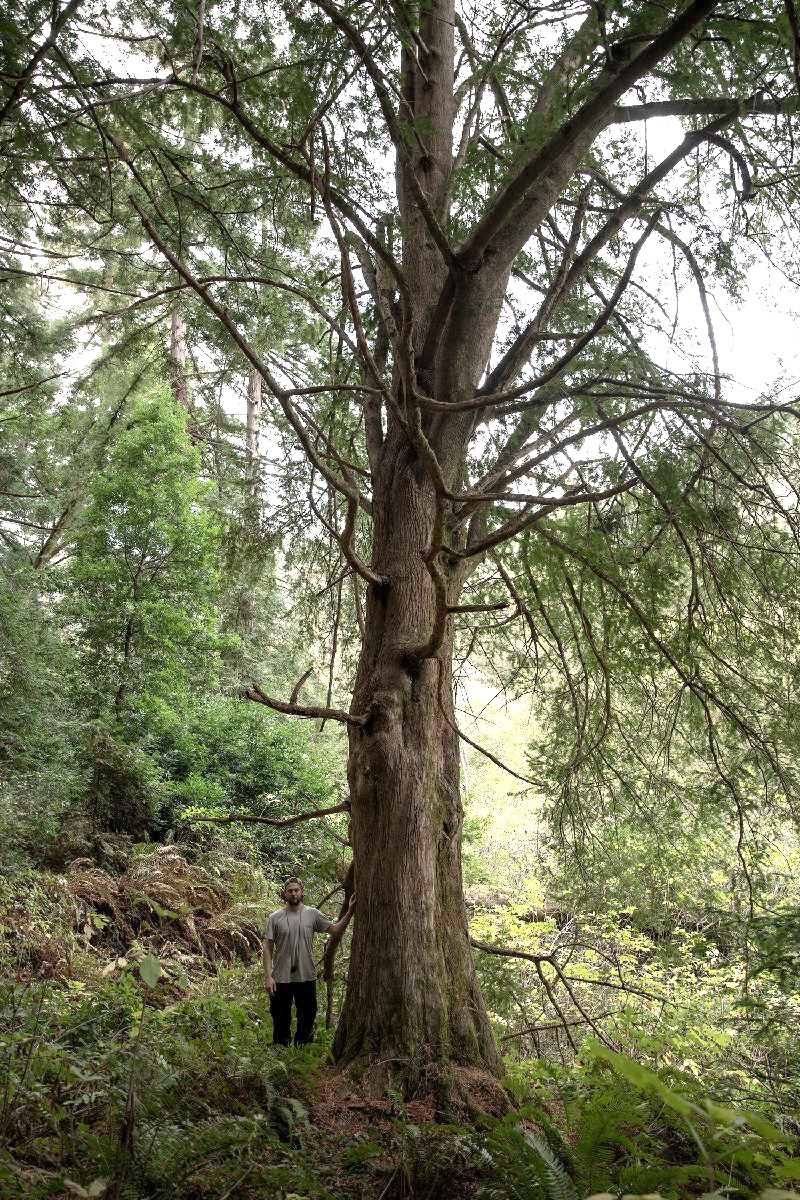
LEFT: In 2005 I took a field trip to a half dozen sites of California Torreya growing in the wild. The then-champion tree (at Scott's Creek Watershed north of Santa Cruz) was in decline. Photo left is of me with that tree.
MIDDLE: In 2012 a new champion was declared just a bit north in Big Basin State Park. Three photos were recently posted, including the photo in middle here. Notice the human for scale. This new champion is 105 feet tall, circumference is 133 inches, average crown spread is 60 feet. This compares with the late champion, whose stats when nominated by Frank Callahan in 1993 were 96 feet tall, circumference 251 inches, average crown spread 68 feet. Access lots of photos of California Torreya I took in the field in 2005, via the California Torreya page on this website.
|
June 2019 / Frank Callahan / Update on Florida Torreya seed-producing pair in Medford Oregon
 |
|
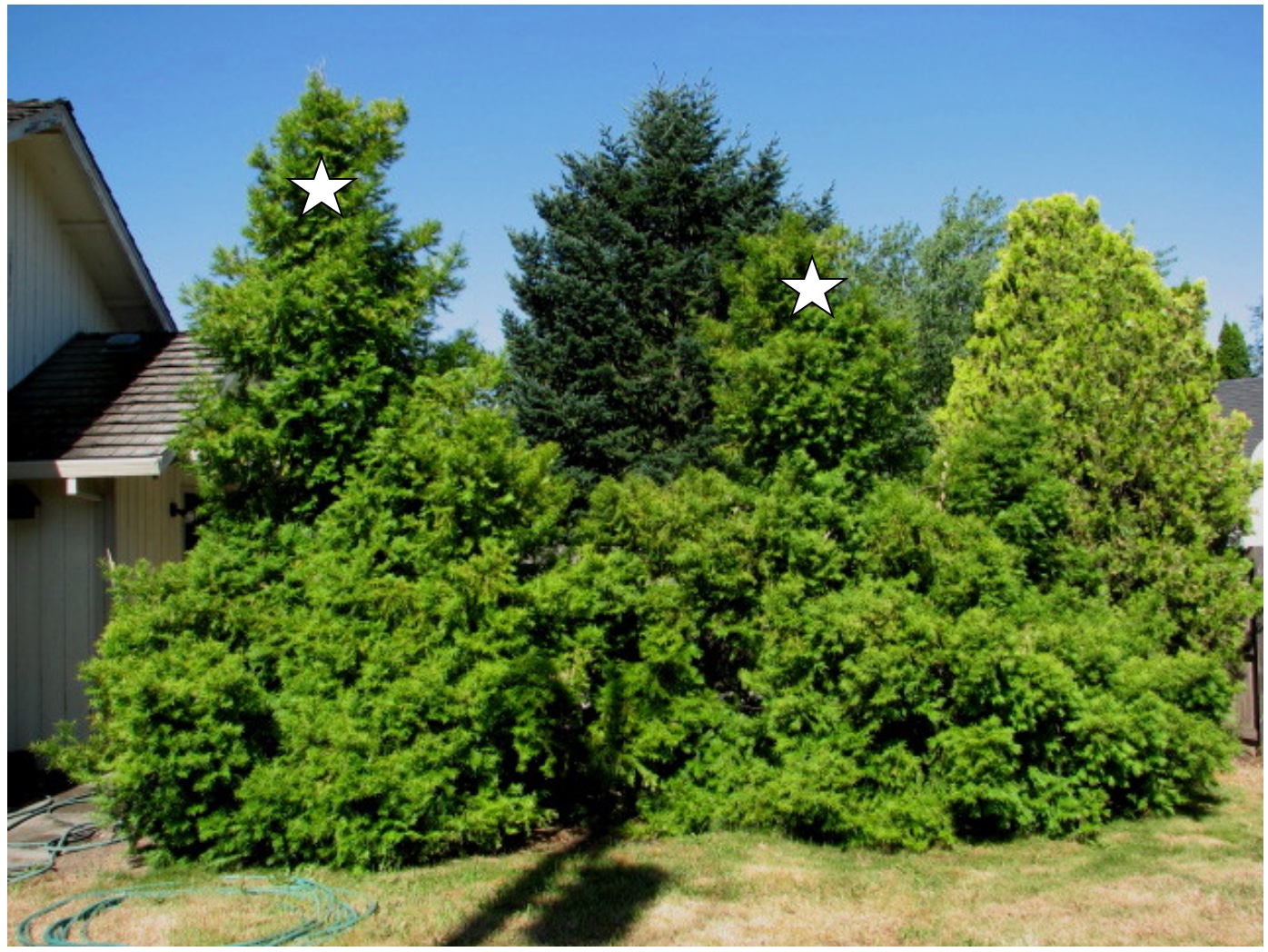
May 31, 2019 FRANK CALLAHAN wrote: "I was just over to my mother's place for her 95th birthday. The Torreyas are doing well; however there has been little seed production since your visit. Speaking of seeds, how was the germination rates on all the seeds that were sent out?" [from the Fall 2016 harvest of seeds from the two Florida Torreya trees, shown at left with white stars]
June 12, 2019 FRANK CALLAHAN wrote: "Here are some images of Torreya taxifolia trees at my late mother's property in Medford. Mickey just had her 95th birthday and passed away 6 days later, and her house and property are now up for sale. (I trust we can make a deal to care for the trees with a new owner.) The two trees are doing quite well as you can see. (Connie added the white stars). That is a bluish Douglas fir in the background. The tree on the right is an arborvitae. There is no crop to report for this year."
Editor's note: Visit the Medford OREGON Torreya page for the full history of seed production and a video of the trees several months after seeds were harvested in fall 2016.
|
June 2019 / Connie Barlow / Article indicates Atlanta Botanical Garden still not considering assisted migration
A 9 June 2019 online article titled "Atlanta Botanical Garden opens Southeastern Center for Conservation this summer", announces a new multi-million-dollar conservation center at Atlanta Botanical Garden. Both mentions of Torreya, however, fail to indicate that the conservation strategy will yet expand to include assisted migration poleward.
EXCERPTS PERTAINING TO FLORIDA TORREYA: ... This summer the garden opens its Southeastern Center for Conservation, a $7 million two-story building adjacent to the Fuqua Orchid Center. It was funded through the successful $53 million Nourish and Flourish fundraising campaign, which included $40 million for capital improvements and $13 million for the endowment. The new center will serve as a home for the garden's conservation, education, and experimentation. The building includes a 3,800-square-foot research facility with a molecular lab that lets scientists examine genetic material at the nucleotide level. The cold-storage seed bank is augmented by cryogenic coolers that can preserve the embryos of the Torreya trees as they try to determine why the trees die in the wild before they can become adults.
... They also feel the pain when a natural disaster spoils plans. The garden had transplanted 700 Torreya trees to Torreya State Park in Florida, with noted Harvard biologist E.O. Wilson, 88, as a guest of honor. Then, Hurricane Michael destroyed the entire stand, dumping hardwoods on top of little saplings. "It can be really discouraging," said Carter. But even if they're not successful now, they retain hope for future prospects, she said. "One thing we're doing is keeping individual genetic material alive," said Carter. "In the future, we hope there is something to be learned from holding on to these plants."
May 2019 / Connie Barlow / New paper useful for understanding male/female flexibility in Torreya
During our site visit to the mature Florida Torreya trees in Louisiana, our guides recounted their experience with the largest specimen beginning as male and then starting to produce some female buds on various branches — culminating in seeds that fell and germinated beneath the parent tree. A 2019 paper on Striped Maple of eastern North America (a subcanopy species, just as is Torreya) can help us understand how to observe and possibly predict an individual's ability and propensity to begin producing seeds. Access full text.
 |
|
EXCERPTS: ... Male-dominated sex ratios occurred consistently across study sites and the 4 years that sex expression was monitored. Approximately one-third of trees [studied as single branches cut and grown in a lab conditions] changed during any 2-year period. The five most common transitions were, in descending order of frequency: from non-reproductive to male, male to full or partial female flowering, female to dead, and from partial to full female flowering....
... We have shown that in the sexually plastic tree Acer pensylvanicum a variety of factors influence expressed sex. Chief among them are previous sex and the health of an individual. Although the general theory regarding ESD in dioecious plants has indicated that females are often found in relatively better condition and at larger sizes, we find the opposite pattern in this species.... We show that mortality is disproportionately high in females....
|
May 2019 / Connie Barlow / Paper by Alabama professor details Torreya grandis cultivation in China
Alabama A & M University's Professor Xiongwen Chen has published several papers on the ecology, economics, and social aspects of the more than thousand-years of cultivation of the endemic Torreya grandis. Because of his expertise, it would be ideal for USF&WS to invite him onto the ADVISORY BOARD for the recovery plan update of Florida Torreya, now underway. Several helpful aspects of this 2019 paper:
 |
|
1. All Torreya species in the wild (including Florida) bear a bitter seed, except for this thousand-year-old-cultivar of Chinese Torreya — which is reproduced mostly by grafting the tasty-fruited genotype onto wild rootstock in mountain villages.
2. Planters of the cultivar as a profitable food crop are advised to start the young grafted tree in shade and among diverse trees or crops, not as a monoculture.
3. The species is also grown as an ornamental in China, owing to its beautiful form. Specimens can live (and continue to produce nuts) for more than a thousand years.
|
May 2019 / Connie Barlow / Photos of March Site Visit to Tennessee Torreyas
 |
|
March 18 I visited the home of Clint Bancroft (left) — Torreya planter in Ocoee watershed of Tennessee. I captured a lot of video — which I have yet to edit and upload to youtube.
Because his plantings are astonishingly vigorous, I decided to grab some stills from the video and post those on Clint's torreya webpage.
Key observations include evidence that Clint's 18 acres of sloped deciduous forest in southeastern-most Tennessee encourage not just 2 but 3 growth spurts annually.
As well, the oldest specimen is still heading upward as well as outward and with perfect vertical and radial symmetry. (See photo left.)
|
May 2019 / Clint Bancroft / First germination from Fall 2017 seed harvest at Harbison House, NC
 |
|
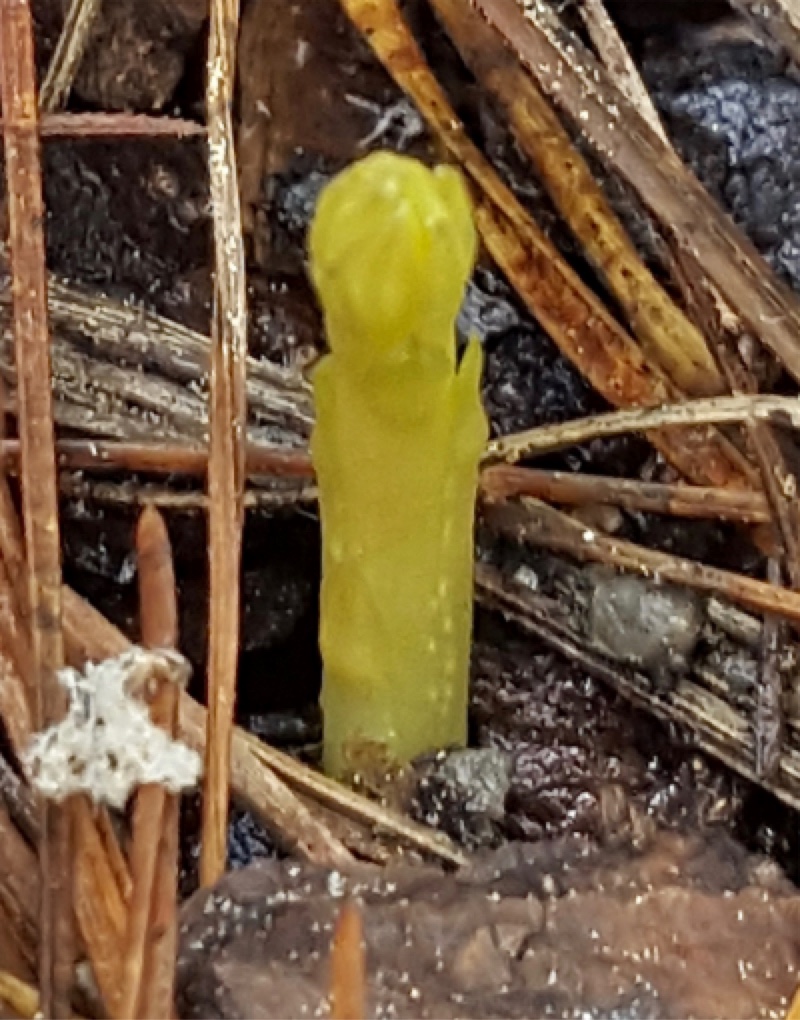
May 6 email from Clint Bancroft (Torreya planter in Ocoee watershed of Tennessee) to Connie Barlow:
"Highlands germination! It is being kept in extreme protective custody."
Note by Connie: October 2017 Clint Bancroft and Jack Johnston ventured to the private grove of century-old Florida Torreyas at Harbison House, near Highlands NC.
Clint has his seed beds and rooted branchlets outdoors in with a deer-proof exclosure. But a woodchuck apparently had a feast there in the past, so now he puts wire mesh over the tops of the exclosures too.
|
May 2019 / Connie Barlow / Our northernmost Torreya planter reports on harsh winter
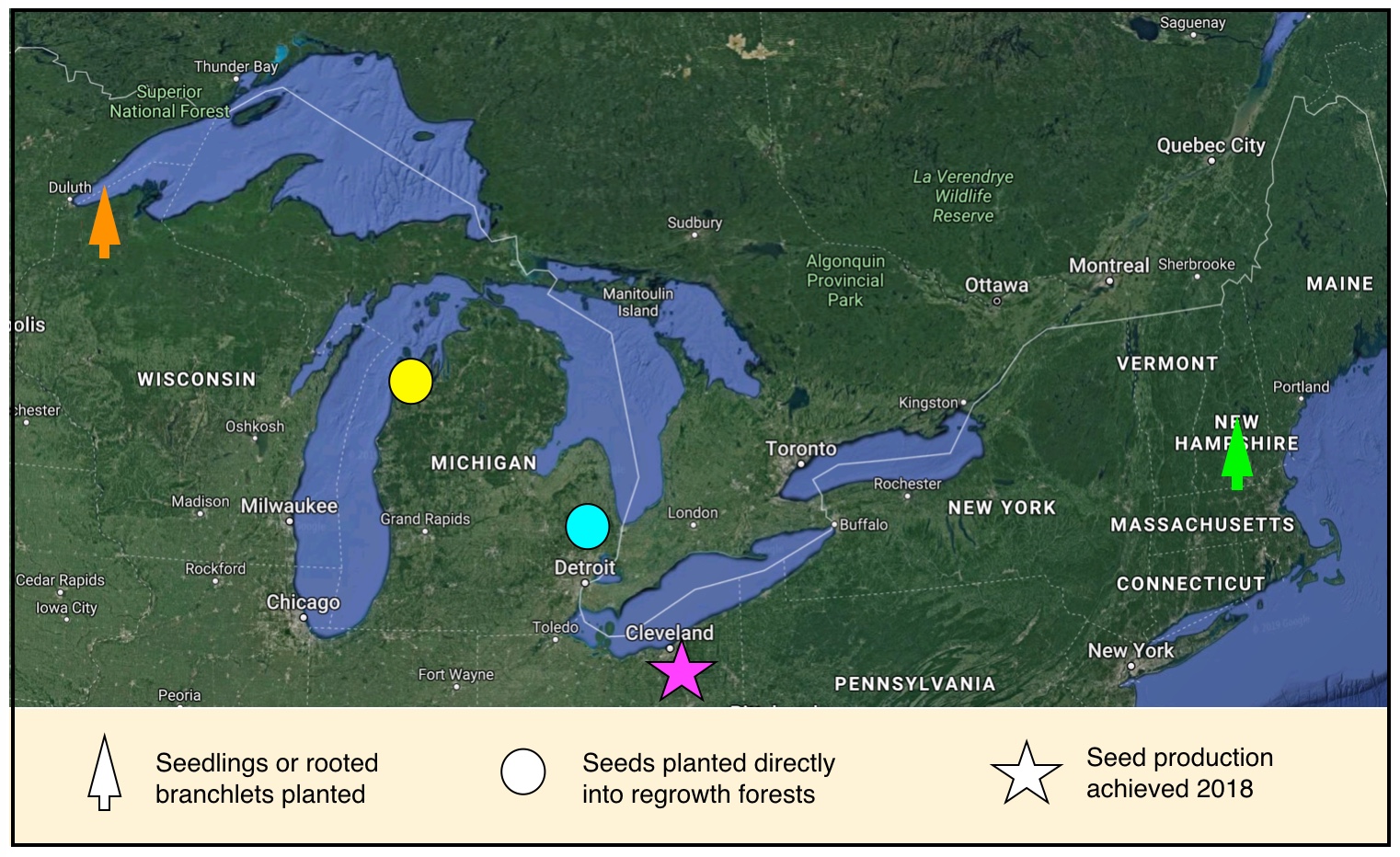
As of 2019, the MAP below depicts all the NORTHERN-MOST successful plantings of Florida Torreya made by Torreya Guardians during the past 15 years.
 |
|
Mike Heim is a horticulturalist and science teacher in Hayward, Wisconsin. His location is marked by the orange conifer symbol. He nurtures Florida Yew in his forest as well as Florida Torreya. Heim reports, "I'm waiting for the snow to finally melt off of the T. taxifolia seedling and cuttings. The Taxus floridana all are in perfect condition after a -36F winter with not a whole lot of snow covering them."
• Mike Heim's webpage on Torreya Guardians site includes photos and reports beginning in 2010.
|
Editor's note: Torreya Guardians "assisted migration" plantings center on or near the southern Appalachians. However, experimental plantings in northward states help us ascertain just how far north this ancient genus can be planted in advance of expected climate warming this century.
May 2019 / Connie Barlow / Two photos show Torreya victorious over fire — and composting
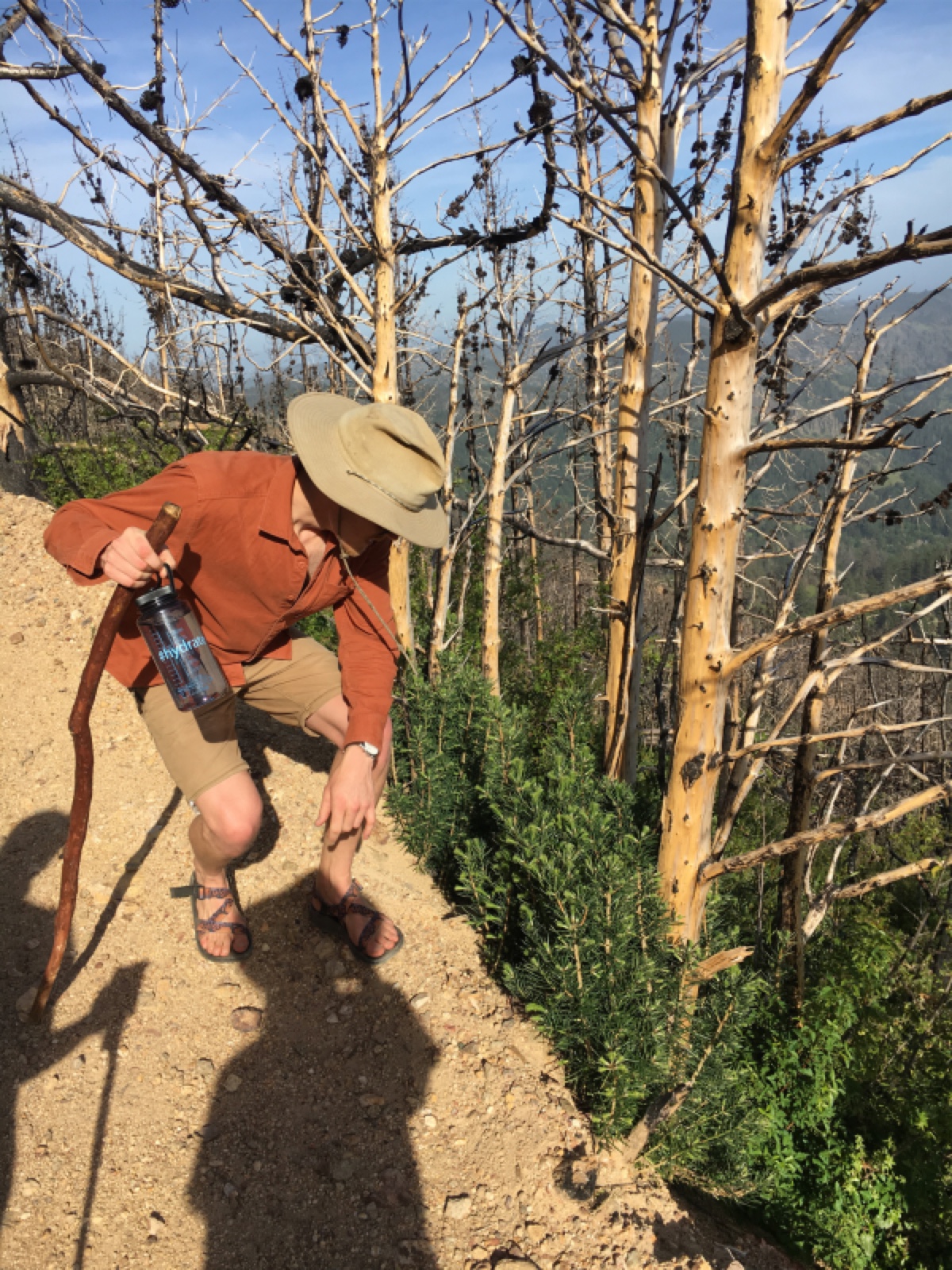
This week I received 2 sets of photos that feature survival skills of genus Torreya:
1. ZACH ST. GEORGE (below) admires lush basal growth in a burned-over grove of California Torreya
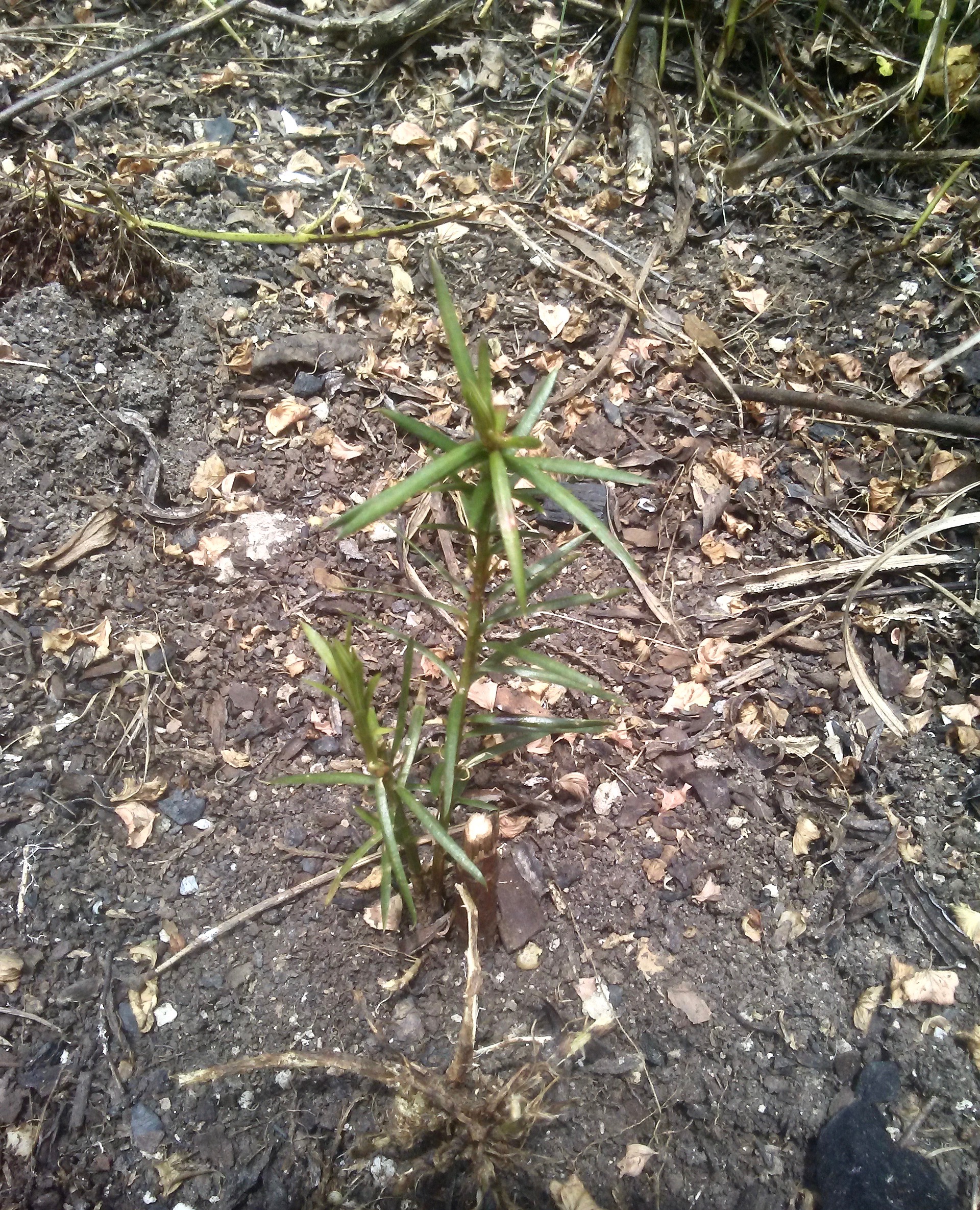
in the coast range north of Napa Valley. April 29 he was hiking in Stevenson State Park. The basal growth followed the 2017 Tubbs Fire.
 |
 |
|
2. A. A. CALLISON sent this unusual photo of Florida Torreya germination in Tennessee. He wrote:
"... None of the seeds came up, so after a couple of years I discarded the contents of the pots in a meadow and made a compost pile there. I was clearing out clover there to plant corn ... and saw a T. tax seedling growing there. This small miracle of life has begun my month of May in a very good mood."
|
May 2019 / Connie Barlow / When plantings decline or fail: Sharing photos and ideas
 |
|
SPRING 2019 this arboretum contacted Torreya Guardians for advice on vegetative dieback that suddenly appeared on some of specimens of Florida Torreya within this arboretum in Asheville, NC.
|
Michigan Torreya Guardian Paul Camire led the effort in collecting views from the key planters among us. The result led not only to a new page on this website but to a realization that it would be useful to aggregate photos/interpretations of physical problems in this species so as to aid others in the future to interpret the cause(s) — and possible techniques to lessen such problems on existing specimens and, more importantly, toward encouraging BEST PRACTICES in future siting and planting choices.
April 2019 / Connie Barlow / Article points to lagging climate adaptation for endangered species
|
|
Note: This article does not mention Florida Torreya, but it does show that other endangered species managed by USF&WS are being considered for assisted migration.
An April 25 New York Times article features climate adaptation projects in forests of northeastern USA — including assisted migration of native tree species (or populations) northward. Projects include reforestation efforts of city watershed forests in Rhode Island that have been devastated by insect pests moving up from the south. Also featured are two forestry projects in Minnesota. One climate adaptation project is on private land. The other is in the Chippewa National Forest.
Assisted migration northward of plants supportive of an insect endangered in Michigan (Karner Blue Butterfly) is reported, too.
|
The article begins with the FORESTRY projects:
EXCERPT: ... Foresters in Rhode Island and elsewhere have launched ambitious experiments to test how people can help forests adapt, something that might take decades to occur naturally. One controversial idea, known as assisted migration, involves deliberately moving trees northward. But trees can live centuries, and environments are changing so fast in some places that species planted today may be ill-suited to conditions in 50 years, let alone 100. No one knows the best way to make forests more resilient to climatic upheaval. These great uncertainties can prompt "analysis paralysis," said Maria Janowiak, deputy director of the Forest Service's Northern Institute of Applied Climate Science, or N.I.A.C.S. But, she added, "We can't keep waiting until we know everything."
The article ends with the implication that life forms regulated by the Endangered Species Act are receiving far less climate adaptation assistance than do the common, unregulated species of trees:
EXCERPT: ... Jason McLachlan, an ecologist at the University of Notre Dame, once spurned the idea of assisted migration, but his views have evolved as the current predicament has sunk in. He concedes Dr. Ricciardi's point about the unknowable risks of moving things around, but counters that doing nothing is also "extremely risky." His broader critique is that classic conservation science risks failure today because it assumes the world is static — and if the world ever was static, it clearly isn't anymore. Consider the Endangered Species Act, he said, a bedrock of modern conservation. It aims to return species to their original habitat. But what if they're now ill-suited to those areas?
To deal with the coming upheavals, our very concept of nature and the meaning of conservation needs to become more fluid, Mr. McLachlan said. "We don't have a philosophy of conservation that's consistent with the changes that are afoot." END OF ARTICLE.
April 2019 / Clint Bancroft / Proof that cutting of basal leader tip yields tree-form Torreya clone
 |
 |
|
April 24 email from Clint Bancroft (Torreya planter in Ocoee watershed of Tennessee) to Connie Barlow:
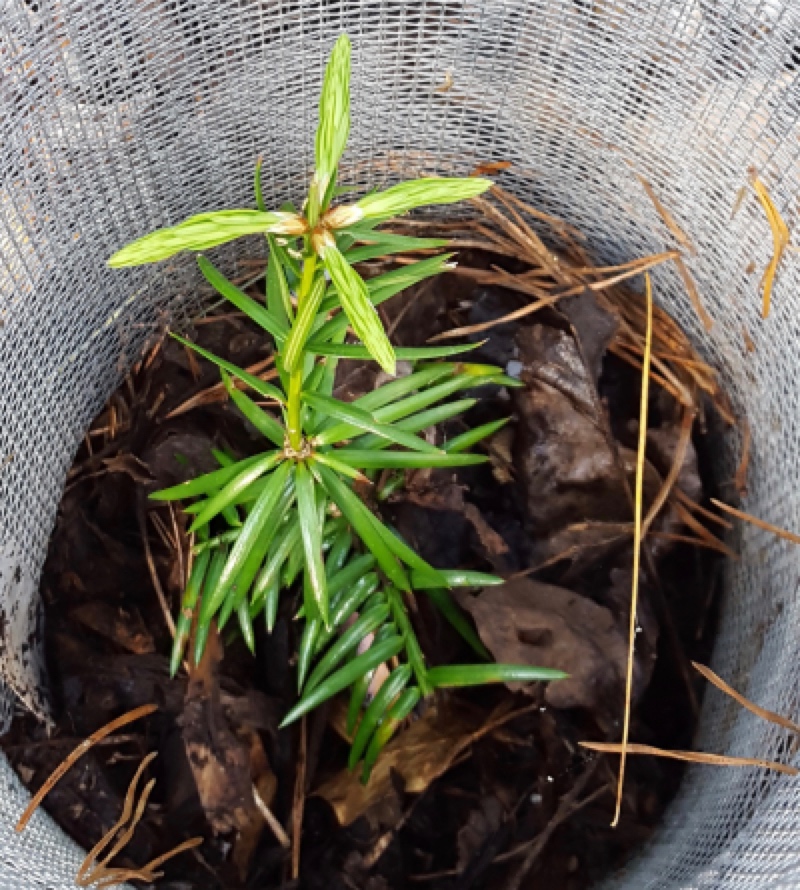
"Look at the new growth on this cutting from Highlands, NC! The cutting is the apical tip from a basal of one of the mature trees."
UPDATED MARCH 2020 with photo of superb root development, as this specimen (far left) is slipped out of its pot for planting into wild forest. Visit the url above for photos and details.
|
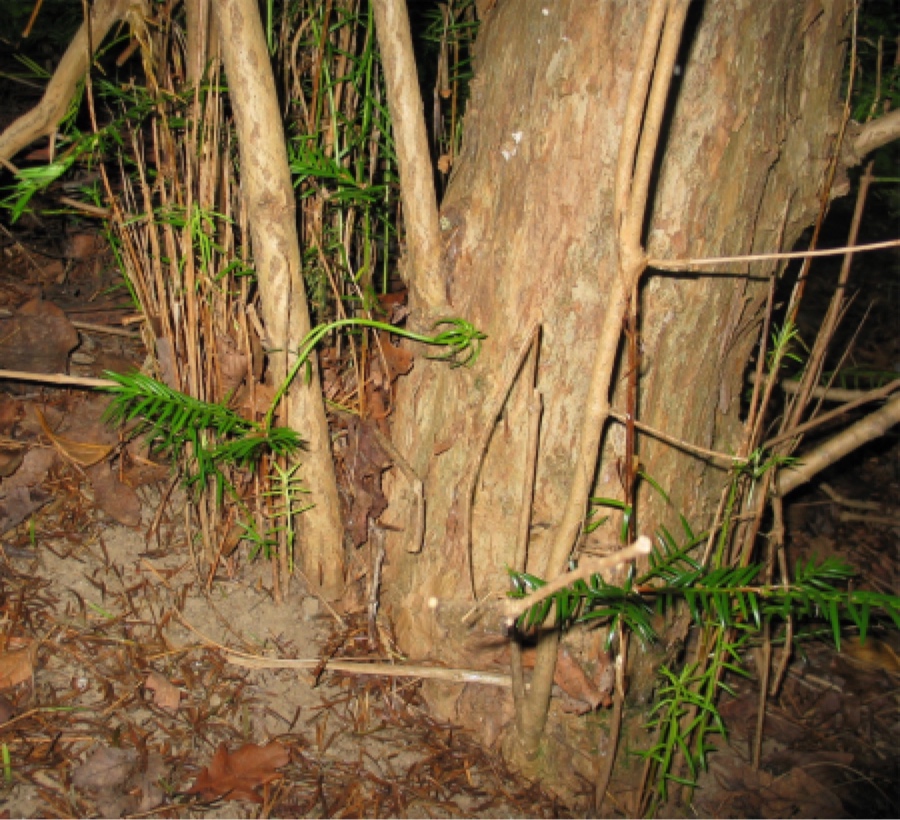
PHOTO ABOVE LEFT by Clint Bancroft is April 2019 of a rooted cutting (collected October 2017 at Harbison House near Highlands NC) that displays superb vertical growth. PHOTO RIGHT is by Connie Barlow 2006, during a Torreya Guardians site visit to the near-century old Highlands NC Torreya grove. Notice the prolific basal sprouting, of various ages.
Editor's note: The original cuttings of wild specimens in the Florida panhandle were collected three decades ago (by scientists working for institutions implementing the official recovery plan under the Endangered Species Act) from lateral branches rather than basal tips. Lateral branch cuttings notoriously assume shrubby growth forms. Wild stock was so weak that cutting of basal terminals would not have been appropriate. However, thanks to this report by Clint Bancroft, we now know that when collecting vegetative growth from healthy horticultural plantings in northward states, apical growth of basals are essential for ultimately producing tree forms.
April 2019 / Connie Barlow / USF&WS article highlights contrasting management aims for Torreya
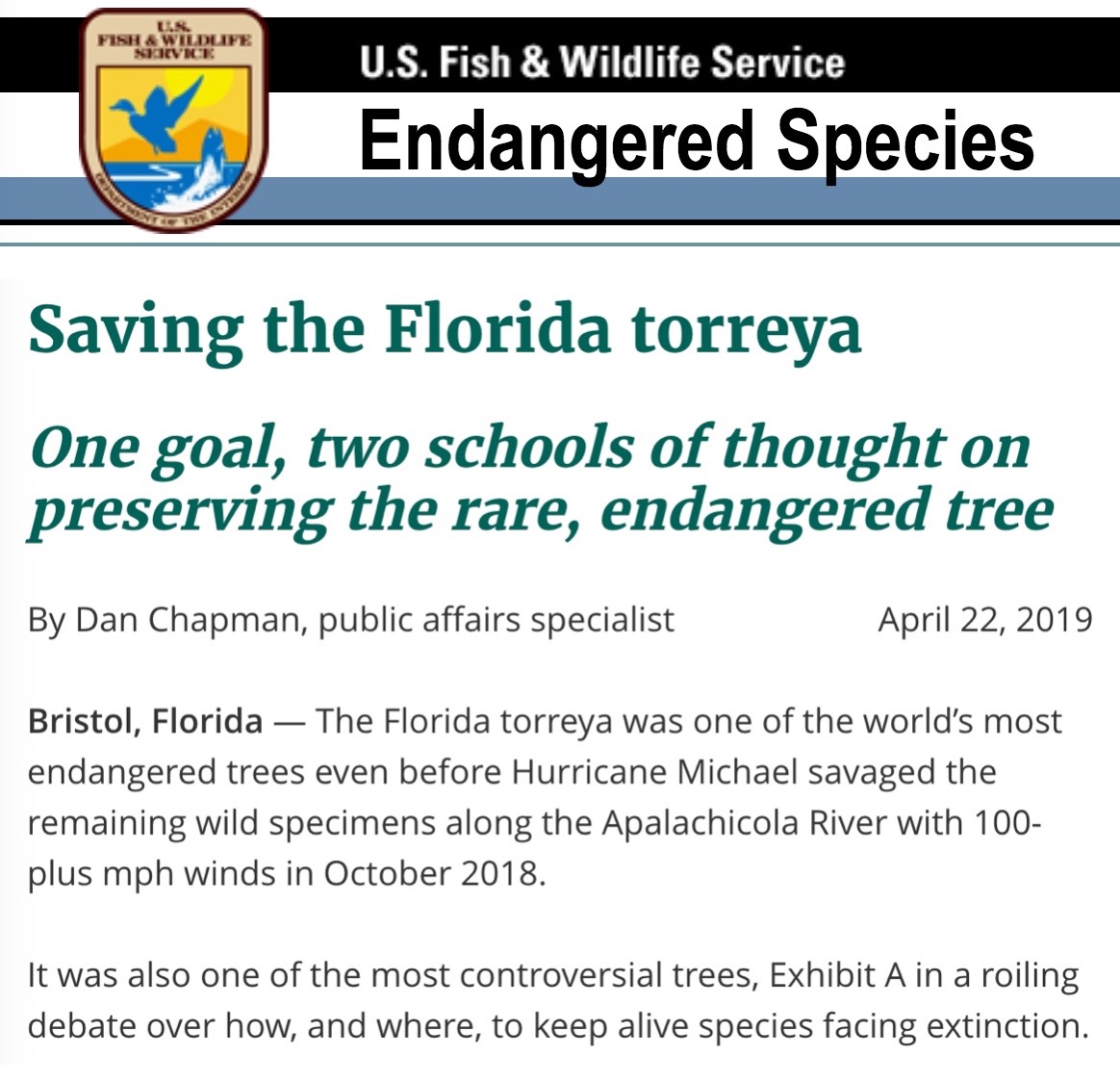
On April 22 Earth Day, the U.S. Fish and Wildlife Service posted an article on their southeast region website, "Saving the Florida Torreya: One goal, two schools of thought on preserving the rare, endangered tree". The theme for this year's Earth Day was endangered species.
|
|
The USF&WS journalist, Dan Chapman, had several phone conversations and many email exchanges with me back in January. He asked very good questions and obviously had read a lot of what we have on our website.
I am disappointed that our success with seed production in Cleveland Ohio and our multi-state documentation of thrival and non-invasiveness within long-ago horticultural plantings (Historic Groves) were not mentioned. But because the USF&WS depends upon the goodwill of institutional partners (who are not fully compensated by federal funds for their efforts in behalf of endangered species), it is far more important for the agency to accommodate the conservation values and choices made by their official partners, rather than by non-institutional volunteers such as Torreya Guardians.
|
Thus, you will see that Atlanta Botanical Garden staff priorities and actions are well represented in this article. The fact that Torreya Guardians is mentioned at all (and that the subtitle presents our work as an alternative "school of thought") is something I am grateful to see gain approval within the agency. Readers will easily grasp that this species is a left-behind glacial relict and that my personal goal of "rewilding" Torreya goes far beyond the official goals of (a) preventing extinction, (b) safeguarding genotypes, and (c) limiting the long-term goal to revitalizing Torreya within its peak-glacial refuge — despite ongoing climate warming.
April 2019 / Connie Barlow / Article features Atlanta Botanical Garden perspective on Torreya
 |
|
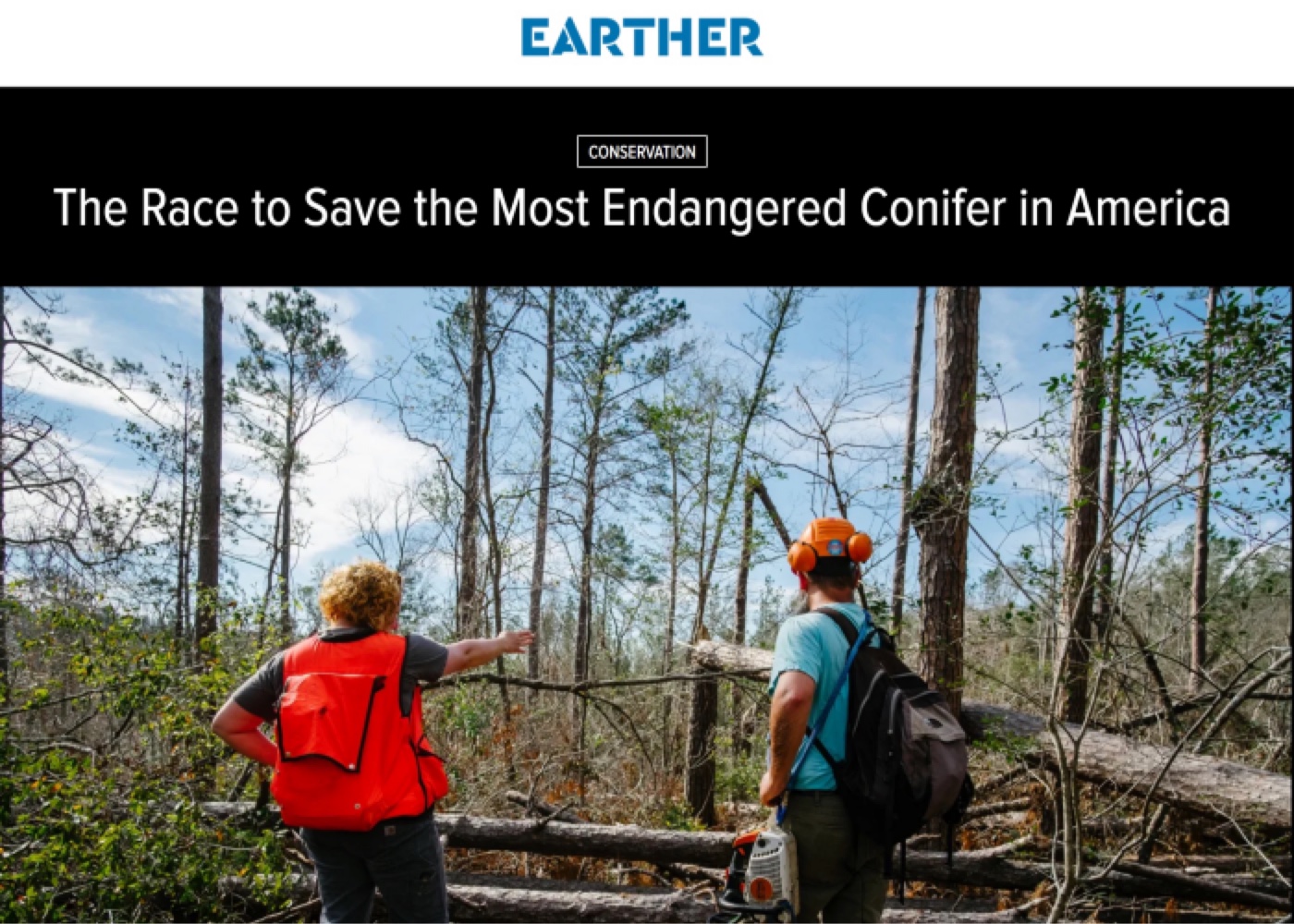
This month, Earther published a lengthy online article by Brian Kahn: "The Race to Save the Most Endangered Conifer in America. The article is very useful for everyone involved in Torreya actions.
However, Torreya Guardians is mentioned in only one paragraph (and in a derogatory way). My contact information is easily found on this website, yet I was not contacted. Indeed, nothing in this article suggests that the journalist even glanced at the Torreya Guardians website.
I immediately emailed "corrections" to the author (none were implemented). I first mentioned aspects of the article that are indeed valuable for the record (see below).
|
EXCERPTS OF BARLOW'S "CORRECTIONS" EMAIL TO THE AUTHOR: "... Two crucial things you accomplished in that article, for which I thank you:
1. You documented that Atlanta Botanical Garden does not concur with U Florida fast-tracking of genetic engineering. I have been hoping that is the case, and you are the first to document it.
2. Your descriptions and your photos of your site visit to the Apalachicola powerfully document what I had only surmised: that Hurricane Michael destroyed the ravine canopy — without which even the beleaguered resprouts of old rootstocks of Torreya cannot survive. Accordingly, I have added 3 of your paras to a crucial webpage on the Torreya Guardians website, where I attempt to link and annotate all important developments in the complex and increasingly politically charged saga of (a) how this endangered tree is officially managed, and (b) how we Torreya Guardians have been utilizing an "exception" for plants that was intentionally written into the Endangered Species Act (which almost was written for protection only of animals). You will find my excerpt of your piece as SECTION 1F of this webpage: http://www.torreyaguardians.org/extinction.html".
You also did a great job in making it easy for readers to understand what we in paleoecology well understand: that Florida Torreya is a left-behind glacial relict, attempting to maintain itself in an ever-warming climate in a locale that served it well in peak glacial. That, of course, is not a fact that Emily Coffey [spokesperson for Atlanta Botanical Garden] would use as supportive of ABG work, but it is good that you found that out yourself and added it. If you would like to access reputable links on its glacial relict status, go to the above url and scroll down to SECTION 3A: "Apalachicola as glacial refugium and Torreya as glacial relict are undisputed."
Because those above accomplishments are so important to finally have documented in an online accessible form, I would like to suggest some "corrections" you could make elsewhere in your article which are either factually wrong or could lead the reader to an unnecessarily restricted (rather than appropriately nuanced, ideally open and questioning) perspective. So here are my suggestions for FACTUAL CORRECTIONS...."
Access Connie's full list of suggestions (including a proposed factual correction in the single paragraph in which Torreya Guardians is mentioned) in PDF.
April 2019 / Connie Barlow / Torreya Guardians mentioned in long-form essay
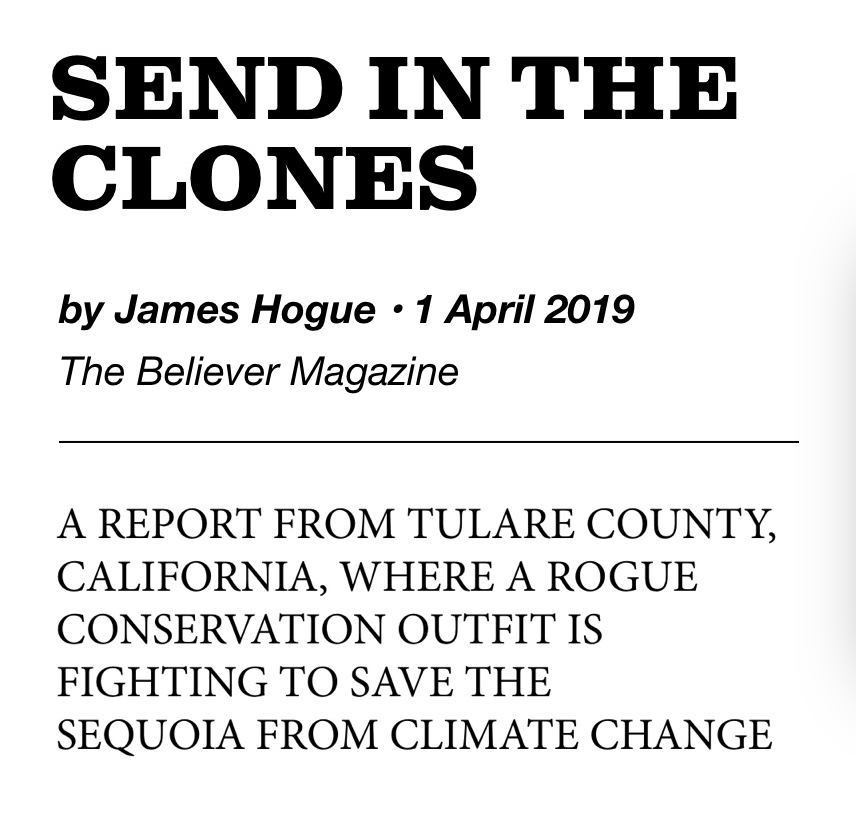
"Send in the Clones" is a long-form essay, personal style, by a journalist describing a site visit he made to a privately owned grove of Giant Sequoia trees in the southern Sierras. Because the topic is a branchlet harvesting visit by Archangel Ancient Tree Project, Torreya Guardians is mentioned as another well documented example of citizens stepping out ahead of the officials in charge in order to help native trees migrate to cooler realms.
|
|
EXCERPTS: ... Activists called the Torreya Guardians, for example, are working to save the Florida torreya — one of the most critically endangered conifers in the world — by planting it far outside of its tiny north Florida range, where the tree has been afflicted by a mysterious fungal blight. The US Forest Service's recovery plan for the tree is restricted to its native but damaged habitat.
... I have not felt, these last few years, that there is much hope left for the South Sierra, for my childhood forest in Ohio, or for this world. But if we could make a political project where large numbers of people felt true intimacy with their local landscape — where everyone felt native on this deep level — it seems at least possible to build an environmental movement where people feel less disempowered and hopeless than at least I have these past few years, where it feels possible to actually do something....
|
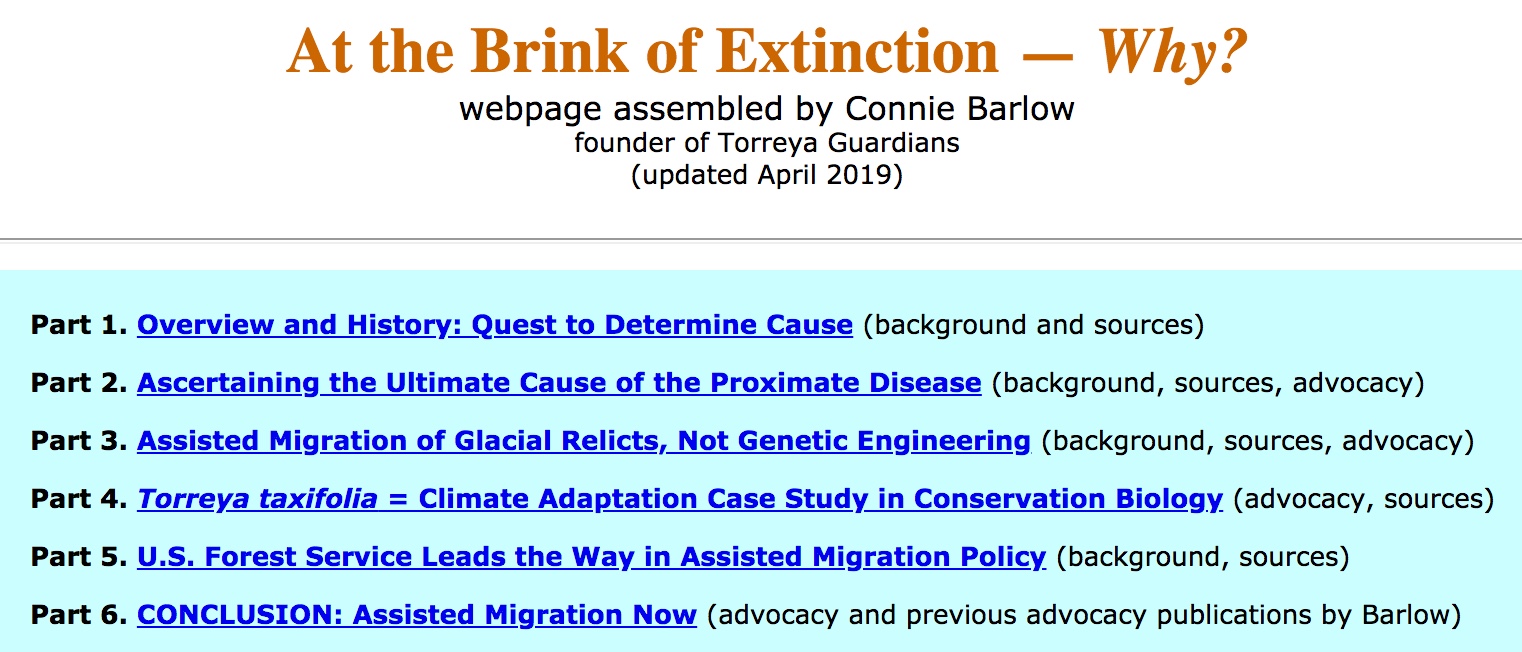
March 2019 / Connie Barlow / "Endangered (causes of)" webpage is updated and expanded
Two events in 2018 indicated a reconfiguration was in order: In March 2018, genetic engineering of the Torreya genome was advocated by a University of Florida forest pathologist. And in August of 2018 the U.S. Fish & Wildlife Service announced that the 2010 recovery plan would be updated in 2019.
|
|
The "Endangered (causes of)" webpage has been online (and periodically updated) for more than a dozen years. However, in 2019 it seemed time to reconfigure the text for ease of use and to distinguish the background, objective summaries (with key links) from my own advocacy sections.
Annotated access to key documents is sectioned into six parts (image left).
|
February 2019 / Connie Barlow / 2-part VIDEO of January 2019 free-planting success in n. Florida
 |
|
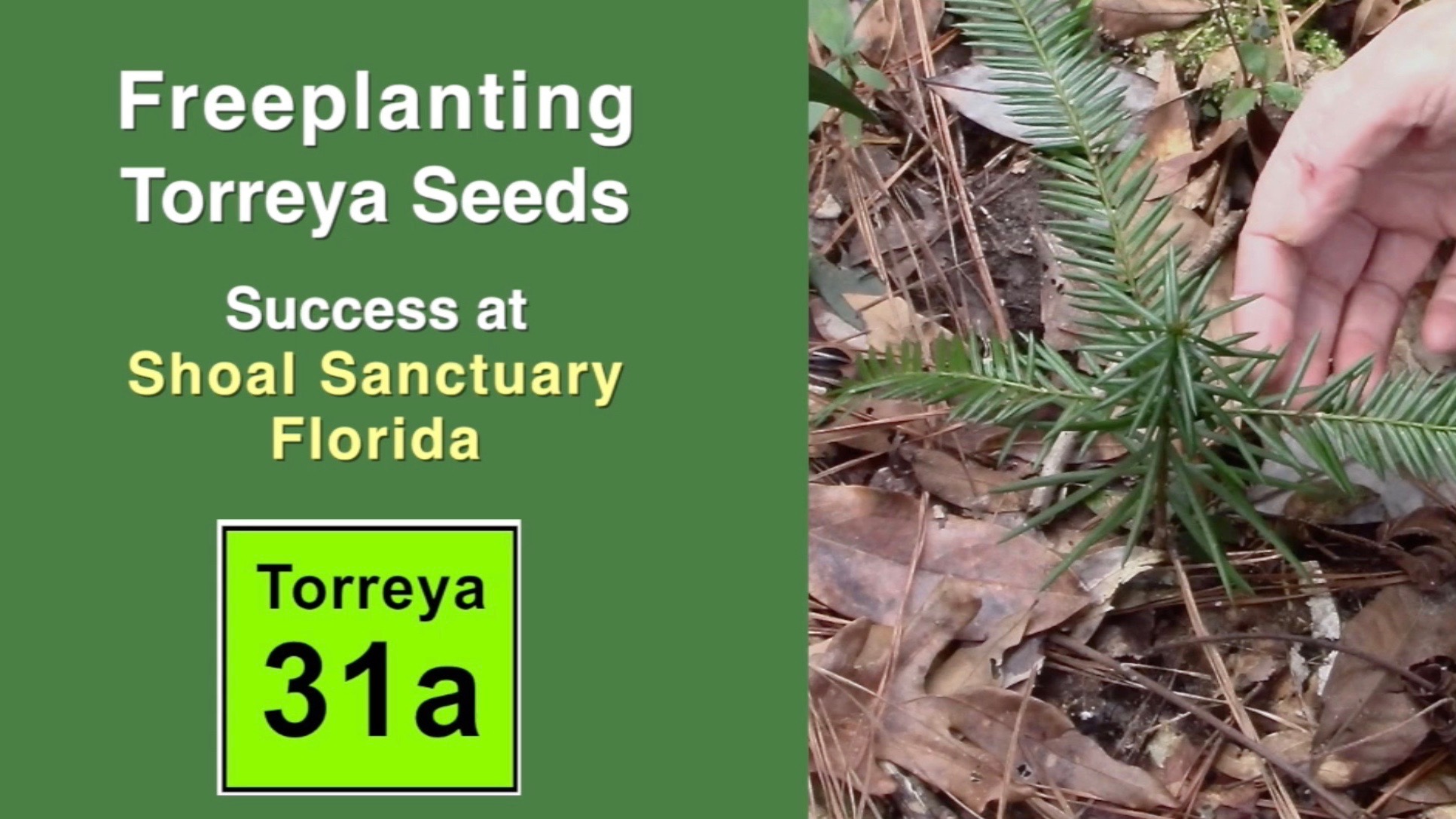
31a: Freeplanting Torreya Seeds - Shoal Sanctuary FL pt 1 of 2
Site visit to Shoal Sanctuary, due west of Torreya's peak glacial refuge in northern Florida. Documentation of 9 seedlings thriving (and remarkably free of herbivory) four years after a total of 40 seeds were placed directly into the coolest, moistest habitats. Distinctions among the sites portend excellent learnings of site preferences in the years ahead. 24 minutes - filmed January 30, 2019 |
 |
|
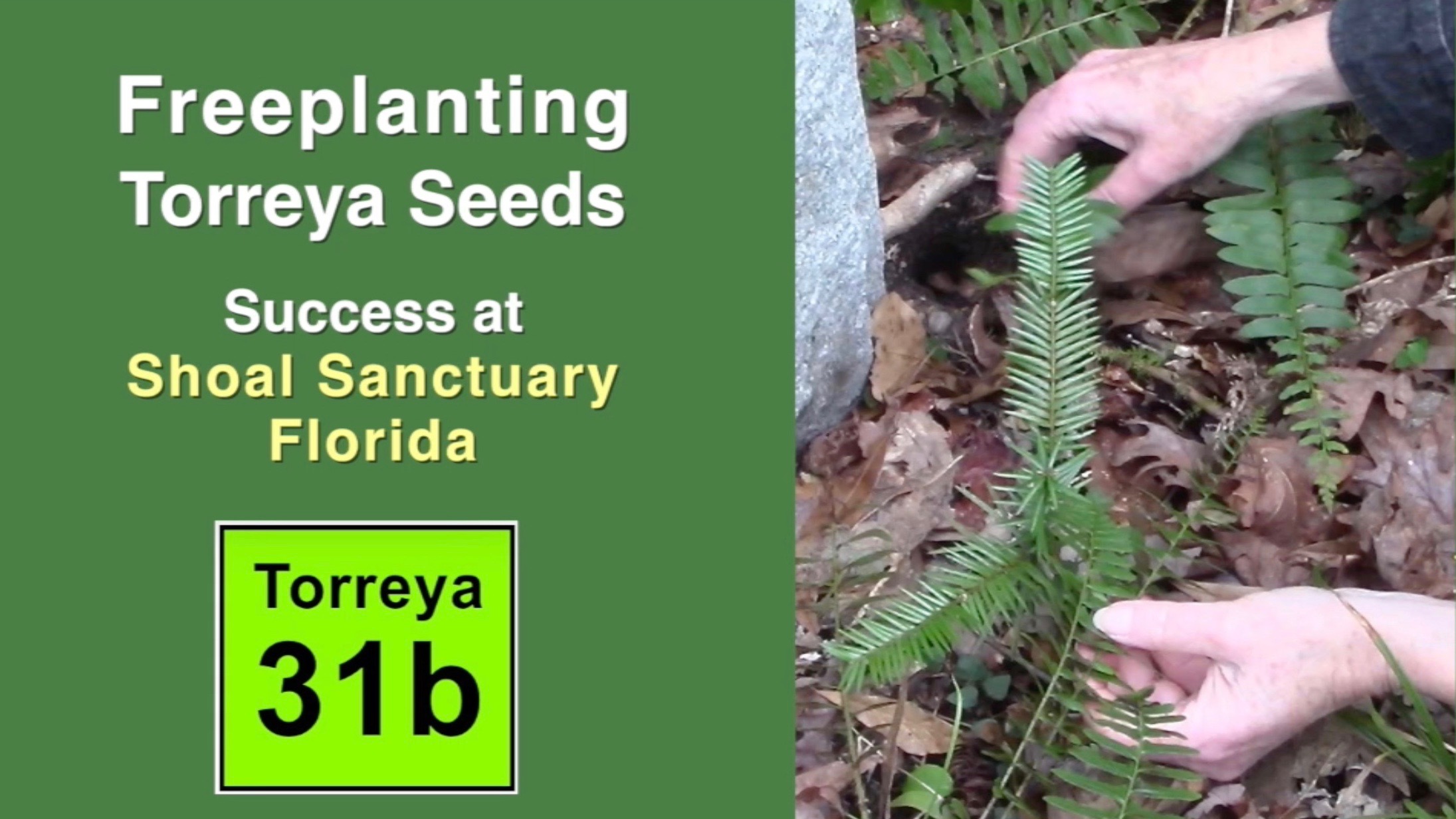
31b: Freeplanting Torreya Seeds - Shoal Sanctuary FL pt 2 of 2
This last half of the video set summarizes the documentation and offers topics for further study — notably, why herbivory was absent at all planting sites. Native Christmas Ferns are pointed out as ideal neighbors for (1) camouflage, (2) its "endo" mycorrhizal network, and (3) as an "indicator species" for identifying best microsites for Torreya.
31 minutes - filmed January 30, 2019 |
February 2019 / Connie Barlow / 2-part VIDEO of November 2018 Torreya site visit in Louisiana
 |
|
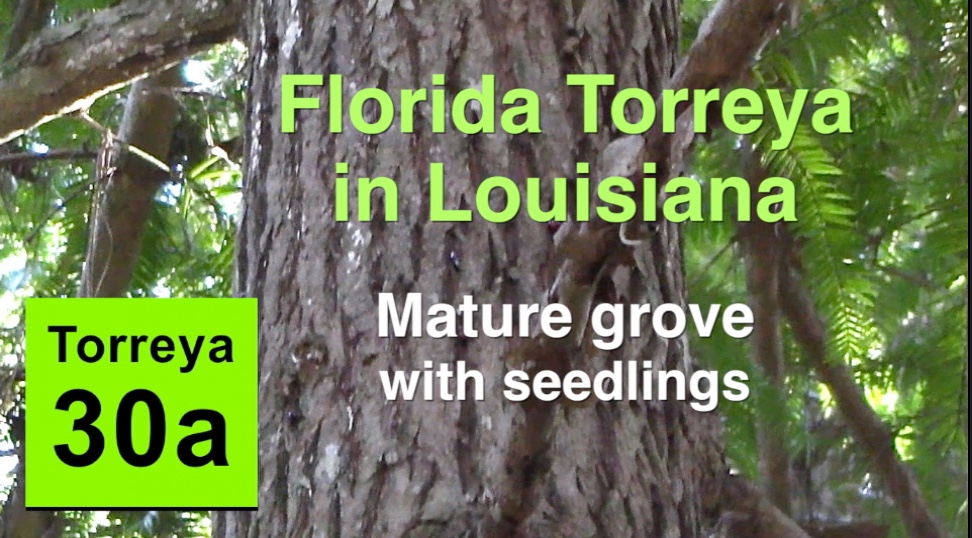
30a: Florida Torreya in Louisiana (Pt 1) - Mature Grove with Seedlings
Site visit to Caroline Dormon Nature Preserve. Of the four long-ago horticultural plantings outside of Florida that produce seeds that have germinated into seedlings nearby (with no human help), this mature grove of Florida Torreya in Louisiana is the first one in which knowledgeable local guides could provide the complete oral history and answer questions posed by Torreya Guardians. This is thus a superb example of why "natural history" observations and inquiry can help the development of best practices for "assisted migration" recovery actions to ensure that this climate-endangered tree does not slide into extinction. |
 |
|
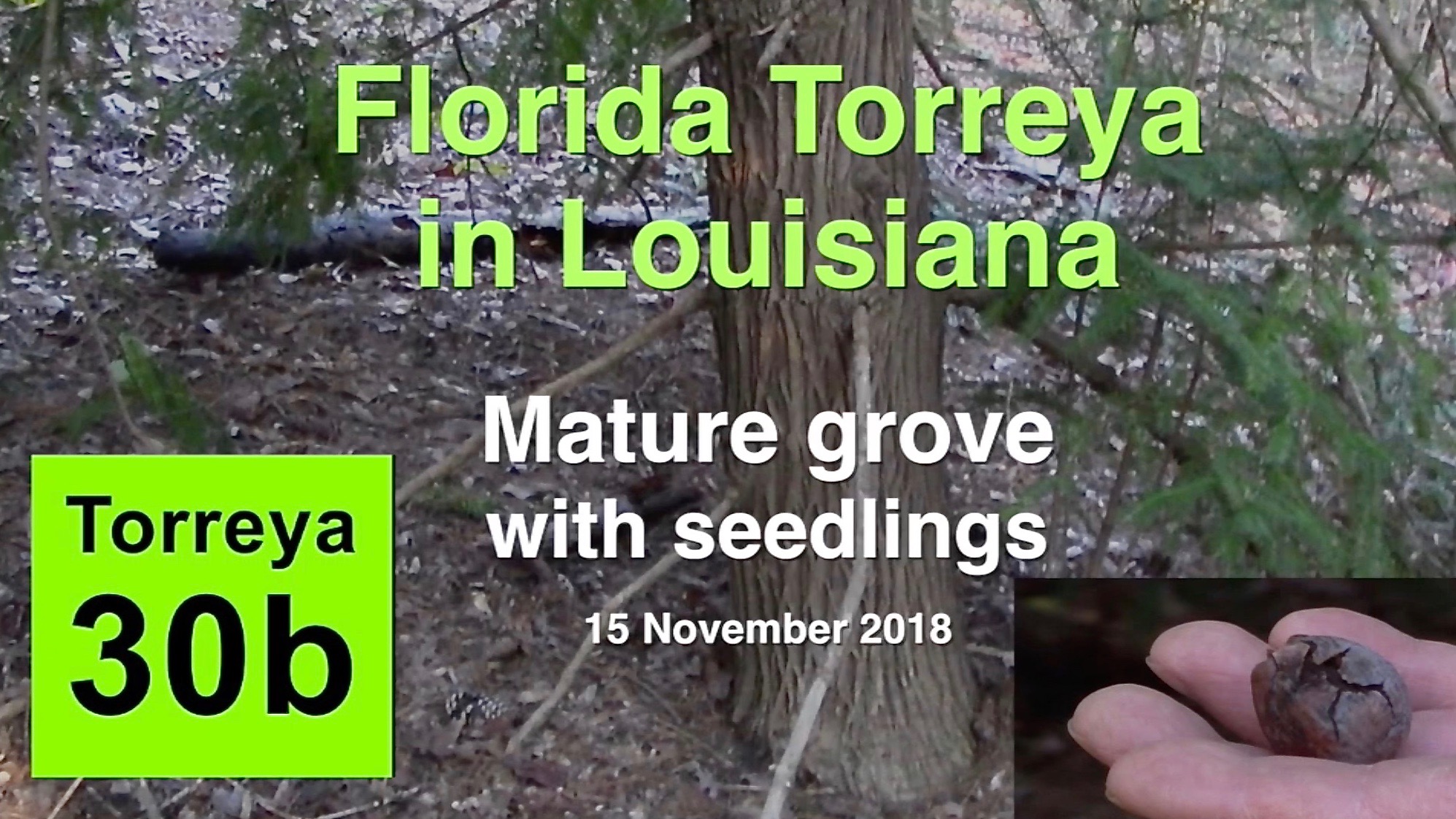
30b: Florida Torreya in Louisiana (Pt 2) - Mature Grove with Seedlings
This last half of the video set covers the largest of the three mature trees — the only one that is producing any seeds. Nearby seedlings naturally established are featured, as is the 30-foot-long twin ground-trending branches that achieve photosynthesis by way of horizontal extension, well beyond what the 50-60 foot high canopy can provide. |
January 2019 / Connie Barlow / Sierra Magazine and National Park Service mainstream assisted migration
"Can We Help Our Forests Prepare for Climate Change?" - by Madeline Ostrander, December 2018, Sierra Magazine.
 |
|
Summary by Barlow: This article focuses on the research and questions happening at Acadia National Park as to whether, when, and which more southerly tree species should be given assisted migration into the park.
That this lengthy article appears in the national magazine of the Sierra Club and that the author goes onsite to a national park wrestling with the assisted migration question means that, finally, this climate adaptation practice may go mainstream.
Notably, the author distinguishes between the early focus on single species needing help moving poleward and the new focus on a land management agency wanting to ensure that a forest canopy remains. Joshua Tree and Sequoia Kings Canyon national parks have previously been the epicenter of national park resistance to assisted migration of climate-injured tree species. But those two parks are brand-named for trees; hence they are the last places to be willing to let go of their famous trees and wish them well northward.
LEFT: Our work as Torreya Guardians is mentioned in the article twice: The graphic left and a sentence in the text. "A group of grassroots activists stirred controversy a decade ago when they moved endangered Florida torreya trees to locations in North Carolina and as far away as Ohio."
|
Note: Also read the short introduction to this climate theme issue by the editor of Sierra Magazine, Jason Mark. Excerpts:
... The terrible fate we sought to avoid is upon us: Even if humans stopped all emissions today, Earth would keep warming for generations. Which means that even as we stay focused on transitioning away from fossil fuels, halting deforestation, and reforming our agriculture systems, we must also begin preparing for life on a planet transformed. This dual task — managing the unavoidable while working to avoid the unmanageable — poses a huge challenge to the environmental movement. It's not an overstatement to say that it may represent the greatest challenge in human history. As the IPCC report put it, the scale and scope of the changes we need to make have "no documented historic precedent."
That's why Sierra is publishing this special issue on climate change adaptation. As our reporting reveals, adaptations will have to take a number of forms. In "On the Move", Madeline Ostrander reports that we will likely have to begin some kinds of assisted migration — helping flora and fauna relocate in order to survive.... Action, especially collective action, is the most effective antidote to despair....
December 2018 / Connie Barlow / Learnings webpage updated at year-end
 |
|
Noting that the 2010 Recovery Plan for Torreya will be updated in 2019, I have made a special effort in 2018 to update and create new webpages that fully document our learnings to date. These are featured as the newest entries on the chronologically organized Torreya Guardians Learnings webpage.
Entries for 2018 include:
Historic Groves of Torreya Trees: Long-Term Experiments in Assisted Migration
Summary of Academic Papers Trending Toward Assisted Migration
Documentation: Free-Planting Torreya Seeds directly into forest habitats
Documentation of Adaptive Growth Forms (10 year results)
|
December 2018 / Connie Barlow / New video shows tenth anniversary results of our 2008 NC planting
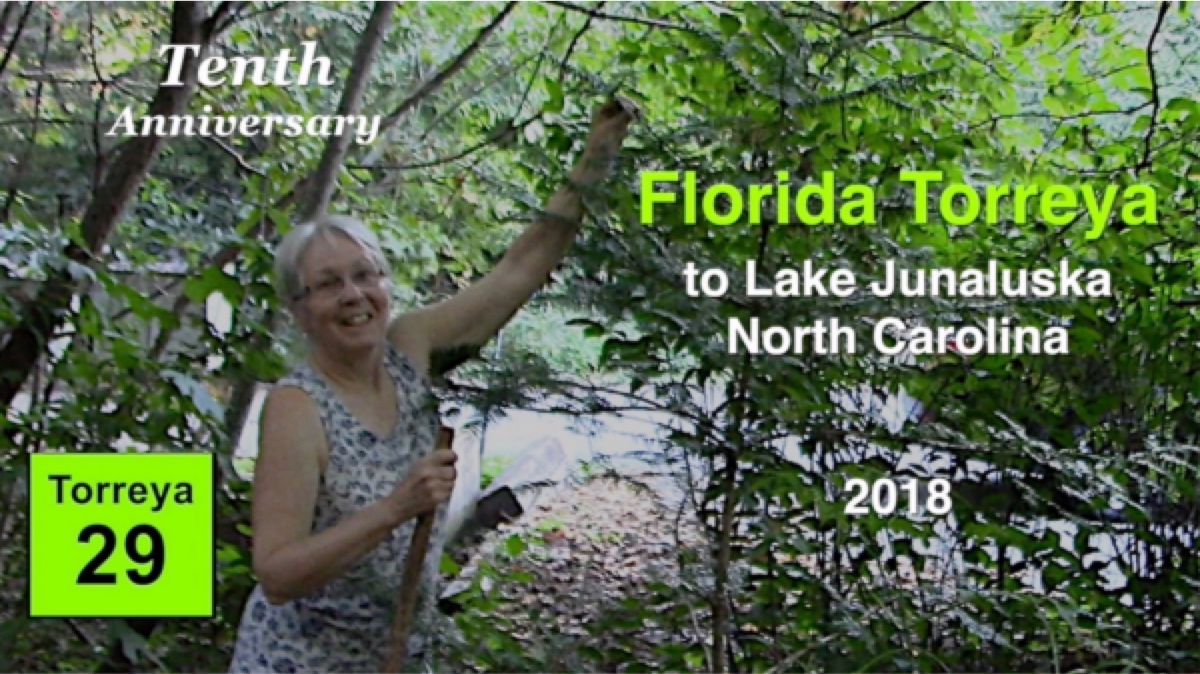 |
|
29: Florida Torreya to Lake Junaluska NC - 10th Anniversary, 2018
Ten years after the 2008 planting of ten potted seedlings as a first "assisted migration" project (reported on by Audubon Magazine), Connie Barlow returns to document ongoing results. The challenges, the successes, and the learnings are all topics covered here and also on the Lake Junaluska webpage. A key learning is how Torreya is capable of adapting its growth form to conditions of shade (horizontal, yew-like form) or abundant sunlight (standard conifer form).
31 minutes - filmed October 7, 2018
|
December 2018 / Connie Barlow / Site Visit to Mature Torreya Grove in Louisiana
Two Torreya Guardians, Clint Bancroft and Connie Barlow (along with Connie's husband, Michael Dowd) were guided by the preserve stewards: Rick Johnson and his son David (November 15, 2018). The group visited the 3 mature Florida Torreya trees that had been planted by botanist Caroline Dormon some 70 or 80 years ago. Visit the LOUISIANA TORREYA WEBPAGE to access the new photo-essay of their site visit. (Connie will edit and post video of the site visit soon.)
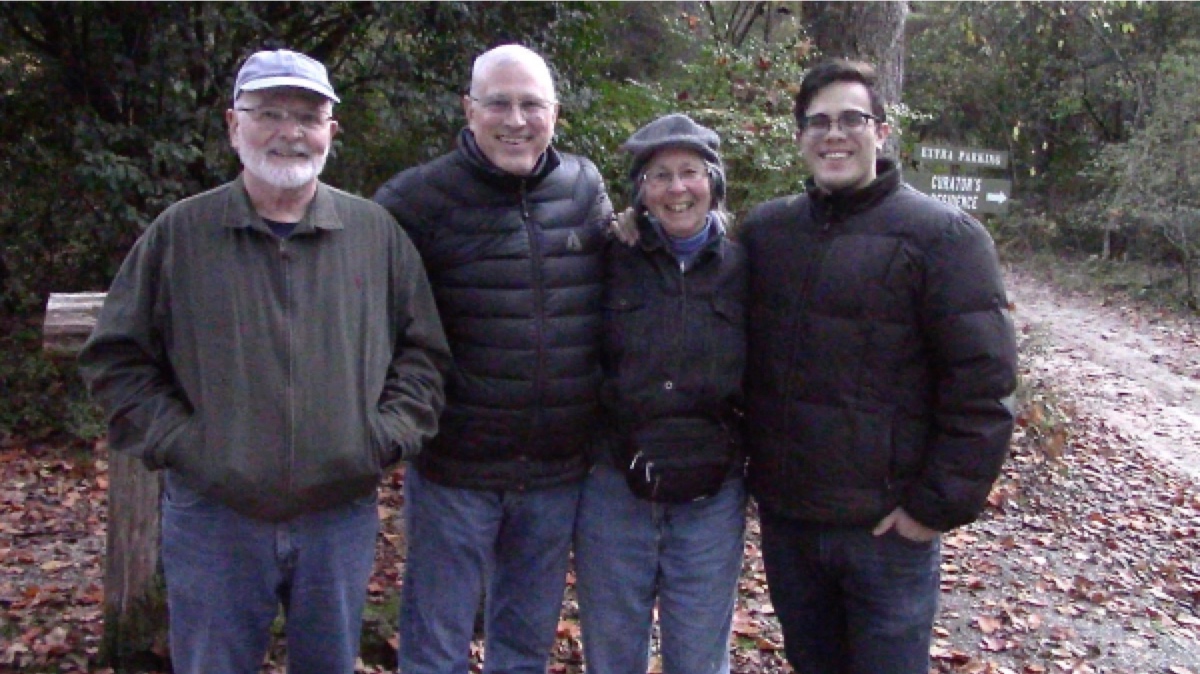 |
|
Importance of the site visit:
1. This is the fourth instance documented by Torreya Guardians of torreyas planted before mid-20th-century that are not only thriving outside of Florida but reproducing. As well, some of the seeds are establishing on their own.
2. This is confirmation, again, that a male genotype Torreya specimen can produce female cones — and viable seeds.
3. Stewards of the preserve donated all 4 seeds produced this year to Torreya Guardians.
• Photo-Essay of Site Visit • Site Visit Video |
December 2018 / Connie Barlow / New webpage to provide summary results for 2019 recovery plan update
Although Florida Torreya was listed as endangered 34 years ago, not much more than "genetic safeguarding" has been attained by the institutions implementing the official recovery plan (last updated 2010). Meanwhile, Torreya Guardians has been conducting "assisted migration" experiments in northward states, documenting historic groves, and experimenting with how best to plant seeds directly into regrowth forest habitats (while minimizing losses). Because the official plan will be updated in 2019, I created a new PHOTO-RICH webpage of summary results to assist the decisionmakers:
 |
|
NEW WEBPAGE: Free-Planting Torreya Seeds:
• Risks and Advantages of Free-Planting
• Learnings 1: Seed Harvesting, Storage, Germination
• Learnings 2: Techniques To Deter Seed Predators
• Learnings 3: Torreya Recovers from Herbivory
• Learnings 4: Siting to Minimize Above-Ground Herbivory
• Learnings 5: Siting to Minimize Antler Rubbing
• Learnings 6: Siting for Myccorrhizal Connections
• Learnings 7: Natural Seedlings in Historic Groves
|
VIDEO 28: Free-Planting Climate-Endangered Florida Torreya - 2018 Update is the 37-minute field documentation that supports the new webpage.
November 2018 / Connie Barlow / Free-planting success: 6 of 15 seeds, Franklin NC
November 7 I made a site visit to the remote mountain home of Russell Regnery, west slope of Blackrock Mountain (3,800 feet elevation), whose forested property slopes up to the Nantahala National Forest. This free-planting success story is so exciting for me personally that I decided to post a detailed photo-essay showingcasing the "baby pictures" I took onsite (with my preliminary interpretations).
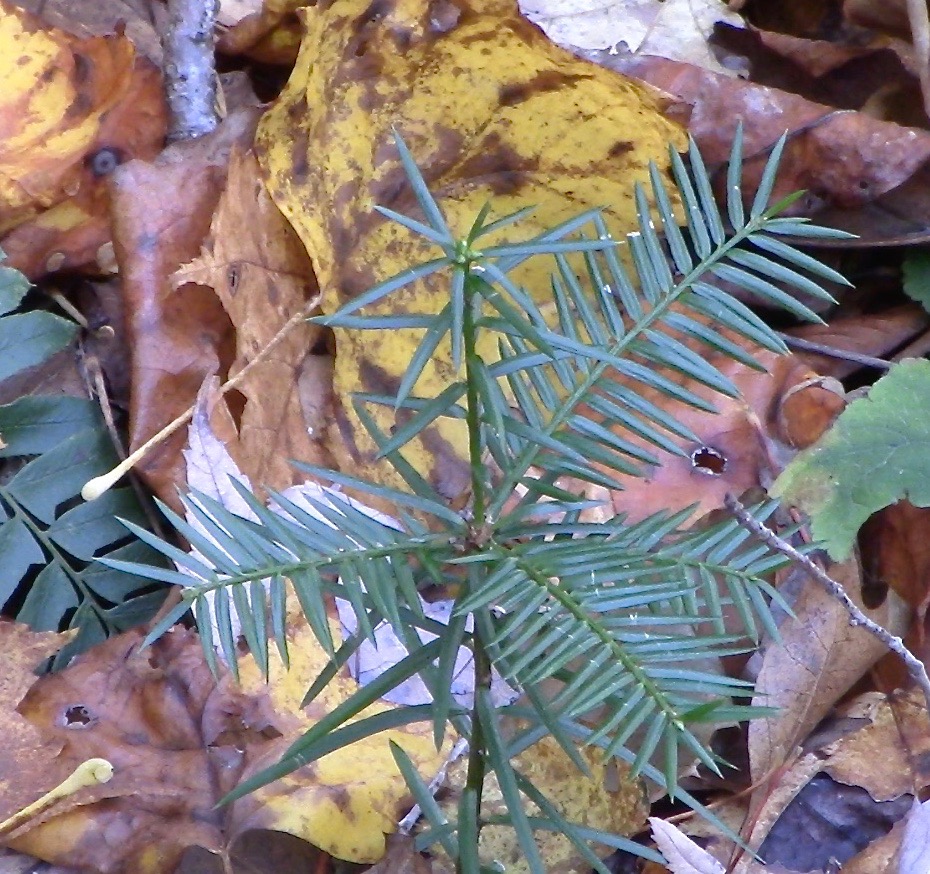 |
|
Because 6 of the original 15 seeds had produced seedlings, this site visit demonstrates that putting seeds directly into forest soil, and with no rodent protection (other than depth), seed losses from natural causes (notably, herbivore predation) need not be exorbitant. (Connie had 1,600 seeds to distribute from the 2014 harvest; it is a lot easier recruiting volunteers to accept large numbers of seeds if potting and wire protection are not required.) LEARNINGS include:
• As many as 3 summers may pass before the germinating (and root-establishing) seed will show any above-ground growth.
• This species exhibits remarkable capacities to recover from early stem and leaf herbivory.
Access the new site-specific FREE-PLANTING photo-essay and VIDEO of the site visit.
|
November 2018 / Connie Barlow / 2018 "National Climate Assessment" update for USA maps climate shift
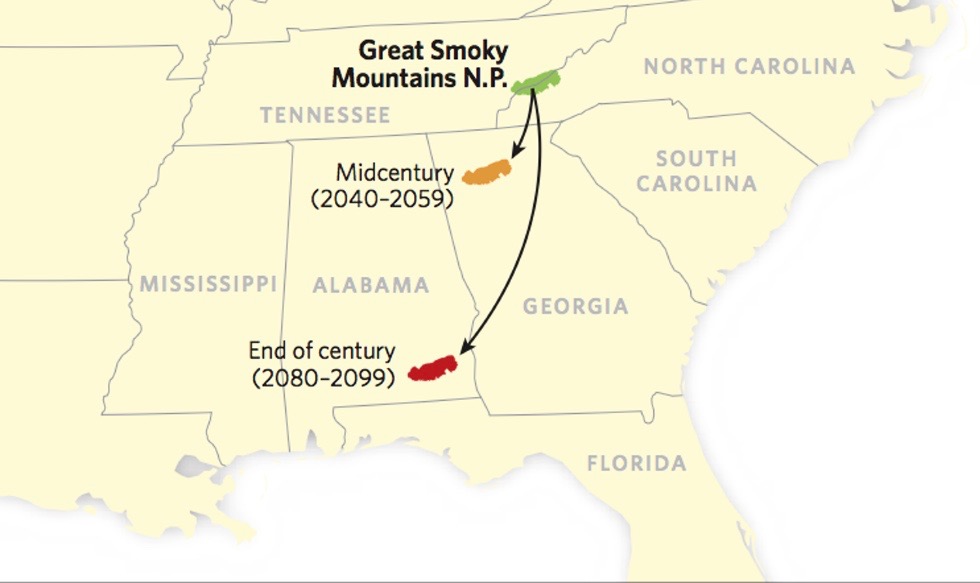 |
|
An article on a lengthy national report includes a MAP (left) cited from the 2018 climate update, projecting climate shift by imaging it geographically. The USA report is massive, so I haven't been able to locate this map within it. But I wanted to put it on the Torreya Guardians website because it is a powerful visual of what lies ahead.
The original proposal to conduct "assisted migration" for Florida Torreya (Barlow and Martin 2004/05) was intentionally limited to its being a "left-behind" relict species trapped in its "peak glacial refuge." But this new map shows how even more out of sync this species will be in the decades of climate change ahead if officials keep insisting it must be returned to its "native" range in North Florida in order to meet the "recovery" goals of the Endangered Species Act.
|
November 2018 / Connie Barlow / New discoveries during site visit at Biltmore torreyas
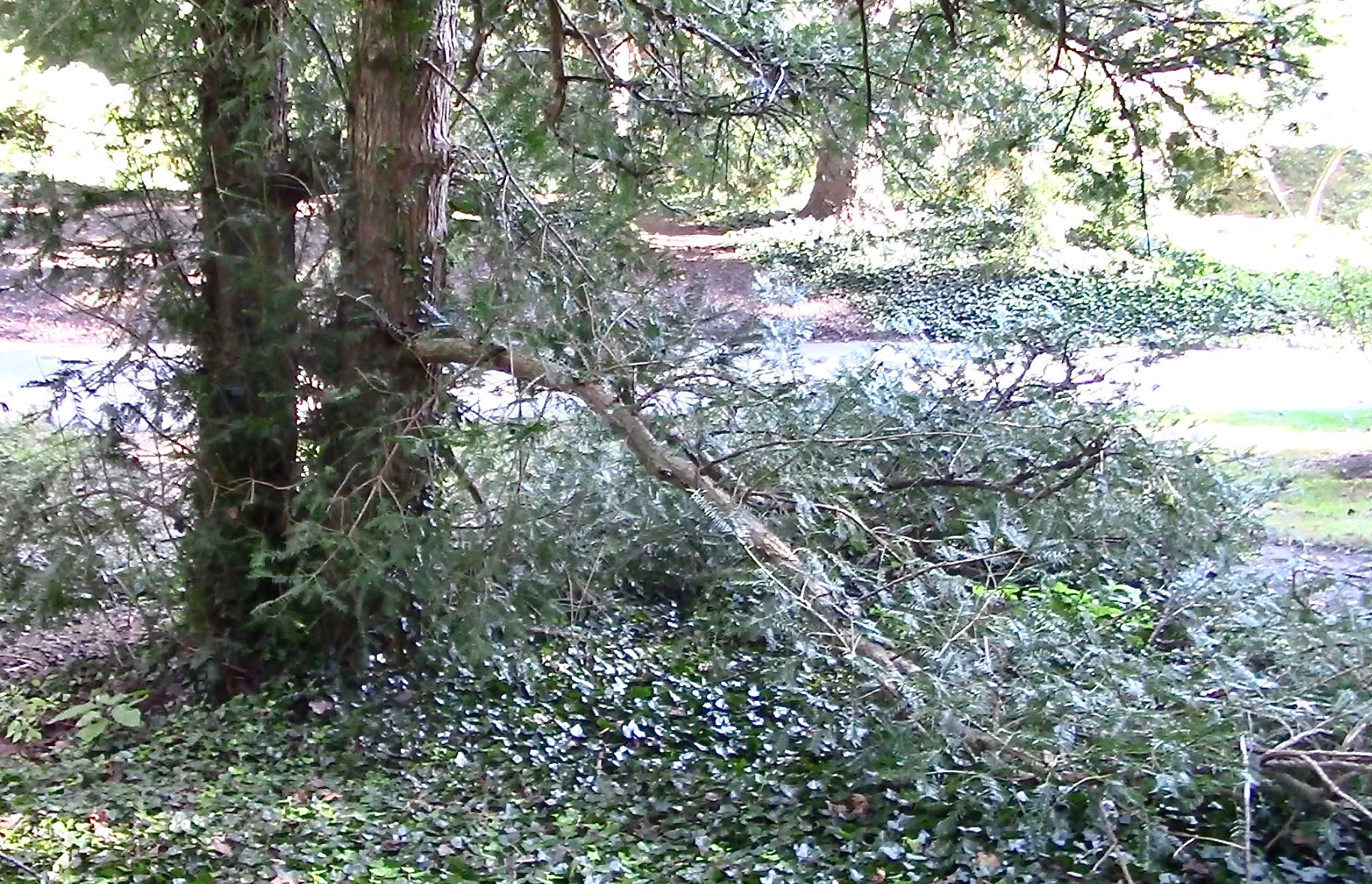 |
|
The Biltmore webpage has been updated with a 2018 section entailing photos and explanations of (1) a new volunteer sapling discovered upslope bearing at least 17 ripe seeds, and (2) documentation of a unique Torreya adaptation: a ground-running branch.
This brings to three the number of torreya sites with documented ground-running branches. The other two: Harbison House (Highlands NC) and Caroline Dormon Nature Preserve in Louisiana. Evidence suggests that when a Torreya begins life in full sun, but is later overtopped by fast-growing tree species (in the case of the Biltmore, by a Norway Spruce and a Liriodendron), then a living branch low on the trunk will push its growth 20 or 30 feet to reach the sunlight. (See photo left.)
|
October 2018 / Connie Barlow / Torreyas produce 23 SEEDS in Cleveland, OHIO!
October 2 I visited Fred Bess in Parma, Ohio (near Cleveland) and rejoiced in his Torreya grove producing 23 seeds this year. (Last year was the first seed production: 5 total.) Visit the Cleveland Torreya webpage to see more photos and commentary or watch the 14-minute VIDEO.
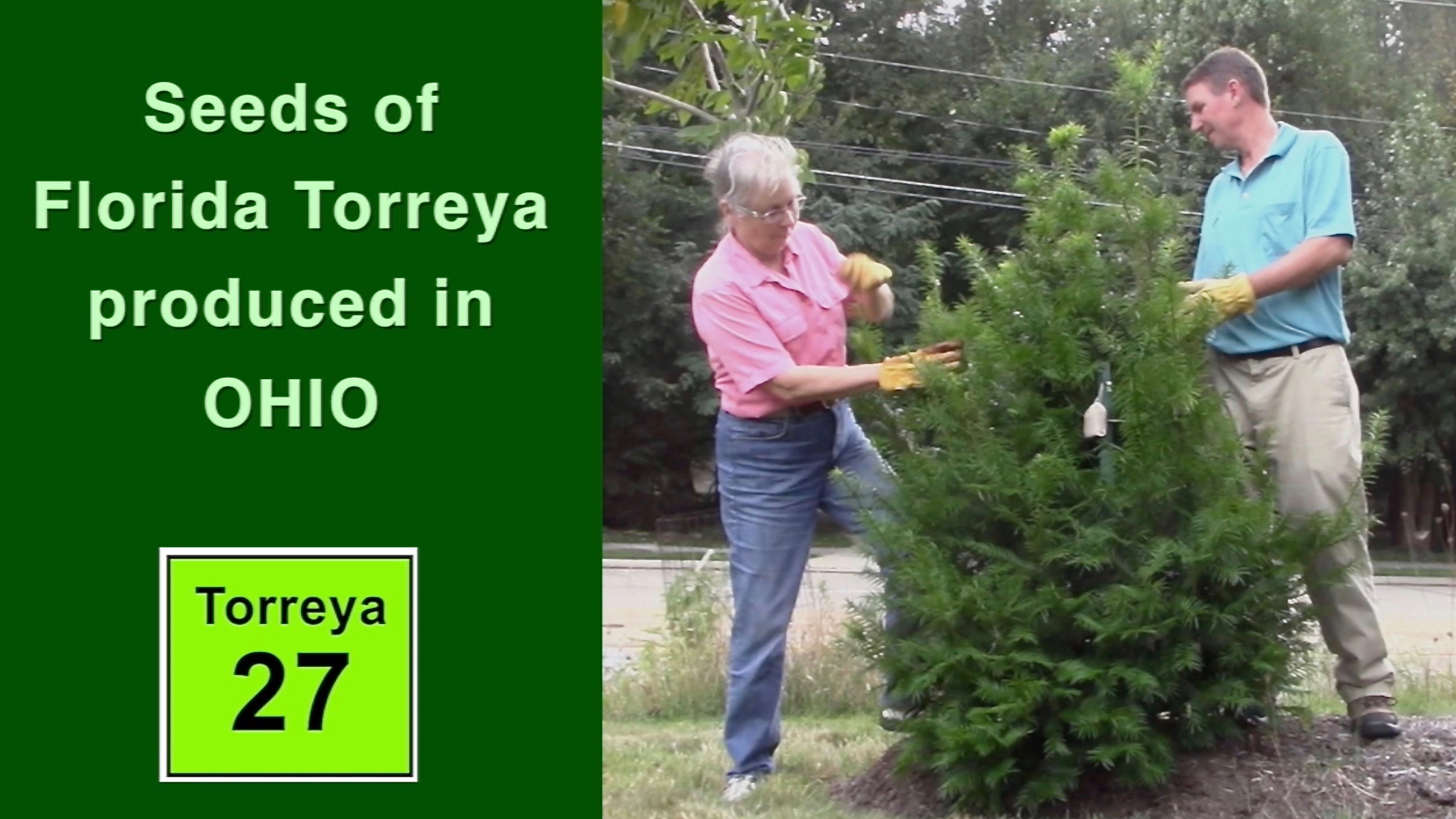 |
|
Connie Barlow filmed this 2 October 2018 site visit. The VIDEO features important findings, including:
1. These trees have put forth leaves well acclimated to severe cold spells in Ohio. On the windward side of the tree, branch tips are occasionally killed, but a ring of new growth results and the tree becomes plusher and thus even more wind-proof.
2. Seeds are produced only on the branches that receive nearly full sun. (Connie notes from her 2005 site visit to wild California Torreya habitat that this seems to be a standard of the genus.)
|
October 2018 / Earth Island Journal / Torreya Guardians featured in endangered species article
 |
|
"Scrappy Group of Citizen Scientists Rallies Around One of World's Rarest Trees", by Sam Schipani, 4 October 2018, Earth Island Journal (1,900 words).
EXCERPT: ... For a group of scrappy citizen scientists known as the Torreya Guardians, though, the Florida torreya is more than just a malodorous, finicky conifer — it is a tree worth saving. And it is also becoming a symbol of what can be achieved when a group of private citizens puts their hearts and minds towards saving an endangered species. Their radical if controversial approach might end up shifting the future of conservation, particularly in a warming world...."These plants have already shown a lot of spunk when it comes to surviving massive climate shifts, but climate is going to be moving much faster than they can move forward," says Connie Barlow, founder of the Torreya Guardians....
|
October 2018 / Connie Barlow / Recovery Plan for Torreya to be officially updated in 2019
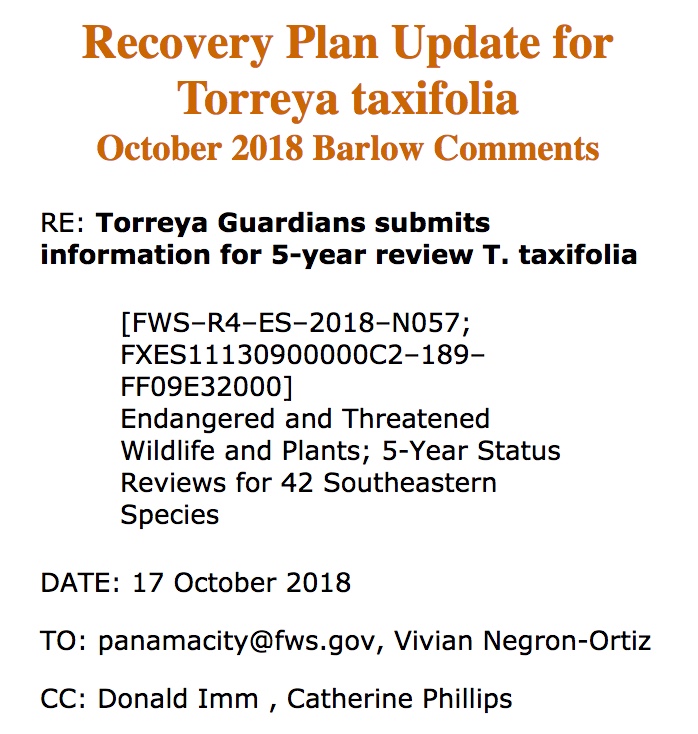 |
|
In October I luckily chanced upon the 6 August 2018 Federal Register notice that the recovery plan for Torreya taxifolia is now under review for updating. I had heard informally through USF&WS that 2019 would likely be the time for an update, as 2010 was the previous update. Russ Regnery (Franklin NC) and I were the two Torreya Guardians who participated in the final phone conference call on the 2010 draft plan — but we had no opportunity to influence formulation of the draft plan itself.
This time I hope will be different. Missing the deadline for submitting "information" by just one week, I quickly submitted an email, which I then formatted into html code so that it would be visible online. Click to access the information I supplied.
You will see that I pointed to information on 3 of the Torreya Guardians webpages, plus made 4 requests. Notably, I requested to be added to the "advisory committee" on T. taxifolia, so that I don't miss out again on important communications that others receive.
|
October 2018 / Paul Camire / Report of online research of ex situ plantings of FLORIDA YEW
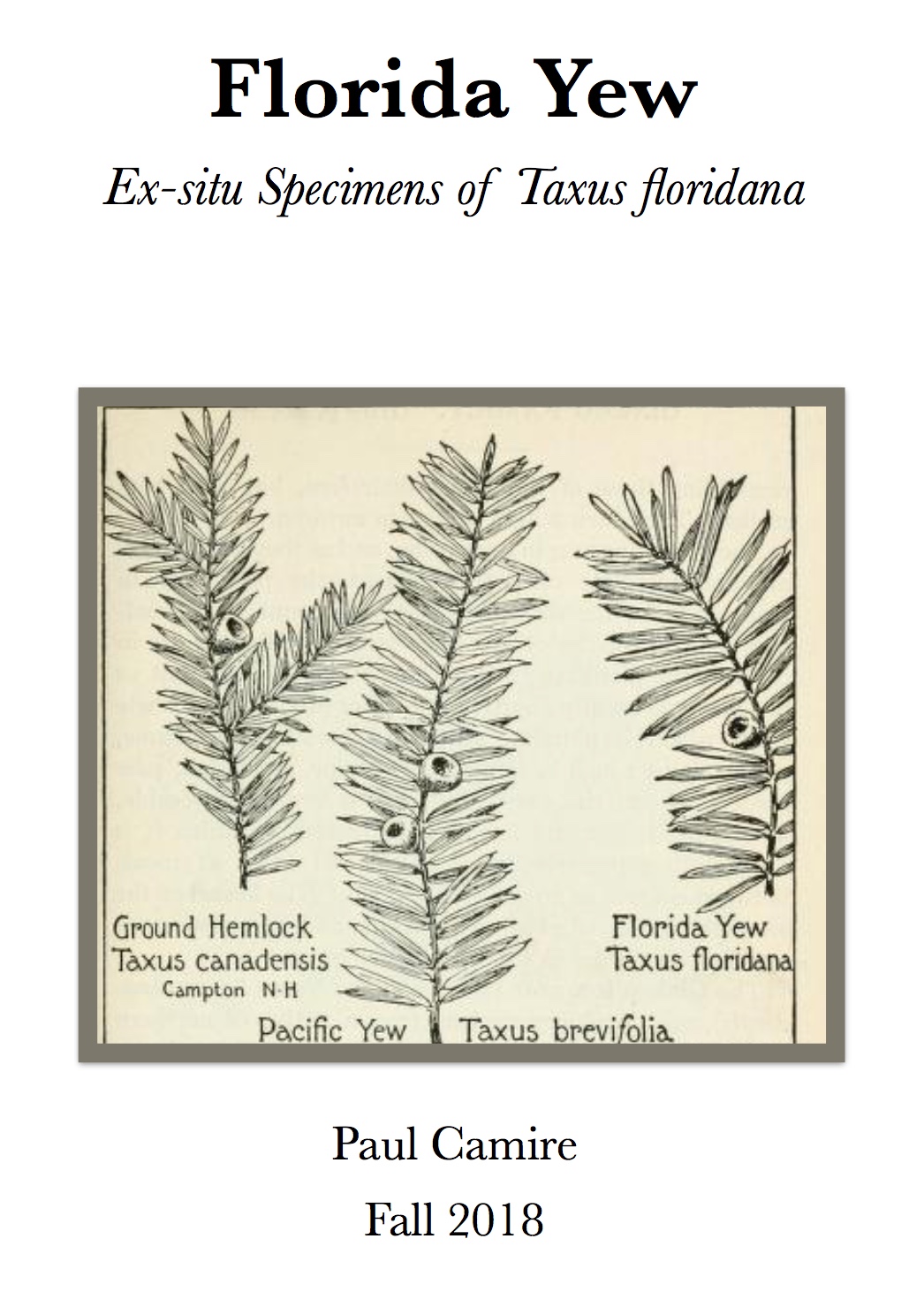 |
|
"Florida Yew: Ex Situ Specimens" by Paul Camire (Torreya Guardian, Michigan) is now available in PDF.
Plantings of this threatened species (whose native range in northern Florida overlaps that of Florida Torreya) includes two government outdoor collections in Washington, D.C. Ten other arboretums and botanical gardens, plus six individuals (half of whom are Torreya Guardians), and three commercial nurseries are also listed.
There are 17 known wild populations on the Florida Natural Features Inventory. 16 are located in Liberty County and one is located in Gadsden County. Florida Yew grows on several private properties in this range.
|
October 2018 / Connie Barlow / Barlow submits comment on proposed regulatory changes, Endangered Species Act.
Access the comment. See also a summary of 2018 events that led to this filing.
 |
September 2018 / Connie Barlow / Results of Freedom of Information Act data request — WEBPAGE
SUMMARY OF RESULTS: Barlow used the Freedom of Information Act (FOIA) to request documentation of number of seeds produced each year (2007-2017) at the two ex-situ plantings of Torreya taxifolia in northern Georgia (one administered by Atlanta Botanical Garden and the other by University of Georgia's State Botanical Garden). She also asked for "ultimate destinations" of the seeds each year.
 |
|
The FOIA inquiry launched March 29 and concluded August 29. A webpage of (mostly chronological) communications documents the entire inquiry process and results. As well, linked and excerpted from that page are Barlow's attempts to use the inquiry as leverage for accessing higher level communications, seeking a "win-win" solution to the conflicts that had arisen between Torreya Guardians and implementers of the offical recovery plan.
Documentation provided failed to supply any of the numbers/destinations per year for this critically endangered tree species, native to northern Florida. This led Barlow to conclude that ex situ seed production was uncounted and therefore presumably unvalued. As well, failure to document annual seed production holds back scientific understanding of (1) the rate of "recovery" evidenced by annual increases in seed production and (2) the ability of this "glacial relict" tree species to thrive when offered "assisted migration" several hundred miles northward into the southern-most Appalachian Mountains.
Access WEBPAGE. See also a summary of 2018 events that led to this filing.
|
September 2018 / Paul Camire / Remarkable recovery of young seedling from apical herbivory
PHOTO SEQUENCE OF NIPPED SEEDLING RECOVERY: Below left to right: July 19, August 23, September 6.
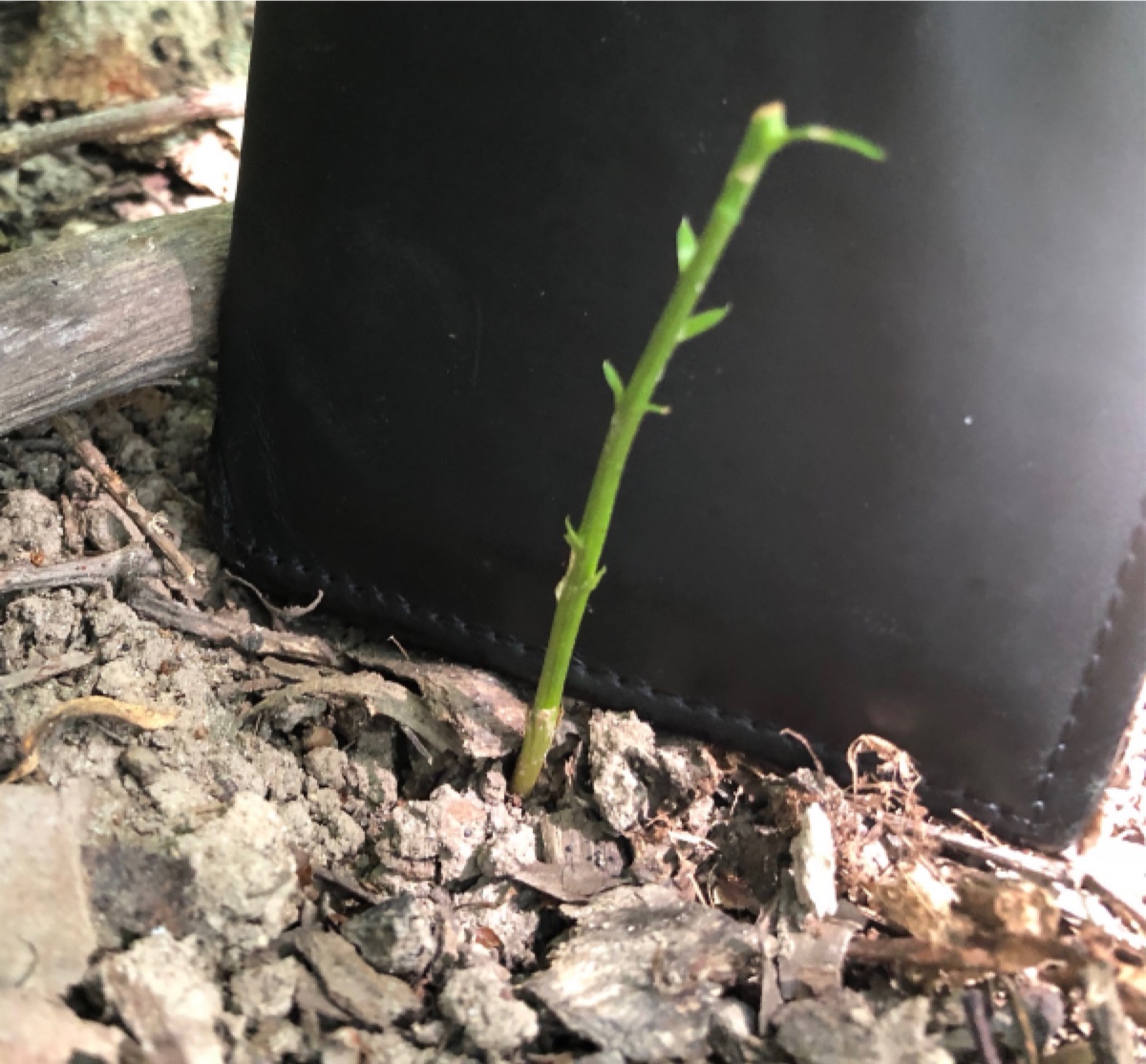
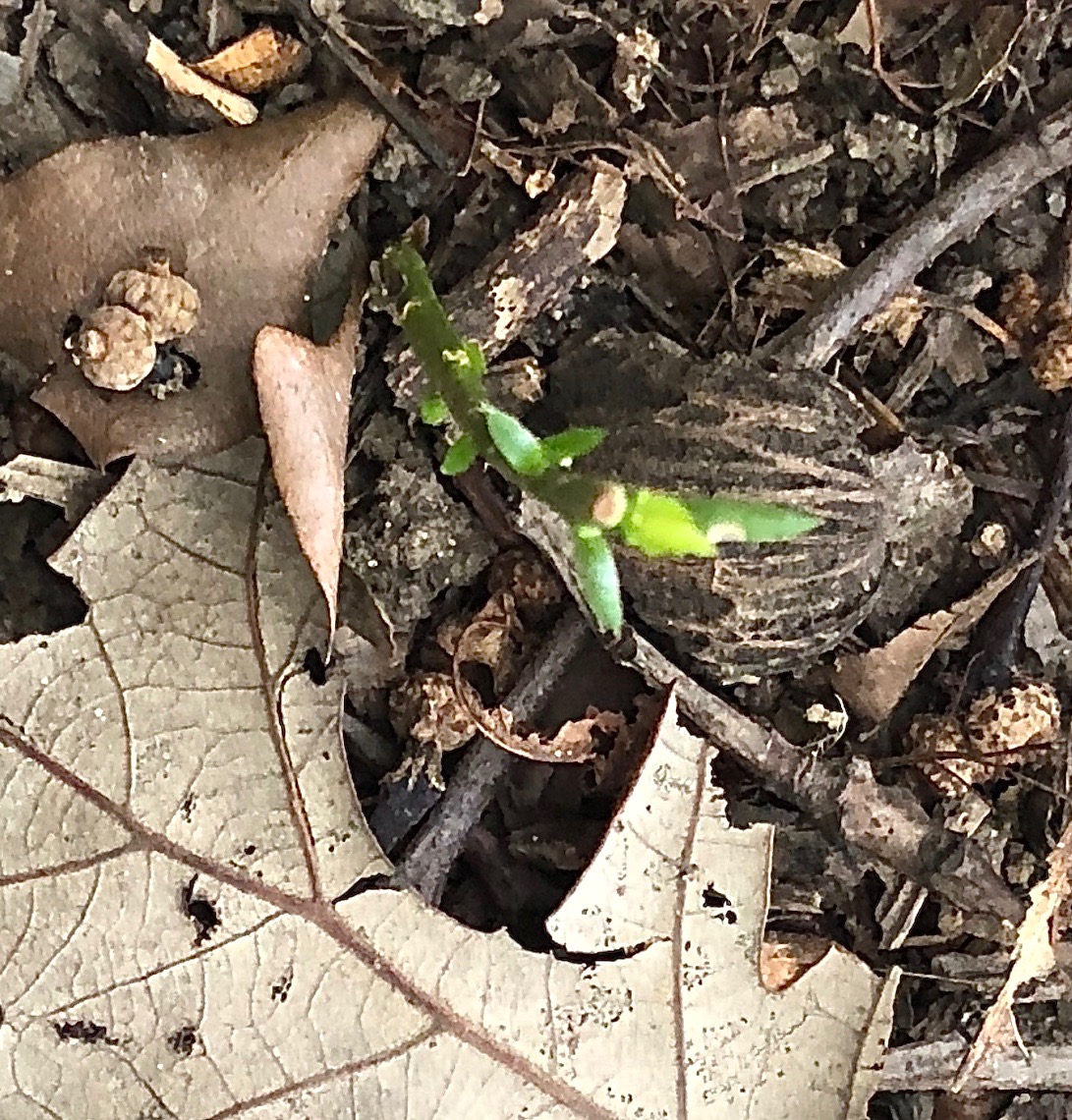
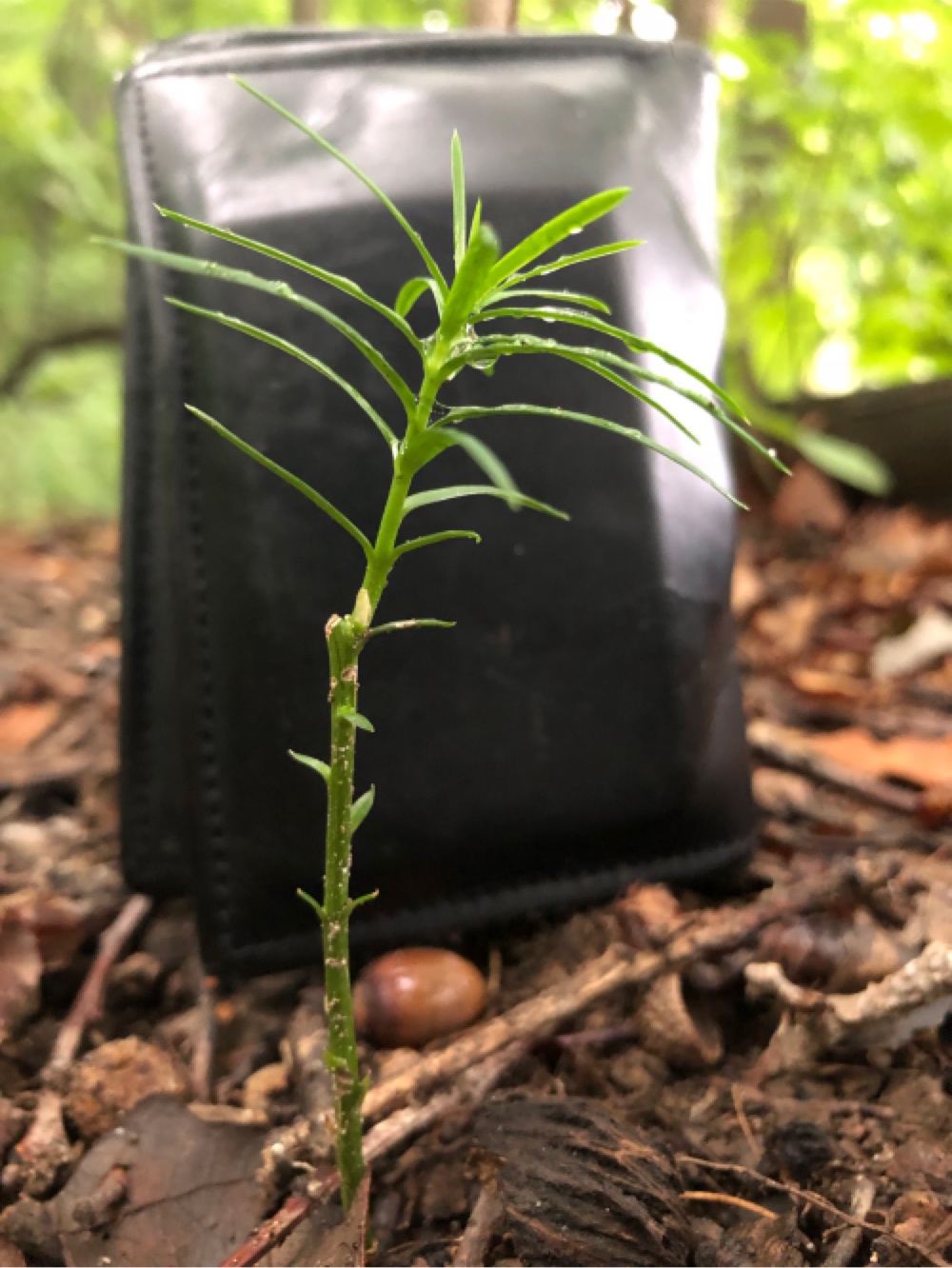
September 2018 / Paul Camire / Online research yields expanded list of historic plantings.
List of all EX SITU PLANTINGS (since 1850), 24 pages in PDF, by Paul Camire, 2018.
 |
|
Types of plantings/sites documented, 25 pages in PDF:
Historic Nurseries that sold Torreya taxifolia: 11
Current Nurseries with occasional inventories for intrastate sale: 9
U.S. government collections: 3
State government / Public Grounds: 6
Private homes / gardens: 23
International Collections: 14
Torreya Guardians seed production (private lands): 2
Note: There are likely many more mature Torreya taxifolia in existence. Over the years there have been many promoters of the species. Burl Turnage, A.J. Bullard, Bill Alexander, Lee Barnes, Jack Johnston and Frank Callahan have distributed seeds/ seedlings widely in order to save the Florida Torreya. After Croom's discovery of the species in 1833, it became a desired plant at several Victorian-era estates, in the north, from at least 1840. There are bound to be more discoveries of plants in the future, and any additions should be made to this list. Contact the author or Torreya Guardians.
|
See the entry below for an interpretive webpage (by Connie Barlow) of ten of the most important plantings.
August 2018 / Connie Barlow / New webpage on Historic Groves of Florida Torreya.
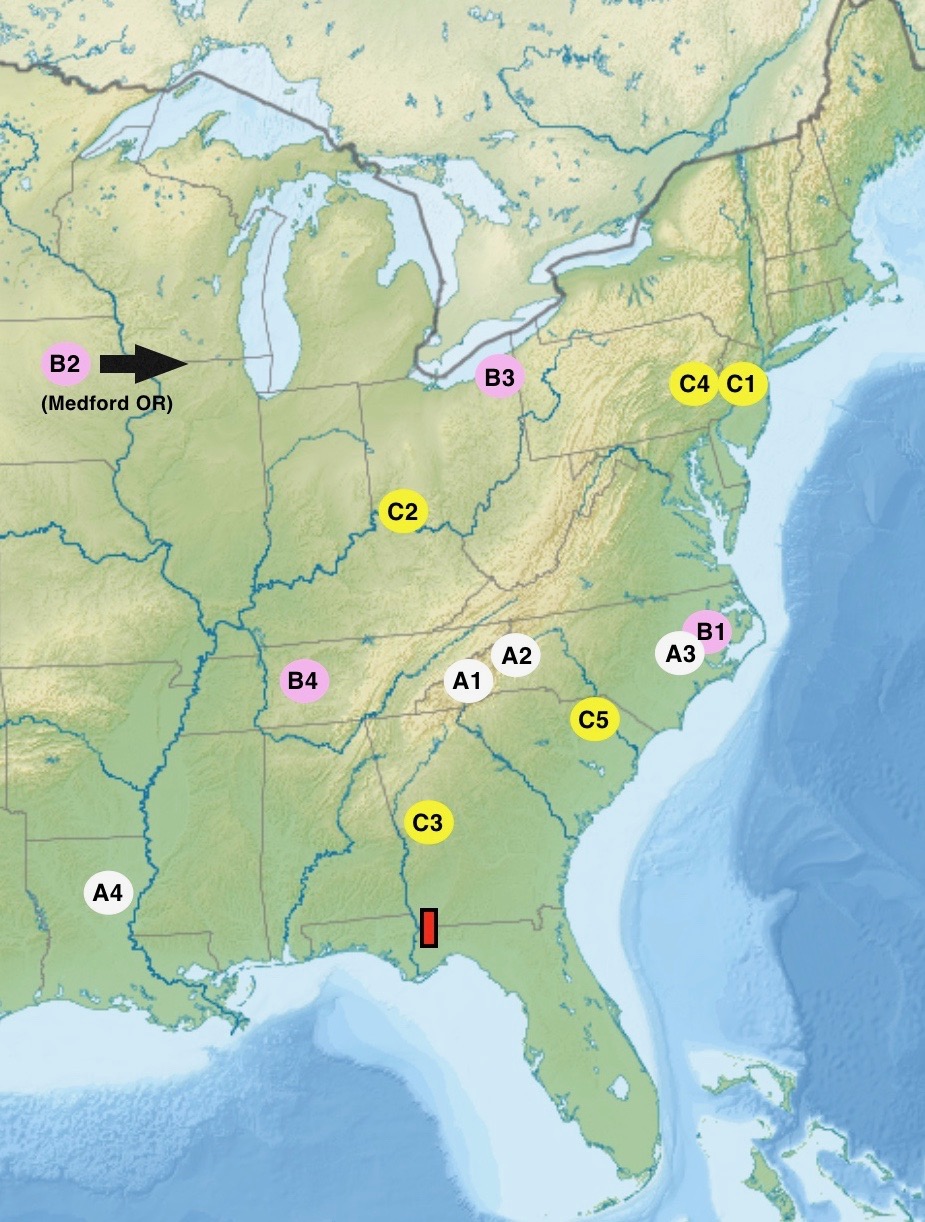 |
|
NEW WEBPAGE - Historic Groves of Torreya Trees: Long-Term Experiments in Assisted Migration
Two things prodded me to spend a couple days aggregating the info and photos for this new webpage. First, Paul Camire sent me photos and a report on his site-visit to the farthest-north mature Torreya trees documented thus far. (Paul's report on the Gladwyne PA trees is announced directly below.)
Second, I've spent the last several weeks updating and improving various webpages in anticipation of writing my own personal "comments" for suggesting ways the Fish & Wildlife Service can improve how it implements the Endangered Species Act. (Comments are due September 24.)
This mature-groves project has taught me that our efforts to document and learn from historic groves can provide a powerful case to finally move the official recovery plan to join with us in assisted migration. These mature trees, collectively prove:
1. Torreya can not only thrive northward of Florida, but it can produce seeds — and volunteer seedlings sometimes show up.
2. Torreya, clearly, is non-invasive.
|
August 2018 / Paul Camire / Pair of mature torreyas photo-documented near Philadelphia.
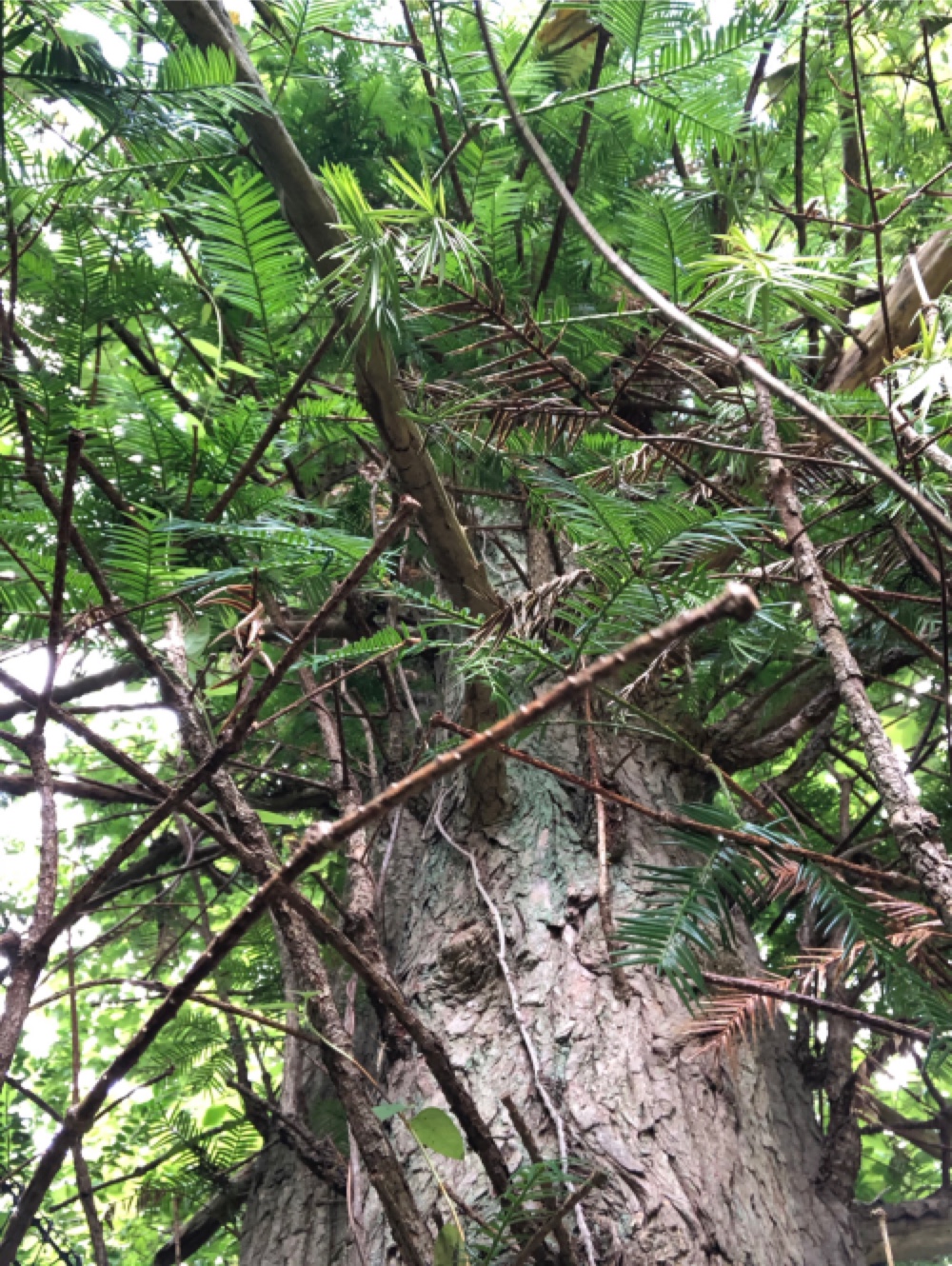 |
|
NEW WEBPAGE: Two Mature Torreya trees at Gladwyne, Pennsylvania
The two torreyas on the grounds have been surviving in Pennsylvania since Mary Henry planted them in the 1940s to 1950s. One is believed to have been grown from seeds and the other was brought in as a seedling.
The purpose of my visit was to take photographs and measure the circumference of both trees, so I could share the information with fellow members of Torreya Guardians. I believe these trees are significant examples of how well Florida Torreya can grow in northern climates and thrive near the foothills of the Appalachian Mountains.
The two Torreyas are located on a southeastern-facing slope, partially shaded and protected by trees on their northern side. I measured the circumference of each trunk (both have multiple trunks)....
|
August 2018 / Connie Barlow / A west-coast good news story of citizens moving climate-impacted trees north
• Citizen-launched project that is moving California Redwoods up to Seattle moves into phase 2.
I regularly visit Seattle, where I lived in the 80s. In December 2016 I began collaborating in a citizen-led project (initiated by Philip Stielstra, the elder below) that is a joint venture of 3 citizen groups: "Moving the Giants to Puget Sound", Archangel Ancient Tree Archive, and a children's group (Plant-for-the-Planet, Seattle) that has kids (including the two below) teaching other kids to join them in becoming "climate ambassadors" and to take action in planting trees for "carbon sequestration."
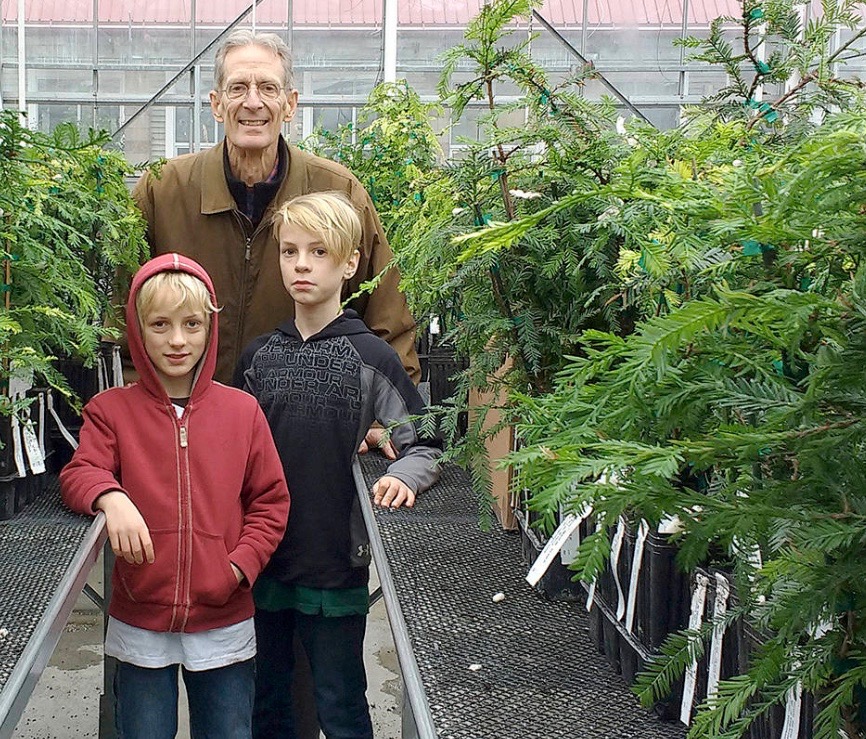 |
|
I am posting this short report of their joint Redwood assisted migration project because it restores my hope, for the reason I communicated to Stielstra in an email:
"I just received from the Archangel mailing list your Dear Friends letter, which included crucial links on your new website. Your work on this project is so professional — and media savvy. The emotional depth you reveal in the media quotes are precious.
I look forward to the day when I can speak that way too; after 14 years I still have to limit myself to objective science speak. This is because |